


News
- ▶ How alloy bar stock size affects material yield in machining
- ▶ Which ultrasonic inspection standard applies to critical alloy bar
- ▶ Why alloy bar can develop cracks during hot forging
- ▶ What to check before buying alloy bar for pressure equipment
- ▶ How alloy bar grain structure affects fatigue resistance
Message
When alloy rod is suitable for corrosion-resistant valve components
When a valve must control acids, chlorides, seawater, caustic solutions, or hot process fluids, the material of its stem, shaft, fasteners, spring, or trim can become the point that determines whether the valve remains serviceable. An Alloy Rod is suitable for these corrosion-resistant components when ordinary stainless steel or carbon steel cannot reliably resist the actual medium, temperature, pressure, mechanical loading, and upset conditions combined.
The commercial decision should not be based on corrosion resistance alone. A rod that survives immersion may still be unsuitable if it galls at the stem packing, loses strength at temperature, cracks under cyclic stress, or is difficult to source in the required forged or machined condition. The right choice begins with the component’s failure mode, then narrows the material family to one with an appropriate corrosion mechanism and mechanical margin.
Start with the component, not the valve label
“Corrosion-resistant valve” is too broad to specify a material. Different valve parts face different combinations of exposure and stress. A body may have thick corrosion allowance, while a slender stem has no such margin. Bolts can be exposed to external marine air and crevice conditions. Springs may operate in a corrosive environment while repeatedly flexing. Trim can see high fluid velocity, particle erosion, flashing, or pressure-drop-related cavitation.
Alloy rod is most justified for valve components where failure would impair sealing, movement, containment, or shutdown capability. Typical examples include:
- Valve stems and shafts exposed to corrosive media and packing friction;
- Seats, cages, plugs, and internal trim where local turbulence intensifies attack;
- High-strength bolts and fasteners used in wet chloride or sour process areas;
- Springs that must retain force during corrosive and elevated-temperature service;
- Small, heavily loaded components for which coating damage or localized corrosion cannot be tolerated.
A lower-cost steel may remain viable when the medium is mild, temperature is controlled, inspection is easy, and a component can be replaced without substantial downtime. Specialty material becomes more reasonable when replacement requires shutdown, access is difficult, or a small component has a disproportionately high effect on valve reliability.
Conditions that usually justify a specialty alloy rod
Chloride-bearing media and seawater exposure
Chlorides create a frequent selection problem because general corrosion rates can appear acceptable while pitting, crevice corrosion, or chloride stress corrosion cracking develops in confined or stressed locations. Valve stems, threaded areas, bolted joints, and packing zones are particularly relevant because they can retain deposits and moisture. Nickel-based alloys, selected according to the chloride concentration, oxidizing character, temperature, and crevice geometry, may provide a more dependable option than standard stainless materials.
Monel-type nickel-copper alloys can be relevant in certain marine and reducing environments, while higher-alloy nickel-chromium-molybdenum grades may be considered when chlorides are paired with more severe chemical exposure. The material should not be selected merely because it is described as “marine grade”; the fluid chemistry and local design details still govern the outcome.
Acid service with changing chemistry
Acid applications are rarely defined by acid name alone. Concentration, dissolved chlorides, oxidizing contaminants, aeration, temperature, and whether the process alternates between wet and dry conditions can change the preferred alloy. In a chemical line, a valve may spend most of its time in a stable solution but encounter cleaning media, startup mixtures, or stagnant residues during maintenance. Those short periods can be decisive for localized attack.
Nickel-based alloy rods containing chromium and molybdenum are often evaluated for demanding acid and mixed-chemical duties because these alloying elements can improve resistance to particular forms of corrosion. Hastelloy C-276 is often considered where broad resistance to aggressive chemical media is needed, but grade selection still requires verification against the actual service envelope. An alloy that performs well in a reducing acid may not be the preferred choice in a strongly oxidizing environment.
Hot oxidation, hot gases, and elevated-temperature process duty
Corrosion resistance at ambient temperature does not demonstrate suitability at high temperature. Valve components in energy production, power generation, thermal processing, or hot gas systems can face oxidation, thermal cycling, creep-related deformation, and loss of spring force. Inconel-family materials are often considered where high-temperature strength and oxidation resistance must work together.
For stems, springs, and fasteners, evaluate the required load retention at operating temperature rather than room-temperature tensile strength alone. Thermal expansion also matters: a stem expanding differently from its mating parts can alter clearances, packing load, or actuation behavior. A high-temperature alloy rod may therefore be selected not only to avoid oxidation, but also to keep the valve mechanically functional through repeated temperature changes.
Match the alloy family to the actual failure risk
The table is a screening tool, not a material approval list. Titanium may be highly effective in some chloride-containing aqueous environments, yet unsuitable in media where its protective film is unstable. Zirconium can be valuable in certain aggressive acid conditions, but the cost and fabrication route may limit its use to components where the exposure clearly warrants it. The alloy family should be compared against a defined operating window rather than a broad description such as “corrosive liquid.”
Do not overlook mechanical and manufacturing requirements
Valve components are machined parts, not laboratory coupons. Rod diameter, straightness, internal soundness, grain structure, heat-treatment condition, and machinability influence the finished component. A large-diameter stem blank and a small spring wire have different property priorities even when they share a similar service medium.
For demanding stem and fastener applications, the specification should state the required product form, nominal diameter, condition, mechanical properties, applicable standard, and inspection expectations. Nickel-based rod is commonly available across a broad diameter range, often from approximately 5 mm to 250 mm or more depending on alloy and production route. Standards such as ASTM B166, ASTM B472, and ASTM B564 may be relevant to particular nickel alloy product forms, but the governing requirement should be checked against the exact grade and component design.
Where machining creates threads, sharp transitions, keyways, or sealing surfaces, ask whether the proposed alloy is prone to work hardening and whether the machining process can maintain the required finish. Stem surfaces that run through packing need a controlled finish and geometry; excellent corrosion resistance cannot compensate for poor surface quality or misalignment. For welded valve parts, evaluate the alloy’s weld procedure requirements and whether post-weld heat treatment or corrosion restoration measures are needed.
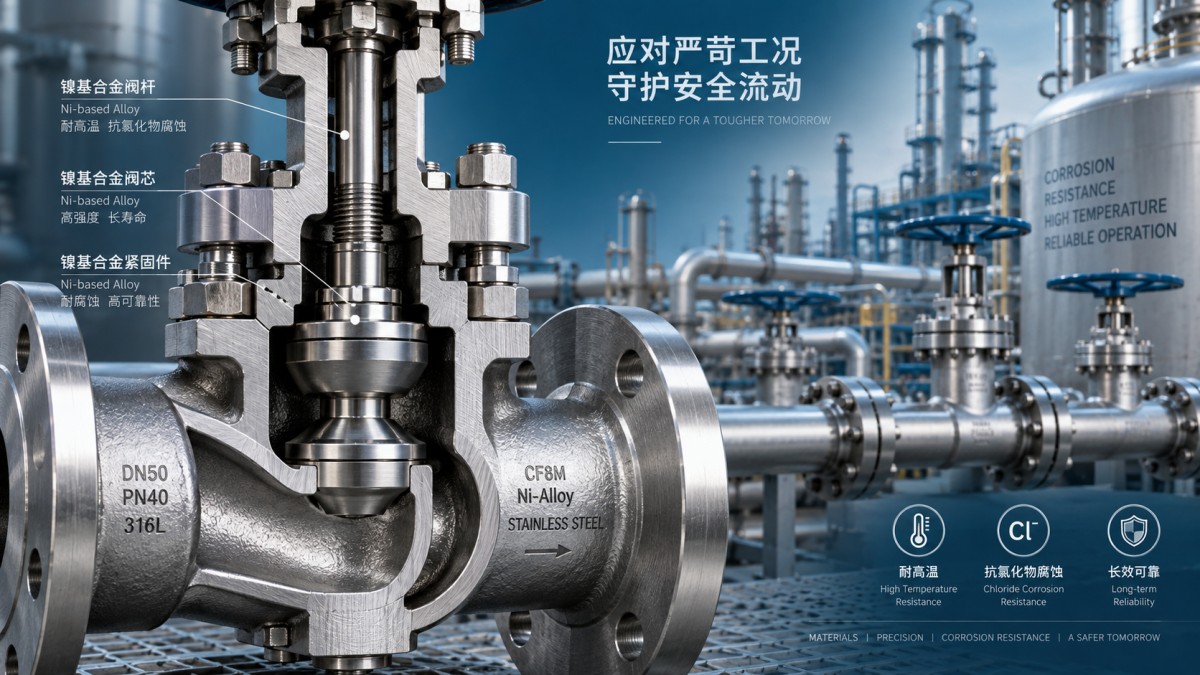
A Nickel base alloy rod can be a practical feedstock for shafts, bolts, fasteners, valve stems, and springs where corrosion, heat, and mechanical stress overlap. Grades such as Inconel 600, Inconel 718, Hastelloy C-276, Monel 400, and Nimonic 90 serve different operating priorities; they should not be treated as interchangeable equivalents.
A procurement review that prevents false economy
The initial cost of a specialty rod is normally higher than that of carbon steel and many common stainless steels because of alloy content and processing requirements. The better comparison is not rod price per kilogram. It is the cost of the finished component over its intended service interval, including machining yield, qualification effort, maintenance access, spare inventory, outage exposure, and the consequence of a stuck or leaking valve.
Before releasing a purchase specification, collect the process information that is most likely to change the recommendation:
- Identify every wetted, externally exposed, and crevice-prone zone of the component.
- Define normal, startup, cleaning, shutdown, and upset media separately.
- Record temperature range, pressure, flow velocity, solids, and expected cycling.
- Determine the component’s stress level, movement, friction exposure, and required hardness or strength.
- Review adjacent materials to identify galvanic corrosion or differential thermal expansion concerns.
- Specify traceability, chemical composition, heat-treatment condition, dimensions, and relevant product standard before quotation comparison.
This level of definition also improves supply comparisons. Two quotations may name the same alloy family while offering different product conditions, inspection documentation, diameter tolerances, or heat-treatment states. Those differences can affect machining time and component performance more than a small difference in unit price.
Situations where alloy rod may not be the right answer
A high-performance alloy is not automatically the best solution. If corrosion is limited to a replaceable external surface, a suitable coating or a different component design may offer better value. If erosion, cavitation, or abrasive solids dominate the failure mode, corrosion resistance alone may not solve the problem; surface hardness and trim geometry may matter more. Likewise, a premium rod will not correct poor drainage, trapped chlorides, incompatible packing, or a design that creates severe crevices.
Use alloy rod when the selected grade directly addresses the likely degradation mechanism and can be manufactured into the required valve part without sacrificing strength, dimensional control, or maintainability. That is the point at which a higher-grade material becomes a defensible reliability measure rather than an unnecessary upgrade.
