


News
- ▶ How alloy rod chemistry influences weld repair performance
- ▶ Can alloy wire retain spring force after prolonged heat exposure
- ▶ How to assess surface finish requirements for alloy wire orders
- ▶ What causes alloy wire to crack during repeated bending
- ▶ How alloy wire diameter tolerance affects automated forming accuracy
Message
How alloy rod chemistry influences weld repair performance
How Alloy Rod Chemistry Influences Weld Repair Performance
A weld repair is rarely judged only by whether the deposited metal looks sound after cooling. In corrosion-resistant and high-temperature alloy equipment, the repair must survive the same pressure, thermal cycling, process chemistry, and mechanical loading as the original component. That is why Alloy Rod chemistry deserves close attention from the start of repair planning.
For quality and safety teams, the central question is not simply whether the filler metal has a similar trade name to the base alloy. The practical question is whether its final chemistry, after dilution with the parent material, can resist cracking, maintain corrosion protection, and remain metallurgically stable in the expected service environment. A rod that appears suitable on a material list can still create a vulnerable repair zone if composition, heat input, and welding procedure are not considered together.
The Repair Weld Is a New Metallurgical System
During repair welding, deposited filler does not remain chemically isolated. Molten base metal mixes into the weld pool, and the degree of dilution changes across root passes, build-up layers, and the fusion boundary. This is especially relevant when repairing castings, dissimilar-metal joints, aged equipment, or components where the original chemistry is near the limits of its material specification.
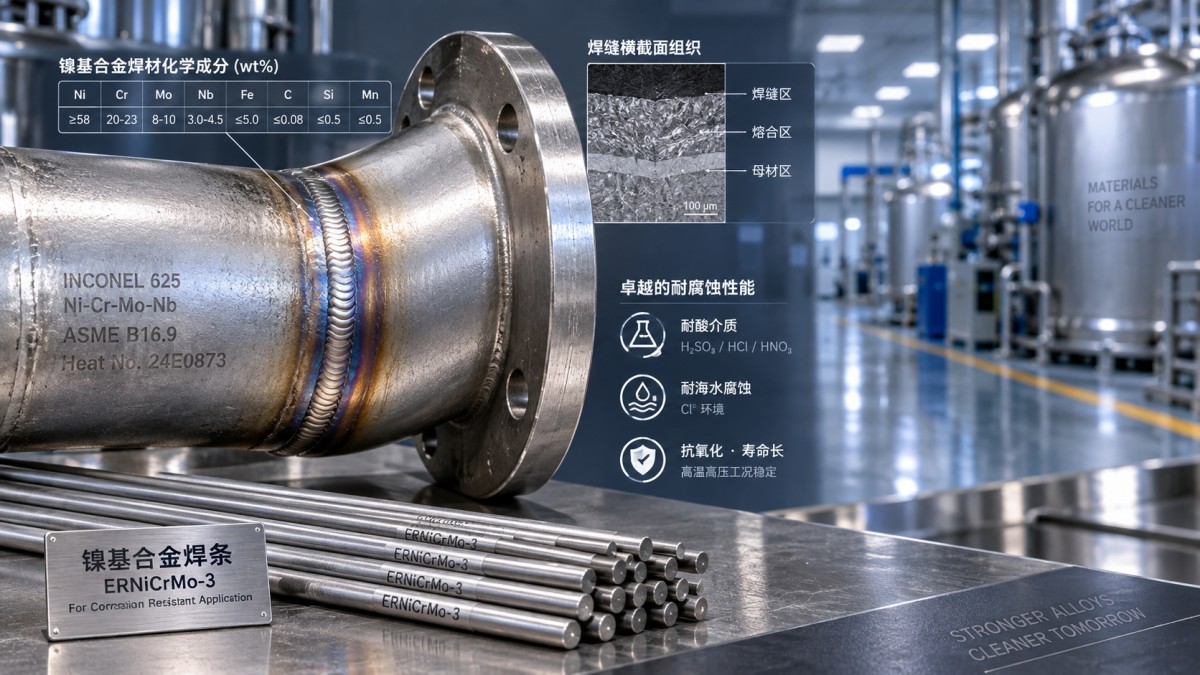
An Alloy Rod is therefore selected with an allowance for this dilution effect. In some nickel-based repairs, a filler with higher nickel, chromium, or molybdenum content than the nominal base material may be considered to preserve the intended corrosion resistance after mixing. That decision cannot be made from a generic compatibility chart alone. The service medium, welding process, joint geometry, and number of layers all affect the resulting repair chemistry.
The heat-affected zone, or HAZ, adds another variable. This narrow region is not melted, but it experiences a thermal cycle capable of changing precipitation behavior, residual stress, grain-boundary condition, or susceptibility to local corrosion. A chemically suitable filler cannot compensate for poor control of preheat, interpass temperature, cleaning, or heat input.
What the Main Alloying Elements Change
Nickel is often the backbone of filler metals used for demanding repairs. It supports ductility and toughness and can reduce the tendency toward certain brittle transformation products that may occur in highly restrained welds. In nickel-rich systems, it also provides a stable matrix for chromium, molybdenum, and other alloying additions. This does not mean that higher nickel is automatically safer; the balance with the base metal and service duty still matters.
Chromium is closely linked to oxidation resistance and protection in oxidizing environments because it promotes a protective surface film. When a repair is exposed to hot gases, oxidizing acids, or wet process streams, inadequate chromium in the diluted weld metal may leave the repair less durable than the surrounding component. Chromium must also be assessed in relation to thermal exposure. Certain alloy systems can form undesirable phases if composition and thermal history are poorly controlled.
Molybdenum is frequently important where reducing acids, chlorides, or localized corrosion are concerns. It can improve resistance to pitting and crevice corrosion in appropriate alloy families. Yet molybdenum-rich weld metal may be more sensitive to segregation during solidification, particularly where heat input is excessive or bead placement is inconsistent. The issue is not that molybdenum is problematic; it is that its benefit depends on preserving a sound, compositionally uniform weld deposit.
Carbon, silicon, manganese, nitrogen, niobium, titanium, and iron also require attention. Carbon control can be significant where sensitization or carbide precipitation is a concern. Iron pickup from the base material can alter corrosion behavior in nickel alloys. Stabilizing elements may help in some systems but are not interchangeable between filler classifications. Quality personnel should treat the certified chemical analysis of the actual consumable batch as a controlled document, not as a minor purchasing detail.
Cracking Risk Is Usually a Chemistry-and-Procedure Problem
Repair failures are often attributed to “bad welding,” but the underlying mechanism may be a mismatch between filler chemistry and repair conditions. Solidification cracking can occur when the weld metal has an unfavorable solidification range, elevated impurities, high restraint, or an unsuitable bead profile. Hydrogen-related cracking is more often associated with susceptible steels, but moisture control and surface cleanliness remain essential across alloy repairs because contamination can damage weld integrity and corrosion performance.
Hot cracking deserves particular scrutiny in nickel-based alloys. Sulfur, phosphorus, lead, zinc, oils, paint residues, and other contaminants can be far more consequential than they appear during visual inspection. A repair area should be excavated to sound metal, cleaned with materials that will not introduce harmful residues, and examined before welding. Where the component has seen process contamination, surface preparation may need to go beyond routine grinding.
The welding procedure specification should define the approved filler designation, process, shielding or backing gas where applicable, current range, interpass limit, cleaning steps, and any required heat treatment. If the repair is safety-critical, the procedure qualification record and applicable construction code or owner specification should govern acceptance—not assumptions based on a previous repair that happened to pass visual inspection.
Corrosion Resistance Must Be Evaluated After Dilution
A repair deposit may look compositionally close to the parent alloy on paper but still underperform in the actual process environment. This is common when repairs are made near nozzle transitions, crevices, overlay edges, or areas with deposits and stagnant liquid. Localized attack normally begins at the weakest microstructural or chemical location, not at the average composition shown on a material certificate.
For equipment handling acidic media, chloride-bearing streams, or elevated-temperature process fluids, the review should include the base alloy grade, filler metal chemistry, expected dilution, and any post-weld surface conditioning. Pickling, passivation, machining, or controlled mechanical finishing may be relevant depending on the alloy and service requirement. These steps should be defined by the project specification rather than added casually after the fact.
The same principle applies to repairs involving Hastelloy C-276, C-22, or B-2 materials. Strip products such as Hastelloy Alloy Strips may be used in fabricated corrosion-resistant assemblies, with thicknesses available from 0.1 mm to 5 mm. When such materials are welded or repaired, the filler decision should reflect the specific alloy family and exposure conditions rather than treating all high-nickel materials as equivalent.
A Practical Review Before Releasing a Repair
Before a repair is approved, quality and safety personnel can reduce uncertainty by checking a few connected records: positive material identification or reliable identification of the base material; filler metal certificate and batch traceability; the qualified welding procedure; repair excavation dimensions; interpass temperature records where required; and the specified non-destructive examination method. For corrosion-critical service, it may also be appropriate to confirm whether corrosion testing, ferrite measurement, hardness testing, or metallographic examination is required by the governing specification.
Visual acceptance alone cannot verify alloy chemistry, dilution control, or HAZ condition. Conversely, requesting every possible test without linking it to a failure mechanism adds cost without necessarily improving safety. The most useful inspection plan is tied to the actual risk: pressure retention, crack initiation, loss of corrosion allowance, high-temperature oxidation, or fatigue under cyclic duty.
Shandong Titanium Nickel Special Steel Co., Ltd. works across nickel-based and iron-based special alloys, including corrosion-resistant grades, heat-resistant alloys, precision materials, Monel, INCONEL, INCOLOY, titanium, zirconium, copper-nickel, and other alloy families. For repair planning, the useful starting point is a technical review of the base material, service medium, filler certificate, and applicable fabrication standard. That information provides a firmer basis for selecting an Alloy Rod than grade-name matching alone.
The chemistry of a repair filler is not a secondary consumable detail. It determines what the repaired zone becomes after welding. When that chemistry is evaluated alongside dilution, thermal control, contamination risk, and the governing acceptance criteria, repair decisions become more defensible—and the chance of returning a component to service with a hidden weak point is materially reduced.
