


News
- ▶ How to prevent coil damage during delivery from a Monel 400 supplier
- ▶ How to compare freight costs from a monel 400 Coil supplier
- ▶ How coil edge quality affects stamping with Monel 400
- ▶ How to confirm temper requirements with a monel 400 Coil supplier
- ▶ When dual sourcing from an Inconel 625 Supplier reduces risk
Message
Nickel Alloys For Aerospace And Power Generation
Why Nickel Alloys Remain Central to High-Consequence Equipment
Aerospace and power-generation buyers rarely begin with a simple question such as, “Which nickel alloy is strongest?” The more useful question is: which material can retain its required properties after years of heat, pressure, oxidation, vibration, fluid exposure, and repeated thermal cycling?
That distinction matters because an alloy can perform well in a laboratory tensile test and still fail prematurely in service. A turbine component may see high metal temperatures, local stress concentrations, coating damage, and thousands of start-stop cycles. A power plant heat-exchanger tube may face chloride-bearing water, deposits, changing chemistry, and long periods in which a small corrosion mechanism can become a leak or forced outage. In both sectors, material selection is a reliability decision before it becomes a procurement decision.
Nickel-based alloys remain important because they offer a combination that ordinary steels and many stainless grades cannot consistently provide: resistance to elevated-temperature strength loss, oxidation, creep, hot corrosion, and aggressive aqueous or process environments. But “nickel alloy” is a broad category. Selecting one based only on its family name, or on a single temperature figure, is one of the most common ways to create avoidable risk.
Two Industries, Different Failure Priorities
Aerospace propulsion and stationary gas turbines share much of the same materials logic, yet their operating priorities are not identical. Aircraft engines place severe weight, fatigue, manufacturing, and traceability demands on every rotating and static part. Industrial gas turbines may operate for long intervals at relatively stable load, but they often face different fuel quality, inlet-air contamination, maintenance practices, and duty cycles. Steam plants, nuclear systems, and renewable-energy infrastructure introduce another set of corrosion and pressure-boundary considerations.
For components near the combustor or turbine hot section, the key concern is often the balance between creep resistance and environmental resistance. At elevated temperatures, conventional strength data are insufficient. Designers need to know whether the alloy will slowly deform under sustained stress, whether grain boundaries remain stable, how its microstructure changes after exposure, and whether oxidation or hot-corrosion attack will reduce the usable section.
For ducts, casings, fasteners, seals, manifolds, heat-exchanger hardware, and auxiliary systems, the dominant threat may be different: chloride corrosion, galvanic interaction, thermal expansion mismatch, vibration fatigue, or fabrication-induced sensitization. The right answer is therefore determined by the component’s actual damage mechanism, not by the prestige of a particular alloy designation.
Where Nickel-Based Materials Create Their Value
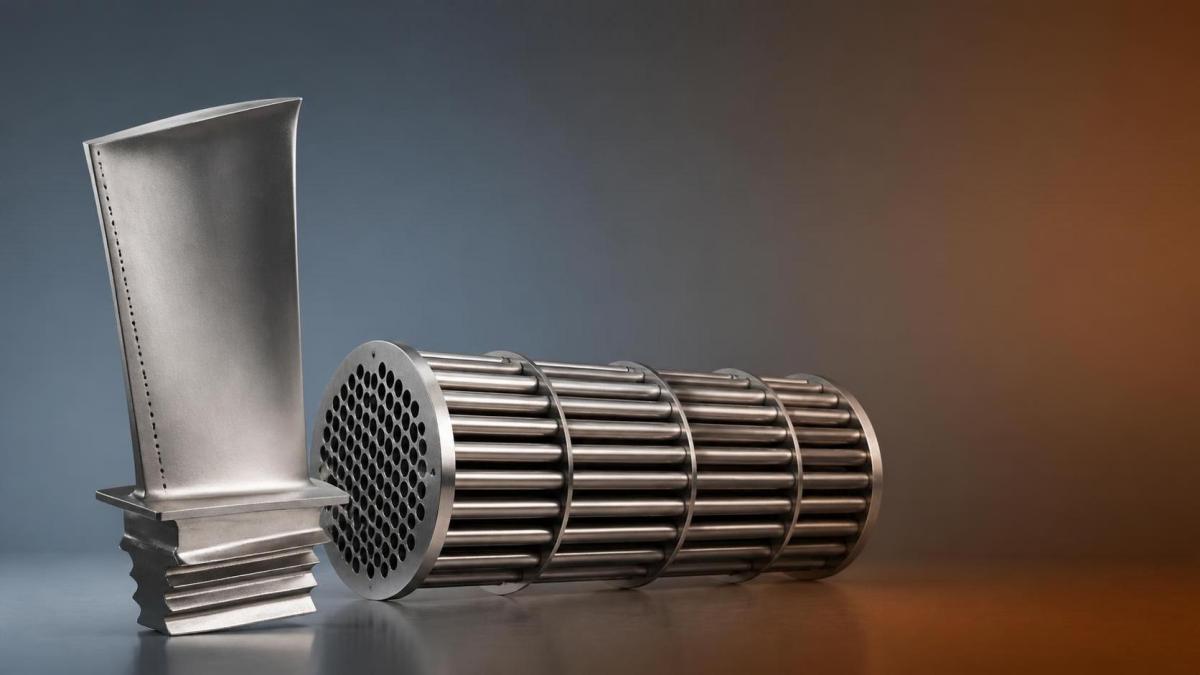
In aerospace engines and gas turbines, nickel-based superalloys are widely associated with blades, vanes, combustion hardware, discs, and other high-temperature parts. Their value comes from alloying systems designed to preserve strength and structural stability at temperatures where many materials soften rapidly. Depending on the grade and product form, chromium, cobalt, molybdenum, aluminum, titanium, niobium, tungsten, and other elements may each contribute to oxidation resistance, solid-solution strengthening, precipitation hardening, or phase stability.
In power generation, nickel alloys also serve in environments that are less visibly dramatic but no less demanding. Examples include flue-gas treatment equipment, high-alloy piping, heat-recovery systems, geothermal hardware, chemical-treatment lines, nuclear auxiliary equipment, and seawater cooling systems. Here, the selection process may focus more on localized corrosion, crevice corrosion, stress-corrosion cracking, or resistance to reducing and oxidizing acids than on high-temperature creep.
This difference is commercially important. A turbine OEM, maintenance provider, and power-plant operator may all use the phrase “high-temperature nickel alloy,” while needing entirely different forms, certifications, machining conditions, and inspection routes. Plate, bar, rod, tube, wire, forging stock, powder, and cast material should not be treated as interchangeable simply because they share a nominal alloy chemistry.
Temperature Limits Need Context, Not Marketing Language
Material data sheets often state a maximum service temperature, but that figure should be read as a starting point rather than a design approval. The permissible temperature depends on stress level, required operating life, atmosphere, thermal gradients, geometry, surface condition, and whether loading is continuous or cyclic. A component operating briefly at a high temperature may be acceptable, while the same alloy under sustained load for tens of thousands of hours may not be.
For turbine applications, engineers should separate gas-path temperature from metal temperature. Cooling design, thermal barrier coatings, wall thickness, and local heat transfer can make the alloy’s actual condition very different from the headline turbine inlet temperature. Equally, a coating does not eliminate the need for a compatible substrate; coating defects, diffusion effects, and thermal-expansion differences must be considered as part of the whole system.
For corrosion-service equipment, a stated temperature limit may say little about chloride concentration, oxygen content, pH, deposit formation, flow velocity, or stagnant zones. These variables can change the corrosion mechanism completely. A good alloy decision therefore starts with the fluid chemistry and operating envelope, including upset conditions, cleaning cycles, shutdown periods, and possible contamination events.
Monel Has a Role, but It Is Not a Universal Turbine Alloy
Monel alloys are often valuable where nickel-copper chemistry provides strong resistance to seawater and certain corrosive media. They are relevant to aerospace and energy supply chains when the component is exposed to marine atmospheres, seawater, chemical process fluids, or selected auxiliary-system conditions. They should not, however, be casually specified as a substitute for a nickel-based superalloy in the hottest sections of a gas turbine or jet engine.
For example, Monel Alloy Rod in Monel 400 or K-500 may be considered for corrosion-resistant shafts, fasteners, fittings, pump-related parts, or marine-associated equipment where the governing requirement is aqueous corrosion resistance combined with mechanical strength. Its nominal nickel content is typically in the 65-70% range and copper in the 29-33% range, but the final suitability still depends on grade, heat treatment, product condition, and service environment.
Monel K-500 can gain strength through aging treatment, while cold work and solution treatment can also affect performance in applicable grades and forms. Procurement teams should request the delivery condition explicitly rather than assuming that a material described only as “Monel” will meet the required yield strength, hardness, or fatigue behavior. Reported tensile strength values can vary substantially with alloy type and heat treatment, so a broad catalogue range is not a substitute for a component-specific requirement.
What a Serious Purchase Specification Should Cover
When alloy material will enter flight-critical, turbine, pressure-boundary, or high-consequence service, the purchase order should do more than name an alloy grade and size. The commercial specification needs to translate the engineering requirement into inspectable supply conditions.
- Material identity: Specify the recognized grade, applicable product standard, chemistry limits, and permitted substitution rules. Trade names alone are not enough.
- Product form and condition: State whether the requirement is bar, rod, forging billet, sheet, plate, tube, wire, or casting feedstock, together with annealed, solution-treated, aged, cold-worked, or other required condition.
- Mechanical and environmental properties: Define the relevant tensile, yield, hardness, impact, fatigue, creep, corrosion, or cracking requirements for the actual service condition.
- Traceability: Require heat-level identification and material test documentation. For critical applications, clarify whether third-party witnessing, retained samples, or additional testing is necessary.
- Inspection scope: Agree on dimensional tolerances, surface finish, ultrasonic testing, penetrant testing, eddy-current inspection, grain-flow expectations, or other nondestructive examination requirements as applicable.
- Manufacturing controls: Clarify melting route, remelting requirements, forging reduction, heat-treatment controls, and restrictions on repair welding where the application warrants them.
Requirements should be proportionate to risk. Applying aerospace-grade documentation to a low-risk chemical bracket can add cost and lead time without meaningful benefit. Conversely, accepting generic mill paperwork for a rotating or pressure-retaining component can leave a serious verification gap.
Supply-Chain Risks Often Appear After Grade Selection
Nickel alloy projects commonly encounter difficulty not because the grade is unknown, but because the requested form, dimension, heat treatment, and qualification package are difficult to obtain together. Large-diameter bar, thin-wall tube, complex forgings, and tightly controlled chemistry may require longer production cycles than standard stainless products. Lead times can also be affected by nickel and alloying-element availability, melting capacity, heat-treatment scheduling, and the need for additional testing.
Buyers should distinguish between stock availability and qualified availability. A supplier may have material with the correct nominal grade in inventory, yet the product could lack the required size tolerance, condition, traceability, test results, or approved manufacturing route. The same issue arises when material is cut from stock: the relationship between the supplied piece and its original heat documentation must remain clear.
Early technical alignment is especially valuable when machining is difficult. Many high-performance nickel alloys work-harden rapidly and can generate substantial cutting heat. A material choice that looks economical per kilogram may become costly if machining allowances, tooling strategy, weldability, distortion control, or final inspection are overlooked. Design and sourcing teams should evaluate total manufactured cost and expected service life, not material price alone.
The Decision Is Increasingly About Lifecycle Evidence
The aerospace and power-generation sectors are moving toward more condition-based maintenance, digital traceability, and lifecycle assessment. That direction raises the value of materials with well-controlled production history and predictable long-term behavior. It also increases scrutiny of repairability, recycled-content claims, supply continuity, and the ability to reproduce properties across batches.
For buyers, the practical next step is to map each component against its dominant failure mechanism, service temperature, exposure chemistry, stress state, expected life, and inspection consequence. Only then does it make sense to compare nickel-based superalloys, iron-nickel alloys, nickel-copper materials, corrosion-resistant grades, or lower-cost alternatives. The best alloy is not the one with the most impressive headline specification; it is the one whose documented condition, processing route, and in-service behavior match the component’s real operating risk.
