


News
- ▶ How Cold Rolling and Annealing Affect Nickel Alloy Strip Properties
- ▶ Nickel-Based Alloy Strip vs Stainless Steel Strip: Key Differences
- ▶ Nickel-Based Alloy Strips: Grades for High-Temperature Service
- ▶ Nickel and Molybdenum Prices: Their Impact on Inconel 625 Costs
- ▶ Inconel 625 vs 316L: Comparing Material and Lifecycle Costs
Message
How Cold Rolling and Annealing Affect Nickel Alloy Strip Properties
Two nickel alloy strips can share the same nominal chemistry and still behave very differently in a press, a welded assembly, or a corrosive environment. The difference often lies in their processing history. For technical evaluators comparing Nickel-based Alloy Steel Strips, cold reduction and annealing are not simply manufacturing steps: together, they influence strength, ductility, dimensional consistency, surface condition, and the reliability of downstream forming.
Despite the common search term “alloy steel strips,” many nickel-based alloys are not steels; nickel rather than iron is their principal constituent. That distinction matters when interpreting specifications and selecting heat treatments.
What cold rolling changes inside the strip
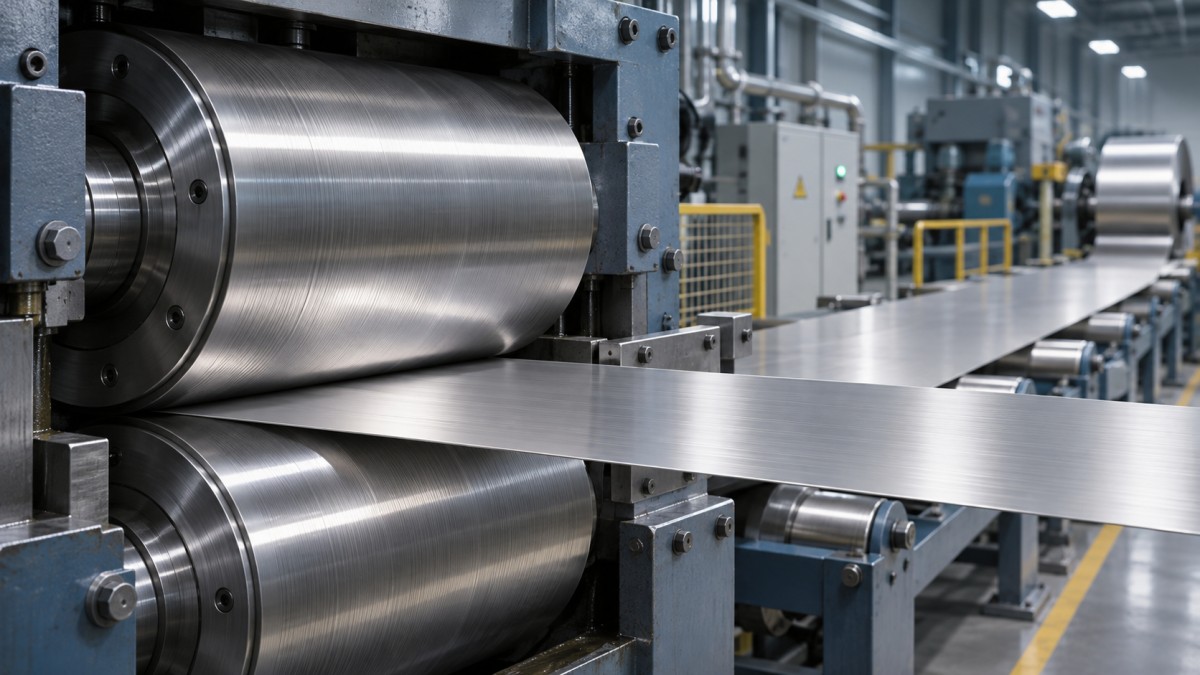
Cold rolling reduces thickness by passing material through rolls below its recrystallization temperature. Plastic deformation increases dislocation density in the metal, making further deformation more difficult. This strain hardening generally raises yield strength and tensile strength while reducing elongation and forming capacity.
The amount of cold work is often expressed as the percentage reduction in thickness from the condition before the relevant rolling operation. Greater reduction usually produces a stronger, harder strip, but the relationship is alloy- and process-dependent. Starting grain structure, intermediate anneals, rolling schedule, and final gauge all affect the result. A reduction percentage alone is therefore not a substitute for measured properties.
Rolling also gives the strip directional characteristics. Elongated grains and crystallographic texture can cause tensile behavior, bend performance, and springback to differ between directions parallel and transverse to rolling. For parts cut in multiple orientations, ask which test direction applies to the reported values.
On the production floor, cold rolling can improve gauge control and surface finish, although the final result also depends on equipment, lubrication, and subsequent finishing. Excessive work hardening or uneven deformation can contribute to edge cracking, flatness problems, and residual stresses. A bright surface is useful, but it does not by itself establish that a strip will form consistently.
Annealing: restoring ductility without treating every alloy alike
Annealing uses controlled heating and cooling to modify the effects of deformation. Depending on temperature, time, alloy, and prior cold work, recovery reduces some stored strain energy; recrystallization forms new, comparatively strain-free grains; and further exposure may cause grain growth. As recrystallization progresses, hardness and strength generally fall while ductility improves.
The target is not simply “as soft as possible.” A strip intended for deep forming may benefit from a fully annealed condition, whereas a spring or load-bearing component may need a controlled amount of retained cold work. Excessive grain growth can reduce strength and lead to a roughened surface after forming, sometimes described as orange peel. Insufficient annealing can leave the material harder or less uniform than expected.
Atmosphere and surface treatment also deserve attention. Bright annealing can limit oxidation when performed under suitable controlled conditions; other routes may leave oxide that requires pickling or additional finishing. Surface acceptance should be agreed separately from mechanical temper, especially for thin strip where scratches, embedded particles, or residual scale can affect fabrication.
Annealing is not the same as precipitation hardening
Some nickel alloys acquire strength primarily through cold work; others can also be strengthened by carefully controlled precipitation heat treatment. Monel 400 is a nickel-copper alloy that is not precipitation hardenable in the same way as Monel K-500. K-500 contains aluminum and titanium and can develop additional strength through age hardening. Its final properties depend on the full combination of prior processing, solution treatment where applicable, and aging—not on annealing alone.
This distinction matters when comparing the Monel Alloy Steel Plate range, which includes strip and plate in both grades. Although these alloys are considered for marine engineering, chemical processing, and oil and gas equipment, a grade and a product name do not define the required temper. Confirm the ordered form, thickness, heat-treatment condition, and applicable acceptance criteria with the supplier.
Reading a strip specification as a process history
A meaningful comparison begins with the required finished condition rather than a single headline strength value. For example, higher yield strength can reduce permanent deformation in service but increase springback during stamping. Greater elongation can help a demanding bend, but may not meet the stiffness or strength expectations of a finished part.
Nominal catalogue values should not be treated as guaranteed results for every thickness or temper. In particular, hardness scales are not directly interchangeable without an appropriate conversion method, and conversions may be unreliable outside their intended range. For thin material, the selected hardness method and specimen support also matter.
Which standards and tests should evaluators check?
Start with the product specification named on the purchase order and confirm that it covers the correct alloy, form, and delivery condition. ASTM B127, for example, covers nickel-copper alloy plate, sheet, and strip for designated compositions; ASTM B906 provides general requirements for certain nickel and nickel-alloy flat-rolled products. Applicability depends on the edition, grade, and order requirements. K-500 may be covered by a different product specification, so do not assume that one standard applies to both grades.
Tensile testing may be performed under ASTM E8/E8M when specified, while hardness testing methods such as ASTM E18 or ASTM E384 may be relevant depending on the material and specimen thickness. These test methods describe how to test; the product specification and purchase agreement establish which tests and acceptance limits apply. Bend tests, grain-size assessment, or corrosion testing may also be appropriate when required by the application, but should be defined rather than presumed.
For a difficult forming operation, request representative material in the intended thickness, width, surface finish, and delivery condition. A trial can reveal springback, edge cracking, or surface marking that a tensile certificate alone may not predict. If the part will be welded or heat treated after forming, evaluate the completed manufacturing route: local heat input or subsequent thermal exposure can alter the properties established at the mill.
Balancing strength, formability, and corrosion service
Cold rolling and annealing do not automatically make a nickel alloy suitable for every aggressive environment. Alloy selection, fabrication quality, temperature, concentration, aeration, and the presence of crevices all influence corrosion behavior. Seawater resistance, for instance, should not be taken as proof of resistance to every chloride-containing acid or operating condition.
For technical reviews, the most useful question is therefore not whether a strip has been cold rolled or annealed, but how its documented condition supports the intended manufacturing route and service environment. Shandong Titanium Nickel Special Steel Co., Ltd. supplies nickel-based and other special-alloy materials; evaluators should confirm the available dimensions and request condition-specific documentation before using any listed property as a design or acceptance value.
