


News
- ▶ How to prevent coil damage during delivery from a Monel 400 supplier
- ▶ How to compare freight costs from a monel 400 Coil supplier
- ▶ How coil edge quality affects stamping with Monel 400
- ▶ How to confirm temper requirements with a monel 400 Coil supplier
- ▶ When dual sourcing from an Inconel 625 Supplier reduces risk
Message
Nickel Alloy Standards: ASTM, ASME, EN, DIN And JIS
Understanding nickel alloy standards is not simply a matter of matching a familiar alloy name to a grade number. In real projects, the standard attached to the purchase order determines what must be supplied, tested, documented, marked, and accepted. A material described as “Alloy 625” or “Hastelloy C-276 equivalent” may appear technically suitable, yet still fail contract requirements if its product form, heat-treatment condition, testing scope, or certification does not match the governing specification.
This distinction matters in chemical processing, offshore systems, power generation, aerospace hardware, heat-treatment equipment, and pressure-containing plant. Nickel alloys are selected because operating failure can be expensive: chloride-induced corrosion, high-temperature oxidation, sour-service cracking, creep deformation, or weld-zone degradation may take place long after installation. Standards provide a common language for controlling those risks, but ASTM, ASME, EN, DIN, and JIS do not organize that language in the same way.
What a nickel alloy standard actually controls
A standard normally does more than define chemical composition. Depending on the document and product form, it may specify:
- Permitted ranges for nickel, chromium, molybdenum, iron, cobalt, carbon, titanium, niobium, and other elements;
- Manufacturing route, such as hot-finished, cold-worked, forged, solution annealed, or age hardened;
- Mechanical-property requirements including tensile strength, yield strength, elongation, hardness, and sometimes impact performance;
- Dimensions, tolerances, straightness, surface condition, and allowable defects;
- Required examinations, such as chemical analysis, tensile testing, hydrostatic testing, ultrasonic examination, or liquid-penetrant testing;
- Certification, traceability, marking, and reporting obligations.
The practical implication is important: the alloy chemistry alone is not a full procurement specification. A bar and a plate made from nominally the same alloy may be controlled by different documents and may have different mechanical-property requirements. The same is true for seamless pipe, welded pipe, sheet, strip, forgings, fittings, and welding consumables.
ASTM: the most widely referenced material-specification system
ASTM International standards are widely used in global nickel alloy trade, particularly for North American projects and for industrial equipment manufactured to international customer specifications. ASTM documents are generally organized around product form rather than around a single alloy family.
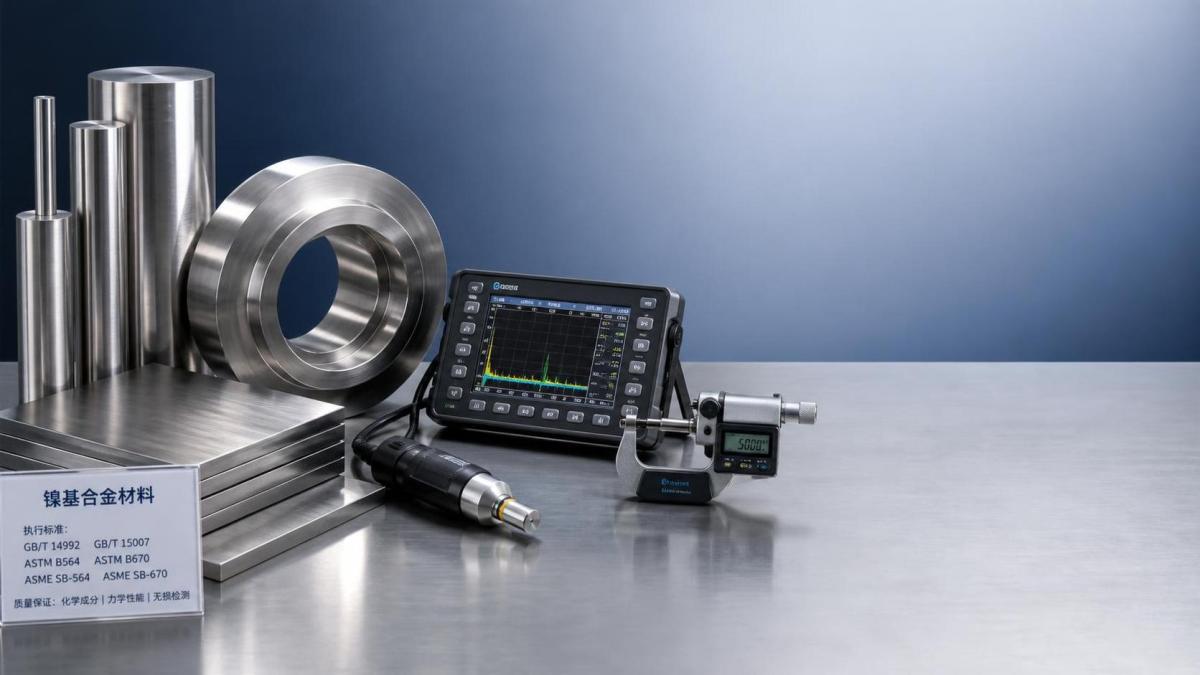
For example, ASTM B166 covers nickel-chromium-iron alloy and nickel-chromium-cobalt-molybdenum alloy rod, bar, and wire. ASTM B472 addresses nickel alloy forgings, while ASTM B564 covers wrought nickel alloy forgings. These documents may cover several UNS alloy designations within one specification, with individual requirements defined by grade, condition, and form.
The UNS number is often the most reliable common reference point in cross-border communication. Alloy 600, for example, is commonly identified as UNS N06600; Alloy 625 as UNS N06625; Alloy C-276 as UNS N10276; and Alloy 400 as UNS N04400. However, a UNS designation identifies chemistry, not a complete delivery condition. An order for UNS N06625 without a governing product standard leaves significant room for misunderstanding.
ASTM specifications are revised periodically. Procurement documents should state the required edition when a project, customer standard, or regulatory framework requires a specific revision. Assuming that any current edition is automatically acceptable can create document-review problems, particularly in long-cycle energy and process-equipment projects.
ASME: when material standards become code requirements
ASME is frequently misunderstood as a separate chemical or metallurgical system competing with ASTM. In many cases, ASME Boiler and Pressure Vessel Code material specifications adopt ASTM requirements, with an “SB” designation replacing the ASTM “B” prefix. ASTM B443, for instance, may appear in ASME construction documentation as ASME SB-443.
That does not mean ASTM and ASME references can always be treated as interchangeable. ASME construction involves the wider code environment: design rules, pressure boundaries, fabrication, welding qualifications, nondestructive examination, inspection, and data-report requirements. A material may meet the ASTM product specification yet still be unsuitable for an ASME-coded component if the applicable code case, allowable-stress basis, certification, or supplementary requirement is not satisfied.
For pressure equipment, the correct sequence is to identify the construction code first, then the material specification accepted by that code, and finally the exact product form and condition. This is particularly relevant for reactor vessels, heat exchangers, high-pressure piping, valves, and furnace components where material substitution affects both design calculations and inspection records.
EN and DIN: European standards require careful designation reading
In Europe, EN standards are the central reference framework. DIN remains highly visible in drawings, legacy documents, catalogues, and long-established supply chains, but many DIN material standards have been superseded or incorporated into EN standards. A request described only as “DIN material” therefore needs clarification: it may refer to a historic German designation, a current DIN EN publication, or a customer’s internal shorthand.
European nickel alloy specifications often use material numbers such as 2.4816 for Alloy 600, 2.4856 for Alloy 625, 2.4819 for Alloy C-276, and 2.4360 for Alloy 400. These references are useful, but they should not be assumed to be one-to-one equivalents with every ASTM product specification. The chemical composition may align closely while dimensional tolerances, test methods, delivery conditions, inspection requirements, and product-form scope differ.
EN documents also commonly distinguish between material intended for pressure purposes and material for general engineering use. For example, standards in the EN 10028 series are associated with flat products for pressure purposes, while other EN standards address bars, wire, forgings, tubes, or corrosion-resistant alloy products. The phrase “equivalent to EN grade” is not sufficient for a critical order unless the exact EN document and material condition are identified.
JIS: relevant for Japanese supply chains and equipment specifications
Japanese Industrial Standards are important where equipment is designed, manufactured, or maintained within Japanese industrial supply chains. JIS standards may use Japanese grade designations and product categories that do not map neatly to ASTM or EN nomenclature. In addition, project documentation may combine JIS material requirements with customer-specific inspection procedures or Japanese pressure-equipment expectations.
A cross-reference table can be useful as an initial screening tool, but it is not a substitute for comparison of the actual standard clauses. For nickel alloys, the most consequential differences may be found in impurity limits, heat-treatment requirements, grain-control practices, mandated testing, and acceptance criteria rather than in headline nickel or chromium percentages.
Why “equivalent grade” claims create avoidable risk
The market often uses trade names, UNS numbers, material numbers, and national-standard labels side by side. This is efficient for quotation, but risky when the terminology replaces technical review. Trade names such as Inconel, Hastelloy, and Monel identify recognized alloy families, yet the commercial name is not itself a complete material specification.
Three common errors deserve attention:
- Comparing chemistry only. Similar composition does not ensure equivalent mechanical properties, grain structure, corrosion performance, or test coverage.
- Ignoring product form. Plate, pipe, bar, forging, and fastener stock are governed by different requirements even when produced from the same nominal alloy.
- Using a certificate after the fact. A mill test certificate confirms what was produced and tested; it cannot repair an incomplete purchase specification or prove compliance with unstated requirements.
For critical applications, the purchase order should state the alloy designation, governing standard, edition where required, form, dimensions and tolerances, delivery condition, testing requirements, certification format, marking, and any project-specific supplementary requirements. Where corrosion performance is central, the operating medium and temperature should also be reviewed against the selected alloy rather than assumed from a standard designation alone.
Rod, bar, and forging requirements need separate attention
Nickel alloy rod is frequently used for shafts, valve stems, fasteners, springs, bolts, pump components, and machined high-strength parts. These applications often require more than corrosion resistance. They may depend on controlled grain size, fatigue behavior, elevated-temperature strength, ultrasonic soundness, or a specified solution-annealed or age-hardened condition.
For applications involving Alloy 600, Alloy 718, Alloy C-276, Alloy 400, or Nimonic-type materials, a Nickel base alloy rod should therefore be evaluated against the exact bar or forging specification rather than purchased solely by diameter and nominal grade. ASTM B166, ASTM B472, and ASTM B564 are examples of standards that may be relevant, but the appropriate document depends on whether the component is supplied as wrought bar, rod, or forging and on its final service duty.
Heat treatment is a particularly important checkpoint. Solution annealing may be necessary to restore corrosion resistance after hot working or to place an alloy in the required metallurgical condition. By contrast, precipitation-hardening alloys such as Alloy 718 may require tightly controlled aging treatment to achieve the intended strength. A material certificate should clearly identify the supplied condition, not merely list the alloy name.
A practical method for comparing international requirements
The most reliable comparison starts with the application rather than the country of origin. Establish whether the material will face reducing acids, oxidizing acids, seawater, high-temperature gas, cyclic thermal loading, pressure containment, or high mechanical stress. Then identify the component form and construction code. Only after these points are fixed should cross-standard equivalency be assessed.
A useful technical comparison sheet should place the candidate standards side by side and examine chemistry limits, heat treatment, mechanical properties, dimensions, mandatory tests, supplementary requirements, and certification obligations. Any difference should be treated as a decision point, not automatically as a disqualification. Some differences are commercially manageable; others affect qualification, safety, or service life.
Nickel alloy standards are best viewed as part of risk control rather than administrative paperwork. ASTM provides a widely used product-specification base; ASME connects materials to code construction; EN and DIN require attention to European material designations and delivery conditions; JIS must be read in the context of Japanese product and project requirements. The correct choice is not the standard that appears most familiar on a quotation. It is the one that demonstrably matches the component, service environment, manufacturing route, and contractual acceptance criteria.
