


News
- ▶ How Cold Rolling and Annealing Affect Nickel Alloy Strip Properties
- ▶ Nickel-Based Alloy Strip vs Stainless Steel Strip: Key Differences
- ▶ Nickel-Based Alloy Strips: Grades for High-Temperature Service
- ▶ Nickel and Molybdenum Prices: Their Impact on Inconel 625 Costs
- ▶ Inconel 625 vs 316L: Comparing Material and Lifecycle Costs
Message
Nickel-Based Alloy Strip vs Stainless Steel Strip: Key Differences
When a strip component must withstand chlorides, elevated temperatures, or aggressive process chemicals, the choice between nickel-based alloy and stainless steel can determine whether the design has an adequate service margin. Nickel-based alloys are often the stronger candidates for severe corrosion or sustained high-temperature exposure; stainless steels are usually more economical when a suitable grade meets the operating requirements.
The comparison is not as simple as “nickel versus steel.” Each group contains grades with different compositions and properties, and the service environment matters as much as the material name. An evaluator replacing a corroded strip or specifying a heat-transfer component should compare candidate grades in their intended condition, including welds and formed areas.
Material differences that affect selection
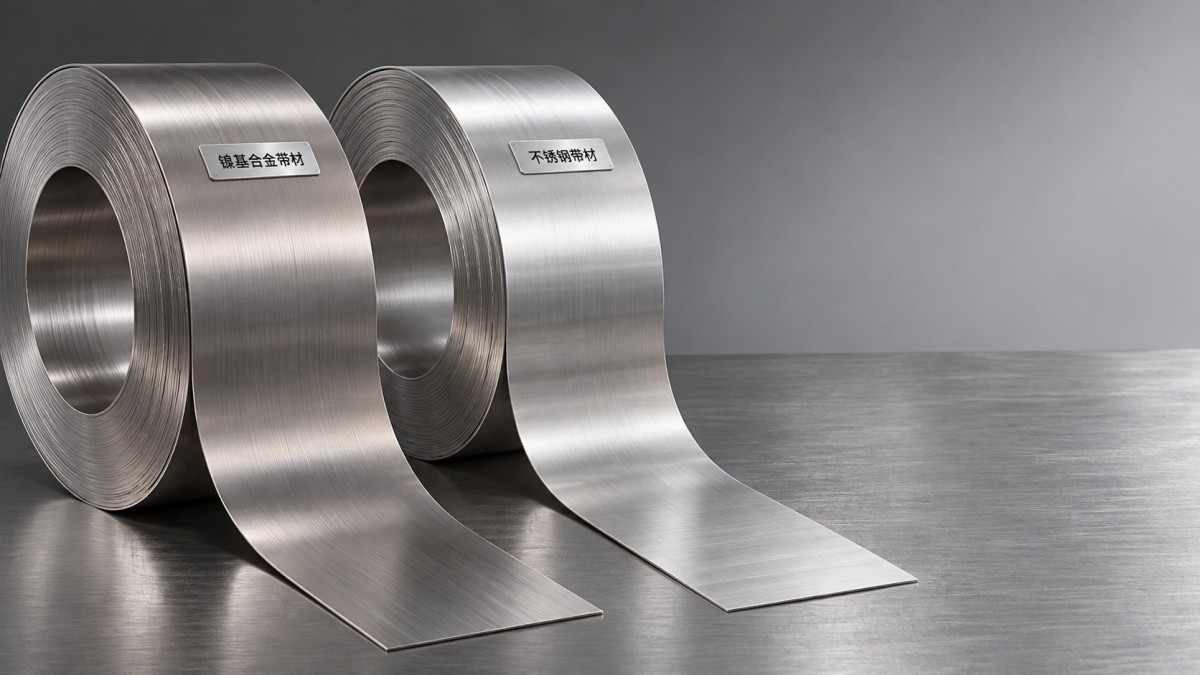
Stainless steel is primarily iron-based and relies on chromium to form a protective passive film. Many grades also contain nickel, molybdenum, or other additions that influence corrosion resistance and mechanical behavior. Nickel-based alloys generally use nickel as the principal element, with additions selected for specific combinations of corrosion resistance, heat resistance, and strength.
The phrase Nickel-based Alloy Steel Strips is sometimes used in product searches, but nickel-based alloys are not necessarily steels. For a technical specification, identify the actual alloy grade and product form rather than relying on that broad description.
Start with the actual corrosion mechanism
A material exposed to a mild fluid during normal operation may encounter a much harsher environment during startup, shutdown, cleaning, or concentration beneath deposits. Record the fluid composition, temperature, pressure, flow conditions, cleaning chemicals, and expected exposure duration before comparing corrosion data. Include both the process side and the external atmosphere.
Chlorides are a useful example of why a generic label is insufficient. Austenitic stainless steels can be vulnerable to pitting, crevice corrosion, or chloride stress corrosion cracking under certain conditions. Higher-alloyed stainless steels or selected nickel alloys may provide a better margin, but neither family is universally immune. Crevices under deposits or at joints can become more aggressive than the bulk fluid.
Acid service also requires grade-specific evaluation. Concentration, temperature, aeration, and impurities can change the corrosion behavior of an alloy. A nickel alloy chosen for one acid mixture should not automatically be transferred to another. When published compatibility information does not represent the actual mixture or operating cycle, consider representative corrosion testing before release.
Separate temperature resistance from mechanical strength
A strip may resist oxidation yet lack sufficient strength for its load at operating temperature. Conversely, a strong material may lose section through oxidation or corrosion. Evaluate both the environmental limit and the mechanical requirements at the metal temperature, which may differ from the surrounding gas or fluid temperature.
For sustained hot service, review the relevant elevated-temperature properties, including creep or stress-rupture behavior where applicable. Thermal cycling adds another concern: expansion mismatch between strip and adjoining parts can impose stresses on joints. Compare coefficients of thermal expansion for the candidate materials and account for the expected temperature range and restraint.
Do not assume that every nickel alloy has the same high-temperature capability. Incoloy 800H, for example, belongs in a different selection discussion from a corrosion-focused alloy such as Incoloy 825. Equally, a heat-resistant stainless grade may be sufficient when the environment and design allow it.
Consider the finished component, not only the strip
Strip is frequently bent, corrugated, stamped, welded, or joined to another material. Those operations change the selection problem. A grade that performs well in a corrosion table may be difficult to form into a tight geometry at the required thickness, or may need a welding procedure that controls heat input and preserves corrosion performance.
For heat-transfer equipment, a heat exchanger fin plate can be supplied in flat or corrugated forms. These geometries increase heat-transfer surface area, but alloy choice still depends on the fluids, metal temperature, joining method, and required mechanical stability. Listed material options include Inconel 600 and 625, Incoloy 800H and 825, Monel 400, and Hastelloy C276 and C22; they should not be treated as interchangeable grades.
Thermal conductivity also deserves a direct comparison using data for the specific grades and temperatures. A corrosion-resistant alloy may require a different fin thickness or geometry to meet a thermal target. Surface area alone does not establish the finished exchanger’s performance: contact quality, fouling, and fluid flow also matter.
Turn the comparison into a material specification
- Define the exposure envelope. Document normal and upset temperatures, chemical concentrations, cleaning cycles, deposits, and wet-dry conditions. Identify which surfaces are exposed and whether crevices are unavoidable.
- Shortlist specific grades. Compare a suitable stainless grade against a nickel alloy intended for the same exposure. Check corrosion and elevated-temperature data at conditions as close as possible to the duty.
- Check the product condition. Specify strip thickness, width, tolerances, surface condition, and the required temper or heat-treatment condition. Strength and formability should be assessed in the condition supplied and after fabrication.
- Review joining and forming. Confirm bend geometry, forming sequence, weld or braze compatibility, and whether post-fabrication cleaning or heat treatment is needed. Assess the joint as part of the corrosion boundary.
- Compare installed service costs. Include material, fabrication, inspection, expected replacement intervals, and downtime assumptions. A higher purchase price may be justified by the duty, but longer life should not be assumed without supporting evidence.
For a relatively benign, well-characterized environment, a suitable stainless steel strip is often the sensible starting point. Move toward a specifically selected nickel alloy when the corrosion mechanism, operating temperature, or required mechanical properties exceed the credible range of the stainless candidates. Before final approval, verify availability and properties for the exact strip dimensions and condition, not just for the alloy family.
