


News
- ▶ Nickel Alloy Strip for Heat Exchangers: Corrosion and Formability
- ▶ How Cold Rolling and Annealing Affect Nickel Alloy Strip Properties
- ▶ Nickel-Based Alloy Strip vs Stainless Steel Strip: Key Differences
- ▶ Nickel-Based Alloy Strips: Grades for High-Temperature Service
- ▶ Nickel and Molybdenum Prices: Their Impact on Inconel 625 Costs
Message
Nickel Alloy Strip for Heat Exchangers: Corrosion and Formability
Nickel alloy strip can be a sound choice for heat exchanger components exposed to aggressive fluids, but corrosion resistance alone does not establish suitability. The selected grade must also tolerate the forming, joining and inspection methods used to manufacture the exchanger. A material that survives the operating environment in flat-sheet tests can still fail at a crevice, a weld or a heavily formed plate.
The decision therefore starts with the complete service and fabrication envelope: both process streams, cleaning chemicals, maximum metal temperature, pressure, component geometry and the intended manufacturing route. The phrase “Nickel-based Alloy Steel Strips” covers materials with substantially different compositions and behavior; it should not be treated as a single specification.
Match corrosion resistance to the actual exposure
Heat exchangers present a more complicated corrosion problem than a simple fluid compatibility chart suggests. The strip may contact one fluid on each side, while deposits, gaskets and joints create localized conditions that differ from the bulk stream. Startup, shutdown and cleaning can introduce additional environments that are more severe than normal operation.
Chlorides deserve particular attention because they can contribute to localized corrosion and, under susceptible conditions, stress corrosion cracking. Their effect depends on concentration, temperature, acidity, oxygen availability and the alloy involved. Deposits can concentrate corrosive species or restrict oxygen exchange, making plate contact points and gasketed areas more vulnerable than open surfaces.
For acidic duties, the identity and concentration of the acid matter as much as its name. Oxidizing and reducing environments can favor different alloy chemistries, and contamination can change the corrosion response. Nickel-molybdenum-rich alloys are often considered for demanding reducing environments, while nickel-chromium-molybdenum alloys provide a different balance of resistance across mixed environments. Neither category is a universal solution; the proposed grade must be checked against the actual chemistry and temperature range.
On the cooling side, stagnant water, deposits and water treatment chemicals may be decisive even when the process fluid is well characterized. The relevant assessment should cover both sides of the wall and credible upset conditions, not just the nominal process specification.
Formability is a property of the supplied condition, not just the alloy name
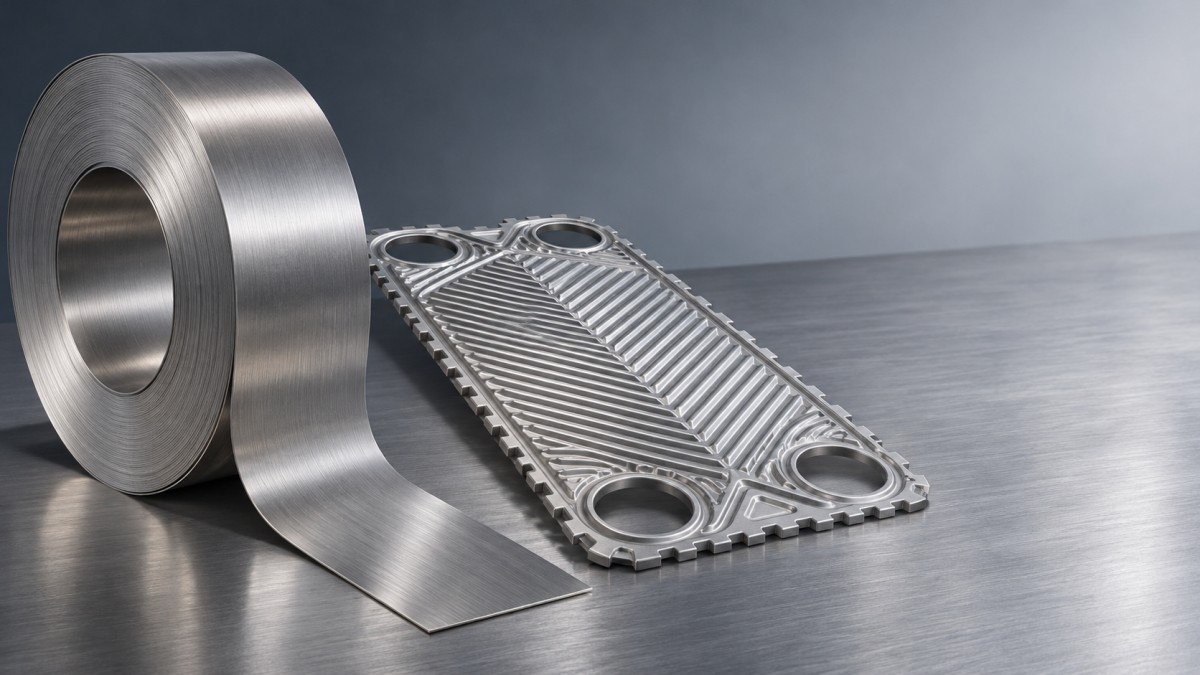
Strip for a plate heat exchanger may be pressed into corrugations, channels and contact points that increase heat transfer and support pressure loads. These features impose local strains that are much higher than the average deformation across the plate. Tight radii, deep draws and complex transitions increase the risk of thinning, wrinkling or cracking.
The same alloy can behave differently depending on its thickness, rolling direction, prior cold work and heat-treatment condition. A harder condition may offer greater strength but less margin for demanding forming operations. Grain structure and surface quality also matter: surface defects or edge damage can become initiation points when the material is stretched.
Forming trials should use representative production material and tooling, particularly when the geometry is new or the design has limited strain margin. Inspection should address the most severely deformed features, including local thickness reduction and cracking, rather than relying only on the appearance of a finished plate. If an intermediate anneal is proposed, its effect on cost, schedule, dimensions and final properties should be included in the manufacturing plan.
Sheet and strip terminology can also cause confusion at procurement. A Precision Alloy Sheet may be specified for controlled expansion or magnetic properties rather than corrosion resistance in a heat exchanger. Its dimensional precision does not establish that its alloy, thickness or supplied condition is suitable for formed, pressure-retaining components.
Consider corrosion and fabrication as one decision
Increasing corrosion resistance by changing alloy grade can alter forming loads, work-hardening behavior and joining requirements. Conversely, a material selected because it forms readily may lack adequate resistance at the intended temperature or in a concentrated cleaning solution. The preferred option is the least complex material and manufacturing route that demonstrably meets both sets of requirements—not automatically the most highly alloyed candidate.
Welded plate assemblies introduce another interface. Welding can change the local microstructure and leave heat tint, contamination or geometric features that affect corrosion performance. Filler selection, joint preparation, heat input and post-weld cleaning should be evaluated for the specific alloy and service. Where brazing is used, the brazing material and joint must also resist the fluids and temperatures involved; a corrosion-resistant base strip does not guarantee a corrosion-resistant assembly.
Forming can leave residual stresses, particularly around tight features. If the environment creates a credible stress-corrosion concern, the evaluation should account for the formed and joined condition rather than relying solely on data for annealed flat material. Any proposed stress-relief treatment must be compatible with the grade and component design; it should not be assumed to improve every alloy.
Turn the selection into a workable project specification
A useful material inquiry identifies the intended component and its manufacturing route as well as the alloy. It should distinguish normal and upset operating conditions, specify both fluid streams and cleaning media, and identify the maximum design temperature and pressure. Where concentrations vary during operation, the relevant range is more useful than a single nominal value.
The fabrication package should define strip thickness and tolerances, width, surface requirements, supplied condition and the forming direction where relevant. It should also state the expected joining process and any limits on surface contamination. For critical geometries, a representative forming trial or qualification sample can resolve uncertainties before full material release.
Material documentation should connect each delivered lot to its specified grade, chemistry, condition and applicable test results. The applicable material standard and pressure-equipment code depend on the alloy product form, exchanger design and project jurisdiction; a standard cited for a different alloy or product form is not automatically suitable. Agreeing on inspection requirements and acceptance criteria before ordering reduces the risk of receiving technically compliant material that cannot be formed into acceptable parts.
Where published corrosion data do not represent the combined chemistry, temperature and crevice conditions, testing in a representative environment may be justified. The test should reflect the exposure that matters, including welds or formed areas when those are the limiting features. Its purpose is to resolve a specific selection uncertainty, not simply to generate a favorable corrosion rate for flat, unjoined coupons.
Protect the decision through fabrication and delivery
Even a suitable alloy can underperform if its surface is contaminated or damaged before assembly. Cutting, forming and handling procedures should control embedded tooling debris, scratches and residues that interfere with corrosion performance or joining. Finished plates also need protection from distortion and surface damage during storage and transport.
Schedule planning should allow time for agreement on the exact grade and condition, forming qualification where needed, and review of material certificates before production is committed. A substitute alloy or change in temper can affect tooling, joint qualification and corrosion assumptions; it should be evaluated as a design change rather than accepted solely because its nominal composition appears similar.
The strongest selection is traceable from the operating envelope to the finished component: the grade addresses the credible corrosion mechanisms, the supplied strip can be formed to the required geometry, and the joints and inspection plan preserve that performance in the assembled exchanger.
