


News
- ▶ How to prevent coil damage during delivery from a Monel 400 supplier
- ▶ How to compare freight costs from a monel 400 Coil supplier
- ▶ How coil edge quality affects stamping with Monel 400
- ▶ How to confirm temper requirements with a monel 400 Coil supplier
- ▶ When dual sourcing from an Inconel 625 Supplier reduces risk
Message
Monel Alloy Steel Plate Uses in Marine Corrosion Environments
Monel Alloy Steel Plate Uses in Marine Corrosion Environments
Monel Alloy Steel Plate is widely valued in marine corrosion environments for its excellent resistance to seawater, salt spray, and biofouling-related damage. For researchers and buyers exploring reliable alloy solutions, understanding its practical uses, performance advantages, and application scenarios is essential. This article examines why Monel alloy plates remain a trusted choice for demanding offshore, shipbuilding, and coastal industrial projects.
If you are evaluating Monel Alloy Steel Plate for marine service, the first thing to check is not the brochure claim. It is the actual exposure condition. In seawater work, materials fail for different reasons: flowing seawater, stagnant seawater, splash zone salt deposition, galvanic contact, crevice attack around fasteners, or simply long service intervals with poor maintenance access. Monel performs well in many of these situations, but the fit depends on where and how the plate will be used.
What To Check Before You Assume Monel Is The Right Marine Plate
- Look at the chloride exposure pattern. Continuous seawater immersion, splash zones, and evaporative salt deposits do not stress a material in the same way.
- Confirm whether the plate is structural, lining, cladding, or a fabricated part. A deck fitting and a pump internals cover plate may need different alloy logic.
- Check joining methods early. Welding procedure, filler compatibility, and post-fabrication surface condition can affect service behavior as much as the base alloy choice.
- Review dissimilar metal contact. In marine assemblies, galvanic pairing is often where the field problem starts, not the plate itself.
- Ask for traceable material documentation. For offshore or shipbuilding supply chains, buyers usually need heat number traceability and chemical composition records, even at the information-gathering stage.
That sounds basic, but many early comparisons are still too generic. “Corrosion-resistant” is not enough. A coastal plant handling warm brine, a shipboard seawater line bracket, and an offshore platform component may all point to Monel, but for different reasons.
Where Monel Alloy Steel Plate Usually Makes Sense
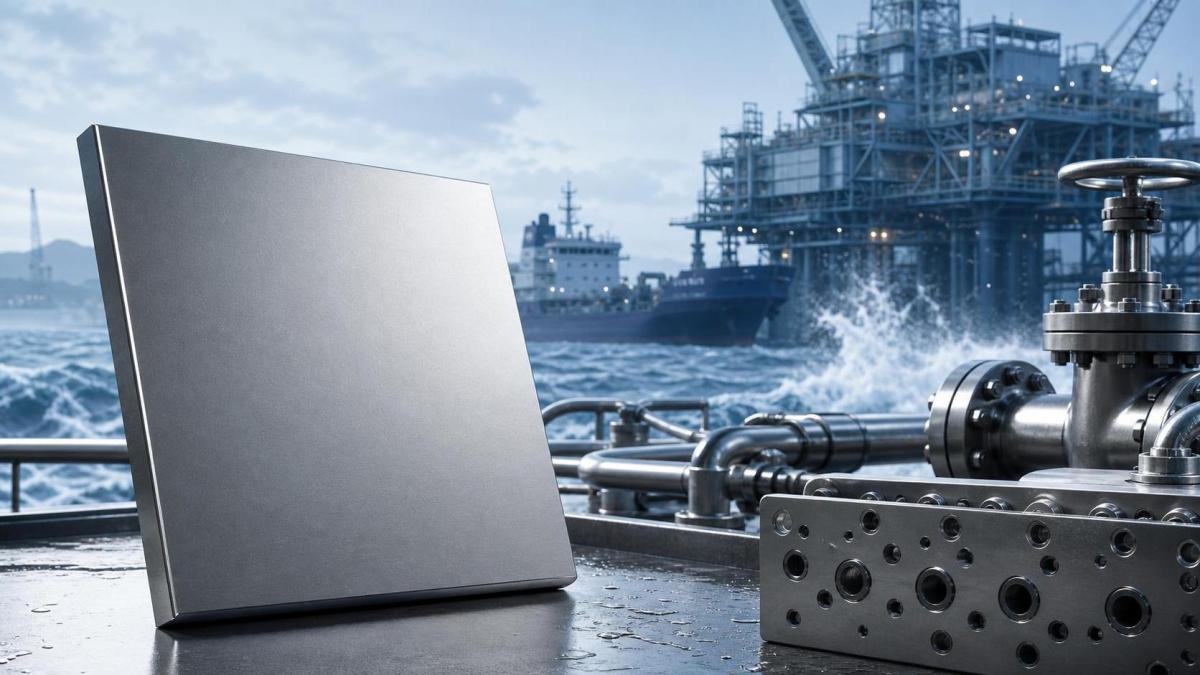
In practical marine use, Monel alloy plate is often considered where plain carbon steel corrodes too quickly and where coating-only strategies become maintenance-heavy. It is commonly associated with seawater resistance and good durability in salt-laden atmospheres, which is why engineers often review it for:
- seawater-exposed equipment covers and housings
- offshore structural accessories and non-primary fabricated parts
- marine pump and valve-related plate components
- coastal chemical or desalination support equipment
- shipbuilding areas where splash, spray, and humid chloride exposure are persistent
One reason specifiers keep returning to Monel Alloy Steel Plate is that it offers a useful balance: corrosion resistance in seawater service, reliable mechanical behavior, and established recognition across demanding alloy applications. It is not a cure-all, and it is rarely selected in isolation from fabrication method and lifecycle cost, but it remains a serious candidate when downtime is expensive.
The Marine Checklist That Actually Helps
Use this when comparing Monel with other corrosion-resistant plate materials.
- Check water movement. Fast-flowing seawater and stagnant pockets behave differently. If the design includes crevices, gasketed joints, lap connections, or dead legs, those details deserve as much attention as the alloy grade.
- Check whether marine growth or fouling matters. In some systems, biological deposits can create localized conditions that change corrosion behavior over time. That risk is often underestimated during material screening.
- Ask what will touch the plate. Copper alloys, stainless steels, coated steel, and fastening systems can create galvanic concerns depending on the electrical path and electrolyte presence.
- Review fabrication thickness and forming needs. If the application uses thin-gauge parts rather than heavier plate sections, sometimes a strip or sheet product is more practical in manufacturing. In related high-performance applications involving corrosion and heat, some buyers also compare Nickel-based Alloy Steel Strips such as Inconel 600, Inconel 625, or Hastelloy, especially for heat exchangers, electrical contacts, and lighter industrial equipment where cold-rolled or annealed thin sections are preferred.
- Do not skip the temperature question. Marine service is not always ambient. Coastal process units may combine chloride exposure with elevated temperatures, and that can change the shortlist quickly.
- Ask for standards and testing documents that are actually relevant to the purchase. If the seller cannot clearly map the material to the requested specification or test scope, slow down.
This is where experienced buyers usually save time: they narrow the service condition before comparing prices. If you compare alloys too early on cost per kilogram, the decision often gets reset later by welding issues, maintenance intervals, or a corrosion mechanism that was never defined properly.
Common Misunderstandings Around Monel In Seawater
A frequent mistake is treating Monel as interchangeable with every nickel alloy. It is not. Nickel alloy families behave differently depending on composition and environment. Another mistake is assuming the plate surface finish does not matter. In corrosive marine service, fabrication marks, contamination, and poor finishing can become starting points for trouble.
There is also a purchasing-side misunderstanding: some teams search for “Monel Alloy Steel Plate” as a commercial category and stop there. In reality, you still need the exact grade, size, supply condition, documentation scope, and intended application clarified. Without that, quotations can look comparable while describing different materials or delivery conditions.
How Researchers And Buyers Usually Narrow The Choice
For information-stage research, a sensible path is to compare service environment, expected life, fabrication route, and inspection requirements side by side. If the project involves offshore platforms, ship components, or coastal chemical systems, ask suppliers whether they regularly handle nickel-based and iron-based corrosion-resistant alloys across multiple forms, not just one product line. That matters because marine projects often evolve from plate to sheet, strip, pipe, or fabricated assemblies during procurement.
Manufacturers with broader alloy capability can sometimes help identify when a plate is appropriate and when another form is more efficient. For example, thin components in marine or high-temperature equipment may be better served by strip or sheet materials with good ductility and oxidation resistance. In those cases, products like Nickel-based Alloy Steel Strips may enter the discussion, particularly where thickness is typically under 5 mm and forming flexibility matters.
Shandong Titanium Nickel Special Steel Co., Ltd. works across a wide range of special alloys, including Monel alloys, Hastelloy alloys, INCONEL, INCOLOY, copper nickel alloys, titanium alloys, zirconium alloys, and other corrosion-resistant and heat-resistant materials. For a reader in the awareness stage, the useful takeaway is simple: Monel Alloy Steel Plate is not just a material name to recognize. It is a candidate to evaluate against seawater exposure, fabrication realities, and maintenance expectations.
If you are still at the early comparison stage, keep the checklist tight. Define the marine exposure, confirm the exact product form, ask for traceable specs, and review galvanic compatibility before discussing price. That sequence usually leads to better decisions than starting with alloy labels alone. For any project tied to formal standards, classification society rules, or end-user approval procedures, the final material choice should be verified against the actual project documents and supplier certificates【待核实】.
