


News
- ▶ How to prevent coil damage during delivery from a Monel 400 supplier
- ▶ How to compare freight costs from a monel 400 Coil supplier
- ▶ How coil edge quality affects stamping with Monel 400
- ▶ How to confirm temper requirements with a monel 400 Coil supplier
- ▶ When dual sourcing from an Inconel 625 Supplier reduces risk
Message
Precision Alloy Bars vs Standard Bars in Machining Performance
Precision Alloy Bars vs Standard Bars in Machining Performance
When machining demands tight tolerances, stable dimensions, and consistent surface quality, choosing the right material matters. Precision Alloy Bars are engineered to deliver better accuracy, improved wear resistance, and more reliable cutting performance than standard bars. For operators and end users working with demanding alloy applications, understanding these differences can help reduce downtime, improve part quality, and support more efficient production.
If you are deciding between precision alloy bars and standard bars, do not start with price per kilogram. Start with what happens at the machine. That is where the real cost shows up: tool wear, setup drift, scrap, rework, chatter, poor finish, and parts that measure fine in the morning but move out of tolerance by the afternoon.
In day-to-day machining, the difference is usually not dramatic on one easy part. It becomes obvious when the job runs longer, the geometry gets more demanding, or the alloy itself is already hard on tools. That is where Precision Alloy Bars usually earn their keep.
What to check before you choose
- Bar diameter tolerance. If your process depends on repeatable chucking, stable stock allowance, or near-net machining, tighter incoming diameter control matters more than many buyers expect.
- Straightness. A bar that looks acceptable on the rack can still cause runout, uneven cutting load, and vibration once it starts spinning.
- Surface condition. Scale, seams, decarburized layers, and inconsistent finish can change how the first cut behaves and shorten tool life.
- Microstructure consistency【待核实 based on mill data】. On difficult alloys, variation from one heat or one batch to another often shows up as unstable chip formation and unpredictable cutting forces.
- Residual stress. This is one of the quiet causes of post-machining movement, especially on long shafts, thin sections, and parts with heavy stock removal on one side.
- Heat number traceability and material paperwork. For high-value or regulated applications, missing traceability is not a paperwork problem only; it can turn into a production hold.
Standard bars can be perfectly workable for general machining, rough components, or parts with generous tolerance bands. But once you need repeatability across shifts or batches, the question changes from “Can this be machined?” to “Can this be machined without constant correction?”
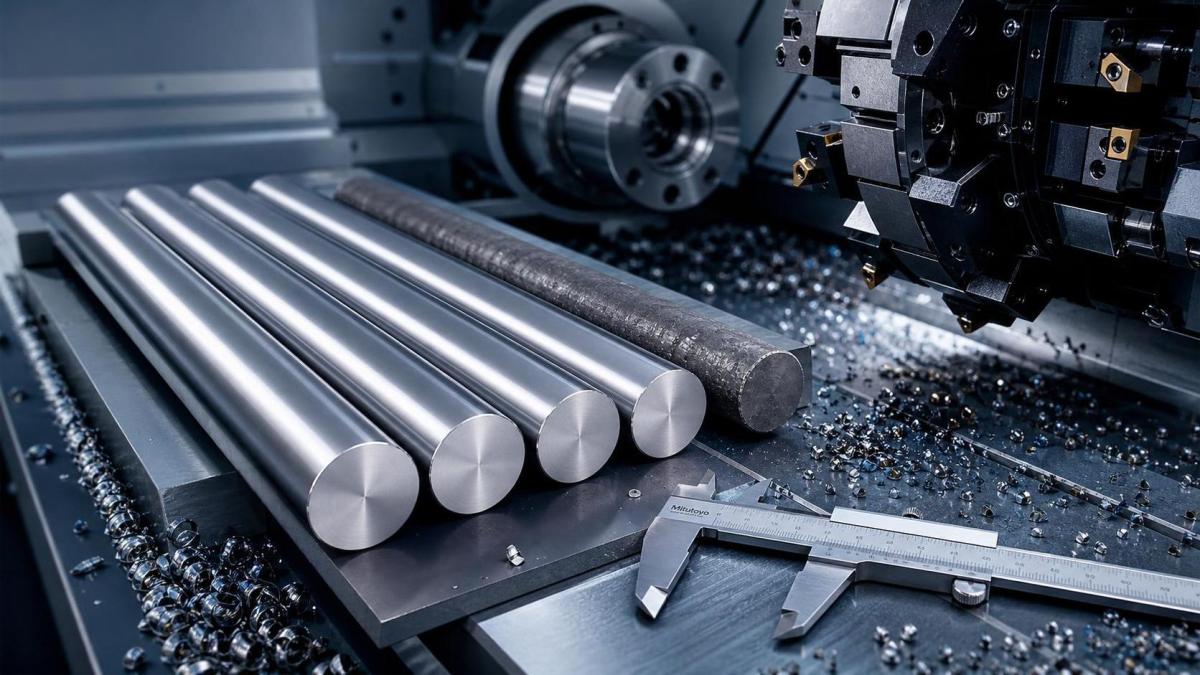
Where Precision Alloy Bars usually perform better
A precision bar is not magic. It simply removes some of the variation that operators normally fight. In practice, that shows up in a few very specific ways.
- Setup becomes less defensive. You spend less time compensating for stock variation, checking eccentricity, or adjusting offsets earlier than expected.
- Cutting becomes more predictable. Feed and speed decisions hold more consistently because the material does not change character as much from bar to bar.
- Dimensional drift is easier to control. This matters on long runs, especially with alloys that generate heat or work-harden quickly.
- Surface finish improves with less tuning. Not always smoother by default, but easier to stabilize without constant parameter chasing.
- Scrap risk drops on close-tolerance parts. That is often the biggest savings, even when raw material cost is higher.
For nickel-based, iron-based, corrosion-resistant, and heat-resistant alloys, this matters even more. These materials already put pressure on tooling and process stability. Shandong Titanium Nickel Special Steel Co., Ltd. works across a broad range of special alloys, including nickel based and iron-based materials, corrosion-resistant alloys, high-temperature alloys, precision alloys, Hastelloy, Monel, INCONEL, INCOLOY, copper nickel alloys, titanium alloys, zirconium alloys, hafnium alloys, and other specialty grades. In this kind of alloy environment, small differences in bar quality can become large differences in machining behavior.
A practical comparison at the machine
One caution here: “precision” should not be accepted as a marketing word. Ask for actual dimensional tolerance, straightness limits, delivery condition, and inspection basis. If the supplier cannot define those clearly, you are still buying uncertainty.
Mistakes operators see too often
A common mistake is blaming the insert too early. If one batch cuts cleanly and the next batch starts pushing, smearing, or building heat faster, the tooling may be fine. Check incoming bar condition first. Another one is using standard bars for prototype success and then assuming the same setup will scale into production. Prototype quantities can hide material inconsistency because the sample is too small.
Also watch for parts that pass final dimension but fail in assembly because of surface instability, distortion after cooling, or movement after secondary operations. That is not just a machining parameter issue. Material stability is part of the chain.
In some jobs, a mixed-material strategy is sensible. Precision Alloy Bars for the critical rotating or sealing components, standard bars for brackets, supports, or rough-machined sections. The right answer is not always all-premium stock.
That same logic applies when you are balancing bars, plates, and sheet products in one project. For example, if a fabrication includes machined bar stock plus heat- and corrosion-resistant formed sections, materials such as Nickel-based Alloy Steel Sheets in grades like Inconel 718, Inconel 625, or Nimonic 75 may be selected for structural components, turbine blades, aerospace parts, or chemical processing equipment. Sheets solve a different problem than bars, but operators benefit when the full material package is chosen with the same discipline.
What to ask your supplier before releasing the job
- What is the specified tolerance on diameter, straightness, and length?
- What delivery condition is supplied: hot-rolled, cold-finished, peeled, ground, or otherwise processed?
- Is there mill test documentation for chemistry and mechanical properties, and does it match the grade standard required by the drawing or purchase specification?
- Has the bar been produced for machining applications specifically, or is it general stock?
- For critical parts, can the supplier support batch consistency information or additional inspection【待核实 based on actual order terms】?
If the component will see high temperature, corrosion, or cyclic stress, this conversation gets even more important. Material selection should line up with service conditions, not just machinability. That is where experienced alloy suppliers add value: matching process behavior with end-use demands instead of treating all bar stock as interchangeable.
A good working rule is simple. If the part is easy, the tolerance is open, and downtime is cheap, standard bars may do the job. If the part is expensive, the alloy is difficult, the tolerance is tight, or the run is long enough for variation to hurt, Precision Alloy Bars are usually the safer choice. Not because the brochure says so, but because operators spend less time fighting the material and more time making stable parts.
