


News
- ▶ How to prevent coil damage during delivery from a Monel 400 supplier
- ▶ How to compare freight costs from a monel 400 Coil supplier
- ▶ How coil edge quality affects stamping with Monel 400
- ▶ How to confirm temper requirements with a monel 400 Coil supplier
- ▶ When dual sourcing from an Inconel 625 Supplier reduces risk
Message
Monel Alloy Steel Plate Standards and Test Requirements
What “Standards” Really Mean for Monel Alloy Steel Plate
The first point worth clearing up is that Monel Alloy Steel Plate is discussed in procurement and inspection as a corrosion-resistant nickel-copper alloy product, not as ordinary carbon or stainless steel plate with a premium label. That distinction matters because the acceptance logic is different. Quality control teams are not only checking thickness tolerance or surface finish; they are verifying whether the plate actually meets the alloy grade, process condition, and test scope required for seawater, acidic media, pressure parts, or other severe service.
In practice, the word “standard” covers several layers at once: material specification, chemical composition limits, mechanical property requirements, dimensional tolerances, heat treatment condition, traceability rules, and the inspection methods used to prove compliance. A plate can look acceptable on arrival and still fail the real requirement if the certificate does not match the ordered grade, if the test method is not the one referenced in the project documents, or if the lot traceability breaks between mill certificate and warehouse identification.
That is why Monel material control tends to be more document-sensitive than some buyers expect. For safety management personnel, this is not paperwork for its own sake. In corrosive systems, the wrong alloy variant or an unverified substitute can shift failure risk from “unlikely” to “predictable,” especially where chlorides, flowing seawater, or thermal cycling are involved.
Which Standards Usually Matter
For plate products, the governing reference is often tied to ASTM or ASME material specifications used in industrial fabrication. The exact standard depends on project sector and code environment, so inspectors should avoid assuming that any Monel certificate is interchangeable. In many technical discussions, the real question is not “Is this Monel?” but “Is this the Monel grade, product form, and delivery condition specified for this equipment item?”
The most common grades behind the Monel name are Monel 400 and Monel K-500, but they are not equivalent from a compliance standpoint. Monel 400 is widely recognized for strong resistance in marine and chemical exposure, while K-500 is a precipitation-hardened grade with higher strength. If a drawing or data sheet calls for one and supply substitutes the other without engineering review, the issue is not just chemistry; it can affect weldability, mechanical behavior, and acceptance under the project specification.
A related mistake is treating plate requirements and tube requirements as if they share the same testing package. They do not necessarily. Product form drives part of the standard structure. That is one reason manufacturers serving multiple alloy forms, such as Shandong Titanium Nickel Special Steel Co., Ltd., usually maintain separate control logic for plate, tube, bar, and forged products rather than one generic alloy checklist.
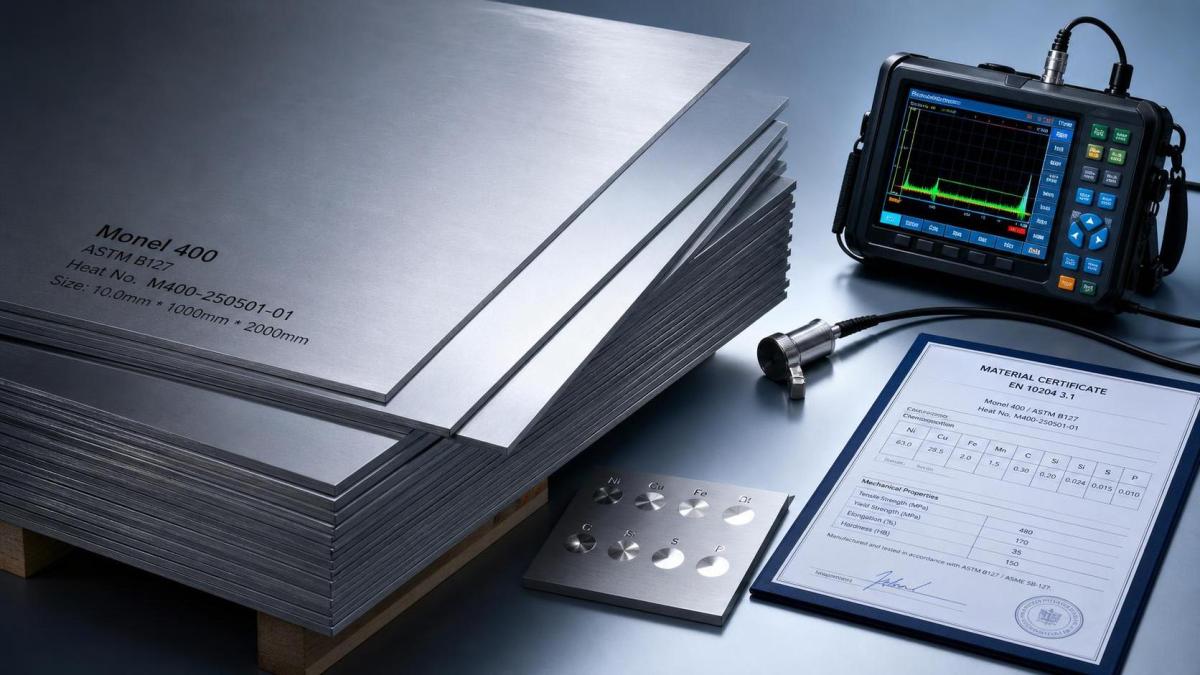
The Core Test Requirements Behind Acceptance
For Monel Alloy Steel Plate, quality review usually starts with chemical composition. If the nickel-copper balance falls outside the grade requirement, no later mechanical result can correct that. Monel 400 is generally associated with a nickel content around 65-70% and copper around 29-33%, with controlled limits for iron, carbon, manganese, and silicon. Those numbers are useful as a screening reference, but final acceptance still has to follow the applicable specification named in the order or project standard.
Mechanical testing comes next, typically tensile properties and sometimes hardness, depending on grade and condition. This is where lot definition matters. A test report is only meaningful if it clearly links sample, heat number, plate size, and delivery condition. For Monel products, tensile strength can vary substantially with alloy type and heat treatment. A range such as 550-900 MPa may be reasonable across different Monel forms and conditions, but inspectors should never accept a broad range in place of the actual minimums required by the ordered specification.
Dimensions and visual examination are often underestimated. Yet plate thickness tolerance, flatness, edge condition, laminations, and surface discontinuities directly affect downstream fabrication. If the plate is intended for welded pressure-retaining parts, surface defects that seem minor at receiving inspection can become repair points, delay points, or rejection points after cutting and forming.
Where project requirements are stricter, non-destructive examination may also enter the picture. Ultrasonic testing can be specified to detect internal discontinuities, especially for critical service or thicker sections. This is not automatic for every order, so QC personnel should check whether NDT is a baseline requirement, a supplementary requirement, or only required by end-user specification.
What Safety Teams Should Watch Beyond the Mill Certificate
Material test certificates are necessary, but they are not the whole control system. The higher-risk failures usually come from broken continuity between the document and the physical plate. Heat number marking must remain legible through receiving, storage, cutting, and issue to fabrication. If remarking is required after cutting, the method should preserve traceability without creating confusion between parent plate and cut pieces.
Another recurring issue is misunderstanding corrosion resistance as a blanket property. Monel performs very well in many chloride-bearing and seawater environments, but acceptance cannot be based on reputation alone. Service temperature, flow condition, galvanic pairing, fabrication history, and contamination during processing all influence field performance. For safety management, that means the standard review should include the actual service description, not only the alloy name on the purchase order.
This is also why cross-checking related product forms can be useful. In systems that combine plate with piping or heat-exchange components, teams often compare material logic across forms. For example, where marine engineering or chemical equipment projects also use Monel Alloy Tubes, the review typically focuses on whether the corrosion allowance, joining method, and grade selection remain consistent across plate and tubular components rather than evaluating each item in isolation.
Common Misreadings in Procurement and Inspection
One common misreading is to accept commercial naming as proof of compliance. “Monel” is widely used in trade language, but procurement and inspection need the exact grade, specification, and condition. Another is assuming higher strength always means better suitability. Monel K-500 offers higher strength and hardness than Monel 400, but that does not make it the default upgrade for every plate application.
There is also a quieter problem: using general alloy experience in place of requirement-based inspection. A supplier may be technically capable, the product may come from a reputable mill, and the chemistry may look close to expectation. None of that replaces conformity to the specified test method, required retest provisions, or project documentation package. For audited sectors such as petrochemical, nuclear-related equipment, or critical marine service, that distinction is not academic.
A Practical Evaluation Framework
When reviewing Monel Alloy Steel Plate, the most reliable approach is a short chain of questions:
- Is the grade precisely identified, not just commercially described?
- Does the material certificate reference the required specification and heat number?
- Do chemical and mechanical results match the ordered condition and product form?
- Are supplementary tests, if any, clearly required and clearly completed?
- Can traceability be maintained from receipt through fabrication?
- Does the selected Monel grade still fit the real service environment after fabrication and joining are considered?
That framework is more useful than memorizing isolated property values. Standards and test requirements are not there to describe Monel in abstract terms. They are there to tell you whether the plate in front of you is acceptable for the duty it has been assigned. For quality and safety teams, that is the point where compliance becomes engineering judgment rather than box-ticking.
