


News
- ▶ How to prevent coil damage during delivery from a Monel 400 supplier
- ▶ How to compare freight costs from a monel 400 Coil supplier
- ▶ How coil edge quality affects stamping with Monel 400
- ▶ How to confirm temper requirements with a monel 400 Coil supplier
- ▶ When dual sourcing from an Inconel 625 Supplier reduces risk
Message
Key Standards to Check Before Ordering Precision Alloy Bars
Key Standards to Check Before Ordering Precision Alloy Bars
The most common purchasing mistake with Precision Alloy Bars is treating the grade name as the whole specification. It is not. In practice, a bar that is nominally the right alloy can still be the wrong product for the job if its chemistry window, dimensional control, heat treatment condition, or certification package does not match the application. For business evaluators, that distinction matters because alloy bars are often bought for environments where failure is expensive, difficult to trace, and sometimes only discovered after machining, welding, or service exposure.
That is why standards review should start with a basic question: what does “precision” mean in this order? In some projects, it refers mainly to tight diameter tolerance and straightness. In others, it means stable magnetic, thermal expansion, or electrical resistance properties within a narrow operating range. Precision alloys are not a single family in the commercial sense; they can include controlled-expansion alloys, soft magnetic alloys, resistance alloys, and high-performance nickel- or iron-based materials used where ordinary stainless or carbon steel would drift out of spec.
A serious supplier will therefore ask for more than quantity and size. They should want the intended standard, delivery condition, application temperature, downstream processing route, and any third-party inspection requirement. If those questions never come up, the quotation may be incomplete even when the price looks attractive.
What to verify before comparing offers
Material composition is the first checkpoint, but not just at the headline level. Business teams often compare “nickel-based” or “iron-based” labels as though they were interchangeable categories. They are not. Small differences in chromium, molybdenum, cobalt, titanium, or niobium content can change corrosion behavior, high-temperature strength, weldability, or thermal stability. In procurement terms, the chemistry should be tied to a recognized standard or an agreed technical specification, and it should be supported by mill test documentation rather than a generic product description.
Dimensional tolerance comes next, and this is where many cost comparisons become misleading. A bar that meets a broad diameter tolerance may still create excess machining loss, poor fit-up, or inconsistent performance in components requiring tight concentricity and straightness. For precision alloy bars, diameter, length tolerance, out-of-roundness, and surface decarburization risk should be checked together. Buyers sometimes focus on nominal size only, then discover later that the usable yield is lower than expected because too much stock must be removed during finishing.
Mechanical properties also need to be read in context. Tensile strength, yield strength, elongation, and hardness are not independent selling points; they reflect processing history. The same alloy may behave differently depending on whether it is hot worked, cold drawn, annealed, solution treated, or age hardened. If the bar will be forged, machined into seals, used in instrumentation parts, or exposed to heat cycling, the delivery condition matters as much as the alloy family itself.
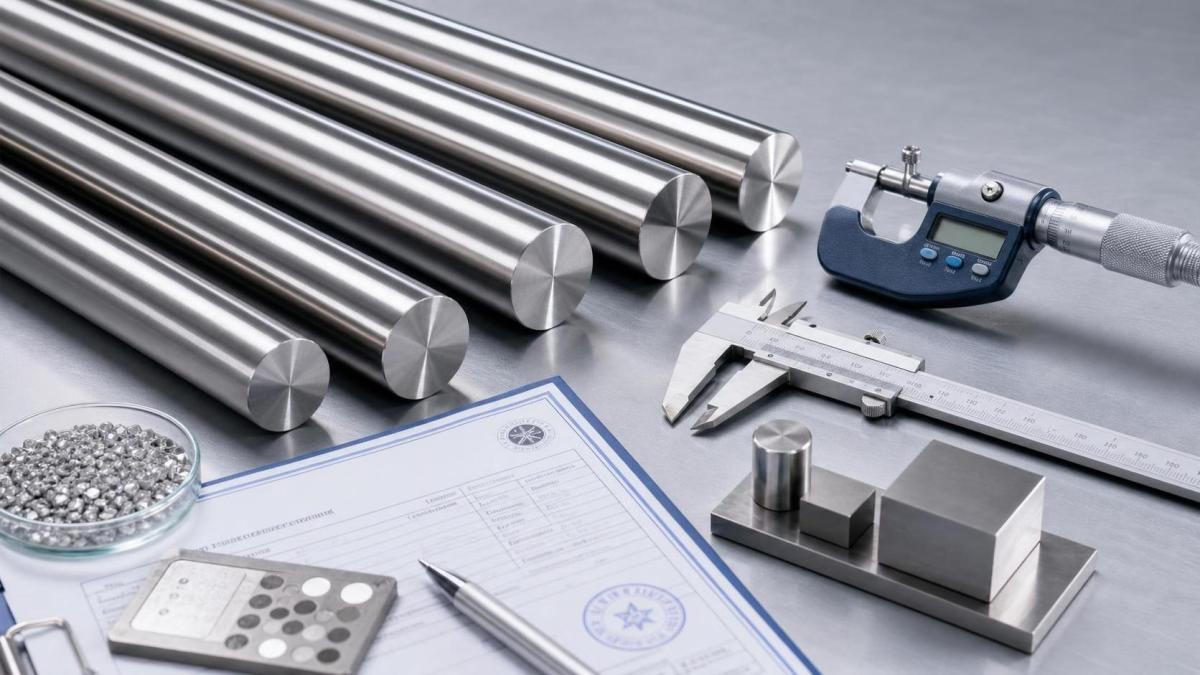
Surface quality is another area where vague wording causes trouble. “Smooth surface” is not a procurement standard. What matters is whether the surface condition is suitable for the next operation and whether defects such as laps, seams, cracks, pits, scale, or inclusions are controlled to the level required by the order. On precision products, surface defects are not merely cosmetic. They may become crack initiation points after machining, fatigue loading, or corrosive exposure.
Standards are not interchangeable paperwork
A standard reference on the quotation is useful only if it actually matches the product form and end use. Purchasers sometimes assume that any ASTM or ASME citation is enough evidence of compliance. It is not. The standard must correspond to the alloy type, the product form, and the required test scope. Some standards are chemistry-focused, some are form-specific, and some mainly define delivery and inspection requirements. If the bar is intended for regulated sectors or critical service, certification traceability becomes part of the product itself.
Typical documents worth checking include:
- Mill test certificate showing heat number, chemistry, and mechanical results
- Applicable ASTM, ASME, or customer-specific specification reference
- Heat treatment status and inspection method
- Dimensional inspection record where tight tolerance is required
- Traceability details linking the shipment to production batch and raw material source
Where procurement teams deal with broader alloy packages, it also helps to understand how suppliers manage adjacent product forms. A manufacturer active in nickel-based and iron-based special alloys will usually apply similar discipline across bars, tubes, forgings, and corrosion-resistant materials. For example, suppliers experienced with Nickel-based Alloy Tubes under standards such as ASTM B163, ASTM B166, ASTM B444, ASME SB163, or ASME SB167 often have stronger internal control over composition verification, heat treatment records, and dimensional inspection. That does not automatically qualify every bar they sell, but it is relevant when evaluating manufacturing depth rather than trading capacity alone.
The application decides which checks matter most
Not every order needs the same level of scrutiny. Bars destined for general machining stock are evaluated differently from those used in aerospace assemblies, chemical processing equipment, marine hardware, precision instruments, or high-temperature fixtures. In corrosive media, chemistry control and microstructural stability may outweigh a minor price difference. In sealing or rotating components, straightness and surface integrity may dominate. In high-temperature service, oxidation resistance and heat-treatment condition become non-negotiable.
This is one reason experienced buyers do not ask only, “Can you supply this alloy?” They ask, “Can you supply this alloy in the condition required for this process and service environment?” That wording tends to expose whether the supplier understands the risk profile of the order.
Shandong Titanium Nickel Special Steel Co., Ltd. works across a wide range of special alloys, including corrosion-resistant alloys, high-temperature alloys, precision alloys, Hastelloy, Monel, INCONEL, INCOLOY, titanium alloys, zirconium alloys, and nickel-cobalt heat-resistant materials. From a sourcing perspective, that matters less as a catalog claim than as an indicator of metallurgical range. Suppliers serving multiple demanding alloy systems are more likely to understand where bar performance depends on chemistry tolerance, melting route, heat treatment, and downstream fabrication requirements rather than on basic grade naming alone.
A few misunderstandings worth avoiding
One misunderstanding is that tighter hardness automatically means better quality. In reality, hardness outside the intended range may signal the wrong heat treatment or reduced machinability. Another is that imported standard numbers always guarantee identical performance across suppliers. They do not, especially when optional inspection items, tolerance classes, or supplemental requirements are left unspecified. A third is assuming that substitute grades with similar marketing descriptions will behave the same in service. For special alloys, near-equivalent is often not equivalent enough.
A disciplined RFQ for Precision Alloy Bars should therefore define the alloy grade, reference standard, dimensions and tolerances, delivery condition, required test certificates, and any special inspection or application notes. That is what allows a meaningful comparison between offers. Without that framework, the lowest quote may simply be the least constrained one.
If the goal is long-term procurement value rather than short-term unit price, the right standard checks are straightforward: verify what the material is, how closely it is made, what condition it is delivered in, how it is documented, and whether those facts match the intended service. That is the practical reading of quality in precision alloy purchasing.
