


News
- ▶ Why melt route matters when selecting a Hastelloy C276 manufacturer
- ▶ How a Hastelloy C276 manufacturer proves corrosion resistance
- ▶ What to evaluate in a Hastelloy C276 manufacturer for chemical plants
- ▶ When to source Inconel 625 from a manufacturer instead of stock
- ▶ How Inconel 625 manufacturers control composition between heats
Message
Why melt route matters when selecting a Hastelloy C276 manufacturer
A purchase specification for C276 can look complete on paper: nominal chemistry, product form, dimensions, and the relevant ASTM or ASME reference. Yet a component may still behave differently in a chloride-bearing stream, a wet flue-gas scrubber, or an offshore process skid than the buyer expected. The missing question is often not “Was it C276?” but “How was it melted, refined, and converted into the final product?”
For a Hastelloy C276 Manufacturer, melt route is a core quality decision rather than a production detail. It governs how well residual elements, non-metallic inclusions, segregation, dissolved gases, and composition variation are controlled before the alloy is forged, rolled, extruded, or welded into a usable form. When corrosion resistance, weldability, and service continuity matter, buyers should evaluate melt practice alongside chemistry certificates and dimensional tolerances.
Why the same grade designation can produce different risk profiles
C276 is a nickel-chromium-molybdenum alloy designed for severe corrosive environments. Its resistance depends on a carefully balanced composition and a clean, uniform structure. Standard chemical analysis confirms whether a heat falls within specified element limits, but it does not fully describe the distribution of those elements or the amount and type of inclusions carried through processing.
A conventional melt route may be adequate for some less demanding applications, especially where the product is thick, the exposure is moderate, and fabrication requirements are limited. In more severe duty, localized corrosion resistance can be affected by small areas of chemical segregation, entrapped oxides, sulfides, or other inclusions. These discontinuities can become relevant at machined surfaces, forming zones, tube bends, weld-adjacent regions, and locations where corrosive media stagnate.
The practical implication is simple: material with an acceptable certificate may still require a closer manufacturing review when the operating environment combines chlorides, oxidizing contaminants, reducing acids, elevated temperature, pressure cycling, or difficult-to-inspect service locations.
Melt route: what buyers should actually ask about
“Vacuum melted” is often used as a shorthand for premium quality, but it should not be treated as a complete answer. Buyers need to know which melting and remelting stages were used, why they were selected, and how the supplier controls the transition from ingot to finished product.
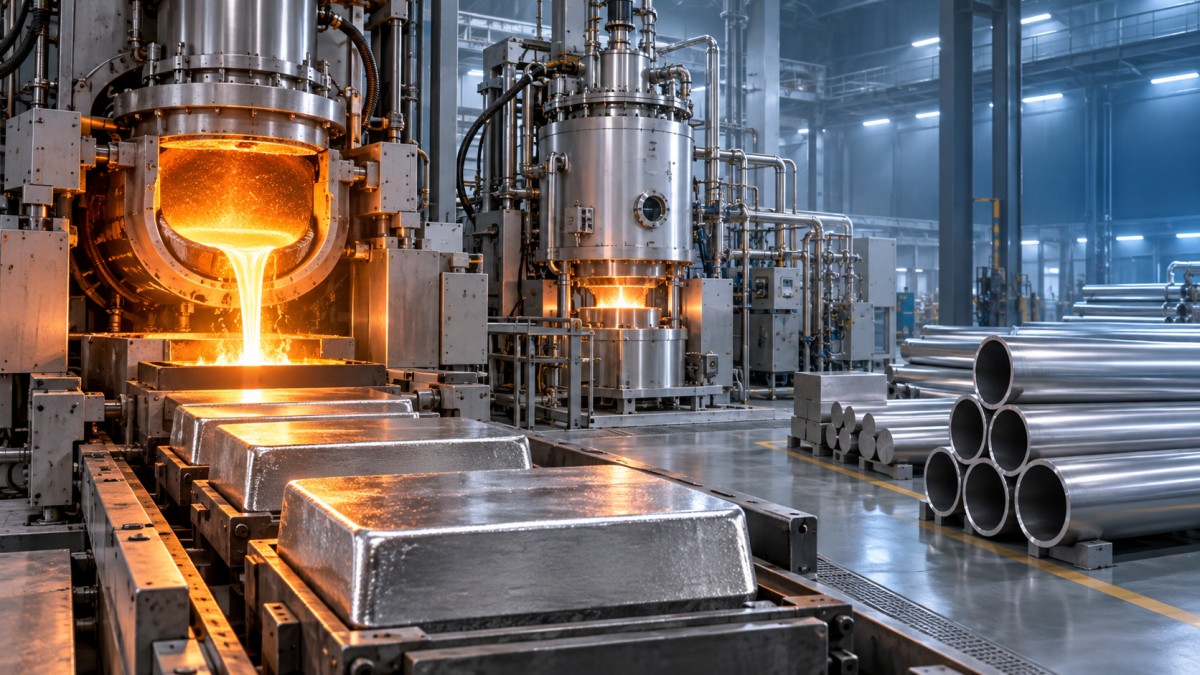
Common routes may include air melting, vacuum induction melting, electroslag remelting, vacuum arc remelting, or a combination of primary melting and secondary remelting. Each route has different strengths. Vacuum induction melting can improve control of gas content and oxidation-sensitive elements. Electroslag remelting can help refine cleanliness and improve ingot soundness under controlled slag conditions. Vacuum arc remelting may further support uniformity and reduce certain internal defects in high-integrity material.
There is no universal rule that one route is mandatory for every C276 order. The right route depends on product form, section size, required testing, fabrication method, and failure consequence. A thin-wall tube for aggressive process media does not present the same exposure pattern as a non-pressure structural plate. However, the manufacturer should be able to explain the route in specific terms rather than relying on broad claims about “high purity” or “advanced melting.”
Questions that reveal whether melt control is meaningful
- Was the alloy primary melted in air or under vacuum, and was it subsequently remelted?
- Is the melt route consistent across the offered heat sizes and product forms, or does it change by order quantity?
- How are sulfur, oxygen, nitrogen, and other residuals controlled within the supplier’s internal process limits?
- What measures are used to manage segregation during ingot production and hot working?
- Can the supplied product be traced back to its melt heat, remelt lot where applicable, and conversion records?
- Which inspection methods are applied to detect internal or surface discontinuities before shipment?
These questions are more useful than requesting a generic statement that the material is “vacuum refined.” They force a discussion about traceability, process discipline, and the suitability of the actual production path for the intended service.
Purity is not only a laboratory number
In alloy procurement, purity is often reduced to a list of impurity limits. That matters, but inclusion morphology and distribution matter as well. A small population of elongated inclusions, clustered oxides, or segregated regions may not be captured by a standard chemical certificate. During hot deformation, these features can be stretched through the working direction. During later forming or machining, they may become exposed at surfaces that contact corrosive media.
This does not mean that every inclusion leads to premature corrosion. It means that the margin between nominal and reliable performance becomes narrower when the service is severe. Localized attack tends to begin at the weakest microstructural site, not at the average chemistry printed on a certificate.
For this reason, a buyer should align inspection expectations with the application. Surface examination, ultrasonic testing where appropriate for section thickness, eddy-current testing for tubular products, and metallographic review may all have a place, depending on the form and specification. Requiring every possible test without regard to the product can add cost without improving the decision. The better approach is to identify the credible failure mechanism and request evidence that addresses it.
Microstructure follows melting, but also conversion
Melt route is the starting point, not the whole manufacturing story. Ingot breakdown, forging reduction, rolling practice, solution annealing, cooling rate, pickling, and final straightening all influence the microstructure and surface condition delivered to the fabricator. A high-quality remelted ingot can still lose value if subsequent hot working is poorly controlled or if final heat treatment does not restore the intended corrosion-resistant condition.
When comparing suppliers, it is useful to separate three questions:
A supplier that can document all three areas is generally easier to qualify than one that provides only a chemistry report and a general grade description.
When a premium melt route is justified
Higher-integrity melting and remelting are most defensible where material replacement is expensive, shutdown consequences are significant, or inspection after installation is limited. Examples include piping and tubing exposed to mixed acids, scrubber components handling variable condensates, offshore systems facing crevice-prone seawater exposure, and equipment that will be repeatedly welded or cold formed before entering service.
Thin sections deserve particular attention. A small defect, surface imperfection, or local chemistry variation occupies a larger proportion of the wall thickness than it would in a heavy forging. Fabricators also need stable response during bending, expansion, machining, and welding. For these products, ask whether the offered material is made from the same melt route and processing sequence that supported the qualification samples or prior production records.
By contrast, a premium route should not be specified merely because it sounds superior. When the environment is clearly defined, corrosion allowance is available, and the component is readily replaceable, a properly controlled standard route may meet the real engineering need. The procurement requirement should be tied to service risk, not to an assumption that every C276 item requires identical metallurgical controls.
Documents that should accompany the technical conversation
Material test reports remain essential, but they should be reviewed as part of a broader evidence package. The report should identify the heat, product condition, chemical composition, mechanical properties required by the governing specification, and applicable examination results. Where melt route is a contractual requirement, it should appear in the purchase order and be confirmed in supplier documentation rather than left as an informal sales statement.
For critical orders, ask early whether the mill can provide process traceability from melt heat through finished lot, as well as records for solution annealing and non-destructive testing when specified. Clarify whether test coupons represent the same product form and heat-treatment condition as the delivered material. A tensile result from a different section or condition does not answer every question about the final component.
The same documentation discipline is useful across other engineered alloy products. For example, when sourcing Precision Alloy Tubes for instrumentation, electronic equipment, or magnetic shielding assemblies, buyers may focus on dimensional accuracy, thermal behavior, electrical stability, or magnetic permeability rather than corrosion resistance. Even so, traceable melting, controlled conversion, and final-condition verification remain important because the required material properties are created by the entire process, not by nominal composition alone.
A practical way to compare manufacturer quotations
Before selecting a Hastelloy C276 Manufacturer, place each quotation against the actual service conditions. Identify the corrosive media, temperature range, pressure and flow characteristics, weld locations, product geometry, expected fabrication steps, and consequence of leakage or replacement. Then state which proof is needed: a defined melt route, remelting requirement, traceability level, specific inspection, or additional corrosion-related testing where the governing specification and application justify it.
A supplier that responds with clear process boundaries is often more valuable than one that offers an unqualified promise of “best quality.” The technically useful response explains what route is available for the requested form, what documentation can be supplied, where process variation may occur, and which requirements need agreement before production begins. That clarity allows engineering, quality, and purchasing teams to judge whether the metallurgy matches the risk carried by the component.
