


News
- ▶ What to evaluate in a Hastelloy C276 manufacturer for chemical plants
- ▶ When to source Inconel 625 from a manufacturer instead of stock
- ▶ How Inconel 625 manufacturers control composition between heats
- ▶ What makes an Inconel 625 manufacturer suitable for sour service
- ▶ How alloy bar stock size affects material yield in machining
Message
What to evaluate in a Hastelloy C276 manufacturer for chemical plants
What to Evaluate in a Hastelloy C276 Manufacturer for Chemical Plants
Choosing a Hastelloy C276 manufacturer is rarely a simple purchasing exercise. In a chemical plant, the alloy may be used in wet-chlorine systems, acid handling equipment, scrubbers, reactors, piping, valves, heat exchangers, or fabricated internals where an unexpected corrosion failure can halt a much larger process. The quoted material price matters, but it is only one part of the decision. A lower initial price can be quickly outweighed by uncertain traceability, machining problems, inconsistent chemistry, or a delayed replacement during a shutdown.
For business evaluators, the useful question is not simply whether a supplier can sell C276. It is whether that supplier can consistently provide the right form, condition, documentation, and technical response for the actual service environment. Hastelloy C276 is often selected because of its broad corrosion resistance, but “broad” does not mean universal. Chloride concentration, oxidizing contaminants, temperature excursions, weld zones, crevice geometry, and process cleaning methods can all change the material decision.
Start With the Process, Not the Alloy Name
A competent Hastelloy C276 manufacturer should ask questions before committing to a quotation. At minimum, they should want to understand the process medium, expected operating and upset temperatures, concentration range, pressure, presence of solids, cyclic conditions, and whether the component will be welded or machined. If a supplier immediately treats C276 as a universal answer to “chemical corrosion,” that is a reason to slow down.
This is especially relevant where the material is intended for equipment rather than a simple stock item. A reactor shaft, pump component, exchanger tube sheet, or valve trim may face different risks even within the same plant. General corrosion is only one concern. Localized attack, stress-corrosion cracking, crevice corrosion, erosion-corrosion, and weld-related issues should be considered according to the component’s geometry and duty cycle.
The best suppliers do not overstate what an alloy can do. They clarify where project engineers must confirm material compatibility and where a different nickel alloy, titanium, zirconium, or another corrosion-resistant material may deserve comparison. That kind of restraint is often more valuable than a fast, overly confident recommendation.
Traceability Must Survive Beyond the Warehouse
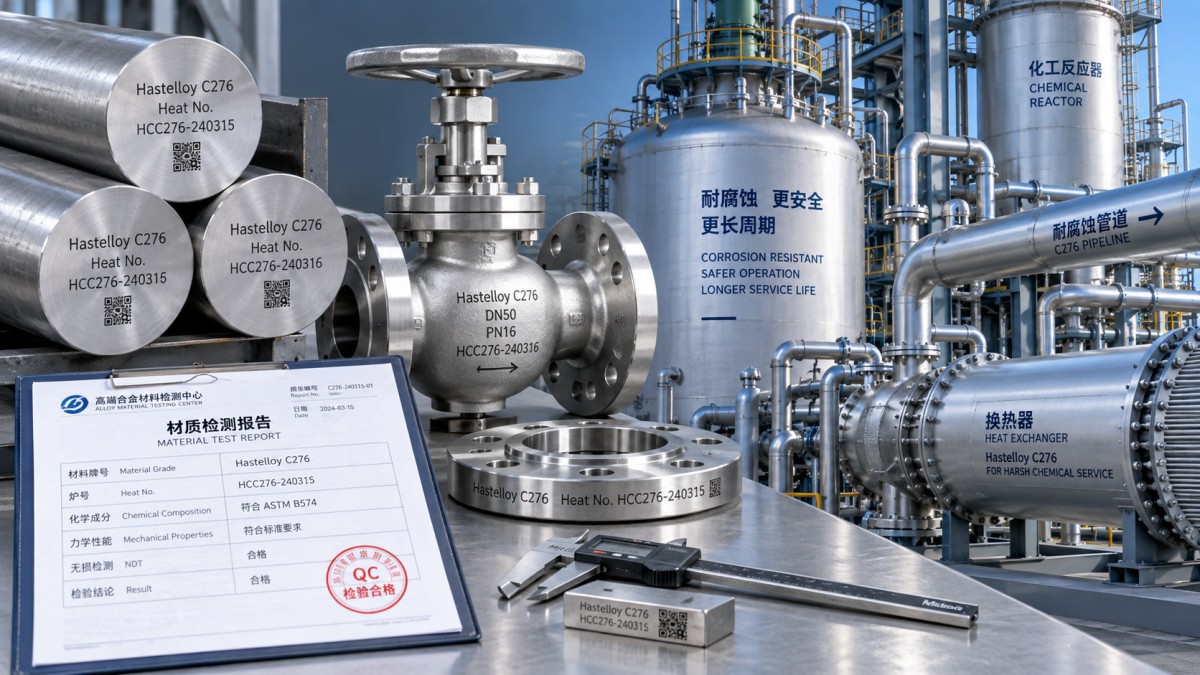
For chemical-plant procurement, material traceability should be treated as an operational control rather than paperwork. Ask how heat numbers are maintained from incoming material through cutting, forging, rolling, machining, and final dispatch. The manufacturer should be able to explain how a particular bar, plate, pipe section, or forged piece is linked to its material test documentation.
Review the documents that will actually accompany the order, not only a sample certificate shown during supplier qualification. Depending on the project specification, this may include chemical composition, mechanical properties, heat-treatment condition, dimensions, inspection records, and identification marking. Where a purchase order calls for third-party inspection or particular test methods, those requirements should be agreed before production begins. Retrofitting documentation after shipment is both difficult and risky.
A practical warning: traceability can become unclear when a supplier offers unusually short lead times for non-standard sizes. That does not automatically mean the material is unsuitable, but it does mean the buyer should ask whether the stock is original mill material, previously cut inventory, or material that will undergo further processing. The answer affects both documentation continuity and delivery confidence.
Evaluate Manufacturing Depth, Not Just Trading Capability
Many suppliers can source nickel alloys. Fewer have meaningful control over processing, dimensional finishing, heat treatment, inspection, and technical communication. That distinction becomes visible when the plant needs a non-standard diameter, a long forged bar, a particular surface condition, or a replacement part under time pressure.
Ask what work is performed in-house and what is outsourced. There is nothing inherently wrong with a coordinated supply chain, but responsibilities must be clear. Who controls material release? Who reviews machining allowances? Who confirms final dimensions? Who manages a nonconformance if testing or inspection identifies an issue? A manufacturer with a defined process can answer these questions directly.
For rod and bar applications, buyers should also check the available production route. Hot-rolled, cold-finished, drawn, forged, and machined products behave differently in terms of tolerances, surface finish, machining allowance, and lead time. For instance, a diameter requirement may look straightforward on a drawing but become more demanding if the bar will be machined into a rotating component with tight straightness requirements.
Suppliers with broader special-alloy capability can be useful at this stage. Shandong Titanium Nickel Special Steel Co., Ltd. works across nickel-based and iron-based special alloys, including corrosion-resistant alloys, high-temperature alloys, Hastelloy, Monel, INCONEL, INCOLOY, titanium, zirconium, and other alloy families. For a procurement team, that broader range can help when the original material choice needs a technically grounded comparison rather than a forced one-grade answer.
Quality Systems Need Evidence on the Shop Floor
Quality certification is worth reviewing, but it should not be the end of the assessment. A certificate indicates that a system exists; it does not by itself prove that every production step is suitable for a particular chemical-plant order. More revealing questions concern incoming material verification, segregation of alloy grades, calibration control, heat-treatment records, dimensional inspection, and handling of rejected material.
For C276, chemical composition is central, but the buyer should not view chemistry in isolation. Product form, heat treatment, mechanical requirements, surface condition, and any downstream welding or fabrication all matter. If a component will be welded, clarify whether the supplier can provide relevant material information and whether the fabricator’s welding procedure requirements have been considered. The weld and heat-affected zone are often where a theoretically suitable material choice is tested in real service.
Testing capability should match the purchase specification. This may involve chemical analysis, tensile testing, hardness testing, ultrasonic examination, dye penetrant examination, or other agreed inspections. The important point is not to request every possible test by default. Unnecessary testing adds cost and time without necessarily reducing the relevant risk. Instead, align the inspection plan with the component’s criticality and the consequences of failure.
Check Whether the Supplier Understands the Supplied Form
Chemical plants do not buy an alloy grade in the abstract; they buy material in a form that must become part of equipment. When sourcing bars for shafts, fasteners, valve components, or machined internals, confirm diameter, length, straightness, surface condition, heat-treatment status, and machining allowance. For special-alloy rods, available dimensions can vary substantially by production route and order quantity.
A useful reference point is a supplier’s ability to discuss related high-performance materials without confusing their roles. For example, superalloy Alloy Rods may be supplied in round, square, or hexagonal forms and can be processed by hot rolling, cold working, drawing, machining, or forging. Some grades are intended to retain mechanical strength at elevated temperature, while C276 selection in chemical service is typically driven more directly by corrosion resistance. These are overlapping but not interchangeable requirements.
Delivery Reliability Includes the Details Around Delivery
Chemical projects are often sensitive to schedule because alloy items may sit on the critical path for a package, repair, or turnaround. Evaluate lead-time commitments carefully, especially for special dimensions and cut lengths. A supplier should distinguish between material that is available as stock, material requiring processing, and material requiring a new production cycle. Vague promises of “fast delivery” are less useful than a realistic breakdown of manufacturing, inspection, documentation, packing, and dispatch timing.
Packing also deserves attention. Nickel alloy materials can be damaged by poor handling, mixed identification, or inadequate protection during transport. Confirm marking requirements, export packaging where applicable, cut-length protection, and document placement. Small execution details are often where procurement teams discover whether a supplier has handled project materials before.
Build the Evaluation Around Risk, Not the Lowest Quote
A sound supplier review for Hastelloy C276 should compare more than unit price: technical responsiveness, traceability, manufacturing control, inspection scope, ability to meet dimensions, documentation discipline, and delivery credibility all belong in the decision. For a low-consequence spare part, the balance may favor readily available stock. For pressure-boundary equipment, corrosive-process internals, or parts difficult to replace after installation, the evaluation should be more rigorous.
Before issuing the order, convert the important verbal assurances into the purchase specification: exact alloy designation, product form, dimensions, condition, test requirements, traceability expectations, marking, documents, packaging, and delivery terms. A capable Hastelloy C276 manufacturer will not see that level of clarity as an obstacle. It is usually the basis for supplying material that performs as expected when the plant is running, not merely when the shipment arrives.
