


News
- ▶ When to source Inconel 625 from a manufacturer instead of stock
- ▶ How Inconel 625 manufacturers control composition between heats
- ▶ What makes an Inconel 625 manufacturer suitable for sour service
- ▶ How alloy bar stock size affects material yield in machining
- ▶ Which ultrasonic inspection standard applies to critical alloy bar
Message
When to source Inconel 625 from a manufacturer instead of stock
Stock is efficient for standard demand; manufacturer sourcing is for controlled risk
Buying Inconel 625 from stock makes sense when the requirement is conventional, the form and dimensions are widely available, and the project can accept the mill condition offered by the distributor. For maintenance spares, small fabrication jobs, or short-notice replacements, available plate, bar, pipe, or fittings may be the fastest route to restore operations.
Direct sourcing from an Inconel 625 Manufacturer becomes more valuable when material is part of a critical pressure boundary, a corrosion-sensitive system, or a component whose failure would create disproportionate downtime, safety, or compliance exposure. The higher purchase price or longer initial coordination time can be justified when the buyer needs to control chemistry, dimensions, test documentation, processing condition, and traceability from the start.
The decision should not be framed as “manufacturer equals better” and “stock equals cheaper.” Stock can be the right commercial answer for a clearly defined, low-variation requirement. Manufacturer sourcing earns its place when a nominal grade designation does not sufficiently describe what the component must withstand.
Start with the service condition, not the alloy name
Inconel 625 is selected for demanding combinations of corrosion resistance, high-temperature strength, and fabricability. Yet specifying “625” alone does not settle the procurement question. The buyer still needs to understand the actual exposure: chloride-bearing media, reducing or oxidizing chemicals, seawater, elevated temperature, cyclic loading, pressure, welding, and expected operating life all affect the material and product form required.
A stock item may carry a grade certificate and still be unsuitable if its thickness, heat treatment, surface condition, or tolerances do not match the design assumptions. For example, a fabricated corrosion-control component may require plate with a particular thickness range, flatness expectation, and surface quality to support welding and inspection. A high-temperature assembly may need material properties tied to a defined supply condition rather than simply a generic inventory description.
Manufacturer sourcing is usually appropriate when engineering has identified a condition that is difficult to verify from off-the-shelf inventory. This includes custom heavy sections, unusual widths or lengths, tight thickness tolerances, non-standard forms, or a required production route. It is also appropriate when the material must fit an existing qualified welding procedure, machining process, or inspection plan.
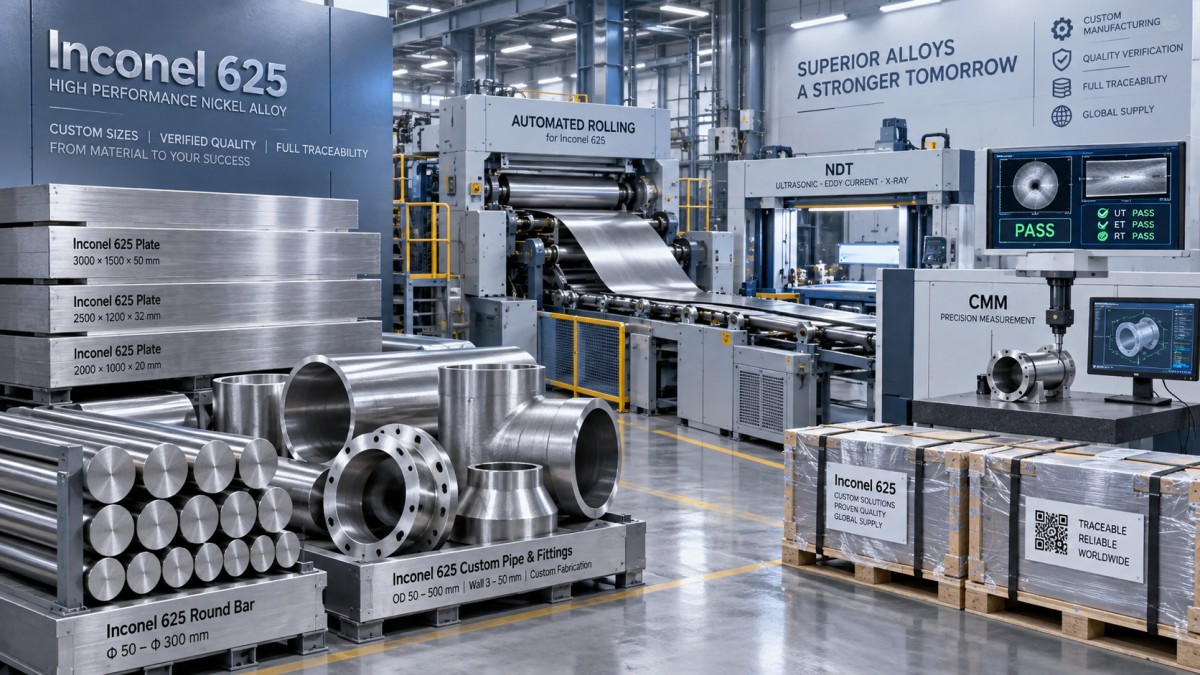
When traceability changes from paperwork to a project control
Many purchasing teams request a material test certificate as a standard document. That is necessary, but it is not always sufficient. On a critical project, the procurement team may need to preserve the relationship between the purchase order, heat number, product marking, test results, cutting plan, and final component identification. Once material is cut, mixed, or subcontracted for fabrication, recovering that chain can be difficult.
Direct mill or manufacturer coordination provides more control over this sequence. It allows requirements to be agreed before production rather than interpreted after shipment. Buyers can define the required certification package, supplementary testing, marking method, inspection hold points, and document format in the purchase order and technical specification.
This matters particularly where material is being supplied into regulated equipment, owner-controlled asset registers, or long-life facilities where replacement material may be needed years later. In those cases, the cost of a documentation gap can exceed the apparent saving from buying available stock.
A practical rule is simple: source directly when the project team would struggle to defend the material selection after a failure, audit, or handover review without knowing exactly how the material was produced and verified.
Custom dimensions can lower total cost even when the unit price rises
Stock purchasing often looks cheaper because the quoted price is immediately comparable. That comparison can miss yield loss, extra machining, fabrication difficulty, scrap handling, and schedule impact. A standard plate may be readily available, but if the required part geometry causes a large amount of expensive nickel-alloy material to become offcut, the delivered cost per usable component can be poor.
Manufacturer sourcing deserves consideration when the project needs:
- Non-standard thickness, width, length, or section size.
- Material supplied close to final dimensions to reduce machining or cutting waste.
- A planned quantity large enough to justify a production run.
- Consistent dimensions across repeated batches.
- Specific surface preparation for fabrication, welding, or final appearance.
The commercial analysis should include more than price per kilogram. Calculate purchased weight versus finished weight, expected scrap value, machining hours, transport, inspection, fabrication rework risk, and the financial consequence of late material. A lower-priced stock plate can become an expensive choice if it creates a bottleneck at a high-value machining center or delays a site shutdown.
Direct sourcing is not automatically economical for a one-off, low-volume part. Manufacturers commonly have minimum order quantities, production scheduling constraints, and longer lead times for special requirements. When the order is small and the design can accept standard sizes, qualified stock may remain the more rational option.
Do not treat lead time as a stock-versus-manufacturer stereotype
Buyers often assume stock is always faster. It is faster when the distributor holds the exact material, in the required form and condition, with acceptable documentation. If the inventory requires additional testing, recertification, extensive cutting, or approval of substitutions, the apparent lead-time advantage can erode quickly.
Manufacturer lead time should be assessed from technical release, not from the date a quotation is requested. The buyer should ask what must be fixed before production starts: specification, dimensions, quantity, test scope, delivery condition, packaging, and certification. Unresolved technical details often create more delay than the melting or rolling schedule itself.
For repeat demand, a direct relationship can support better planning. A buyer may establish a controlled material specification, agreed release process, and forecast-based production arrangement rather than repeatedly searching the spot market. This is especially useful where Inconel 625 is one material within a broader alloy package. A project using nickel-copper alloys in seawater service, for example, may also evaluate Monel Alloy Steel Plate for separate components. Coordinating grades, documentation expectations, and delivery schedules through a capable specialty-alloy source can simplify project administration, even though the materials serve different design needs.
What to put in the inquiry before requesting a quotation
An effective inquiry gives a manufacturer enough information to quote a technically valid supply route. Sending only a grade name and a rough quantity invites ambiguity, substitutions, and later revisions. The request should identify the product form, applicable specification, dimensions and tolerances, required condition, quantity by size, intended service where relevant, and delivery location.
For critical material, include the required testing and records: chemical analysis, mechanical properties, non-destructive examination where applicable, heat traceability, inspection requirements, and any owner or project documentation rules. State whether partial deliveries are acceptable and whether the buyer requires material to be supplied as full lengths, cut pieces, or fabrication-ready blanks.
It is also useful to separate mandatory requirements from preferences. A mandatory corrosion-performance condition, code requirement, or dimensional limit should be explicit. Preferences such as preferred surface finish or packaging can be discussed without holding up the technical release. This distinction helps purchasing compare quotations fairly and prevents a low quote from being selected before its scope is understood.
The decision point is the cost of being wrong
Use stock when the requirement is standard, the inventory can be verified against the specification, and the consequences of variation are limited. Source from an Inconel 625 Manufacturer when material characteristics, documentation, dimensions, or delivery consistency materially affect the finished equipment.
For enterprise buyers, the strongest case for manufacturer sourcing is rarely the alloy label itself. It is the need to remove uncertainty before the material reaches fabrication: uncertainty about what was supplied, whether it can be traced, whether it will process as expected, and whether a late discovery will interrupt a critical project. Where those uncertainties carry real cost, direct sourcing is a procurement control rather than a premium purchase.
