


News
- ▶ How a Hastelloy C276 manufacturer proves corrosion resistance
- ▶ What to evaluate in a Hastelloy C276 manufacturer for chemical plants
- ▶ When to source Inconel 625 from a manufacturer instead of stock
- ▶ How Inconel 625 manufacturers control composition between heats
- ▶ What makes an Inconel 625 manufacturer suitable for sour service
Message
How a Hastelloy C276 manufacturer proves corrosion resistance
For quality-control and safety teams, corrosion resistance must be proven—not promised. A qualified Hastelloy C276 Manufacturer demonstrates material reliability through chemical composition control, traceable testing, corrosion-performance validation, and disciplined production practices. In chemical processing, offshore service, flue-gas treatment, and other aggressive environments, the difference between a sound alloy selection and an unverified one can be measured in downtime, leakage risk, and equipment safety.
Hastelloy C276 is widely selected for its resistance to many oxidizing and reducing media, including chloride-bearing process streams. Yet the alloy name on a purchase order is only the starting point. The real question for an inspector or safety manager is more practical: How can the supplied tube, pipe, plate, fitting, or fabricated component be shown to match the intended material and service conditions?
Start with the alloy chemistry, not the label
Hastelloy C276 is a nickel-molybdenum-chromium alloy with additions such as tungsten and iron. Its corrosion behavior depends on keeping those elements within the required specification range and controlling residual elements that may affect weldability, microstructure, or resistance to localized corrosion.
A responsible manufacturer therefore treats heat chemistry as a controlled production record rather than a generic declaration. For each production heat, buyers should expect a material test certificate that identifies the heat number and reports chemical analysis results. Depending on the agreed standard and product form, the certificate should compare actual values with the applicable specification requirements.
For a quality team, several points deserve careful review:
- Does the certificate clearly identify the alloy grade, heat number, product form, and dimensions?
- Are nickel, chromium, molybdenum, tungsten, iron, cobalt, carbon, manganese, silicon, phosphorus, sulfur, and other relevant elements reported where required?
- Is the testing method defined, or can the supplier provide supporting laboratory records on request?
- Can the heat number on the certificate be matched to permanent marking on the delivered material?
A certificate without traceability may look complete on paper but offers limited value during a failure investigation. Material identity must remain connected to the product from melting through final shipment.
Traceability is part of corrosion assurance
Corrosion failures are rarely convenient. They may emerge after insulation is installed, after a plant has been commissioned, or during a process upset when pressure, temperature, and chemical concentration move beyond normal conditions. At that point, a clear traceability chain is essential.
A reliable Hastelloy C276 Manufacturer should be able to link raw material, melting heat, intermediate processing, heat treatment, inspection results, and final packing identification. This does not mean every order needs the same documentation level. It means the documentation level should be agreed before production, especially for pressure-containing systems, hazardous chemical lines, and safety-critical assemblies.
Good practice often includes heat-number marking, bundle or pallet identification, dimensional records, inspection release documentation, and retained records for defined periods. For cut lengths or fabricated parts, the manufacturer should also explain how original heat identity is transferred after cutting, forming, or machining.
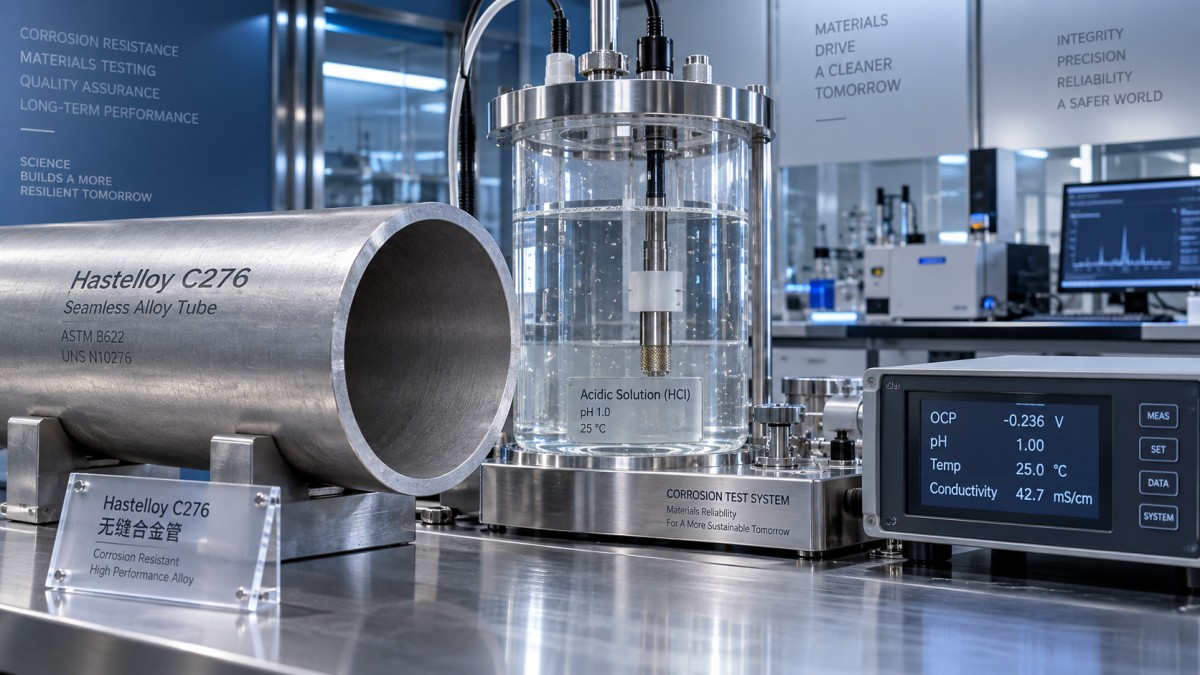
What testing actually supports a corrosion-resistance claim?
No single test can recreate every plant environment. Corrosion is affected by acid type, concentration, dissolved contaminants, flow velocity, temperature, crevice geometry, oxygen availability, and cleaning chemicals. A sound verification plan combines baseline material testing with application-relevant corrosion evaluation where the risk justifies it.
Mechanical and dimensional inspection
Tensile properties, hardness where applicable, wall thickness, outside diameter, straightness, and surface condition help confirm that the material has been processed consistently. These checks do not independently prove chemical compatibility, but they identify manufacturing variations that can influence service life. Thin-wall tubing, for example, may meet nominal chemistry while still presenting unacceptable dimensional variation for a high-pressure line or heat exchanger.
Non-destructive examination
Visual inspection, liquid penetrant testing, eddy-current examination, ultrasonic testing, or radiographic methods may be specified according to the product form and service duty. Their purpose is to identify discontinuities such as cracks, laps, inclusions, or defects that can become initiation sites for corrosion attack.
For welded products, the weld zone deserves particular attention. A corrosion-resistant base alloy cannot compensate for poor welding practice, unsuitable filler metal, inadequate shielding, or contamination from carbon steel tools. Buyers should clarify whether material is seamless or welded, how welds are qualified, and what inspection applies to the weld area.
Corrosion testing matched to the exposure
When the end use involves severe acids, chloride contamination, wet chlorine-bearing gases, or uncertain process chemistry, generic certificates may not be sufficient. The purchaser can request corrosion testing based on an agreed method or a simulated service environment. Common industry approaches may include immersion testing, intergranular corrosion assessment, pitting or crevice-corrosion evaluation, and metallographic examination. The correct method depends on the governing standard and the anticipated failure mechanism.
The important point is not to demand every available test. It is to request the test that answers the real risk question. A test intended for intergranular attack, for instance, should not be treated as proof of resistance to every chloride-induced crevice condition.
Standards create a common language—but scope matters
International material standards can define chemical composition, mechanical properties, dimensions, tolerances, test methods, and delivery requirements. ASTM, ASME, EN, ISO, and customer specifications may all appear in procurement documentation, depending on the project location and equipment code.
However, standards must be read in context. A standard for plate is not automatically interchangeable with one for seamless tube, welded pipe, bar, or forged fittings. Likewise, meeting a material-product specification does not automatically demonstrate that a finished component is suitable for a particular pressure boundary or corrosive fluid.
Quality and safety personnel should check that the stated standard matches the actual product form, manufacturing route, and intended equipment category. If project documentation calls for third-party inspection, positive material identification, hydrostatic testing, or additional corrosion testing, those requirements should be included in the purchase specification rather than assumed after delivery.
A practical review before approving a supplier
Before placing a technically sensitive order, ask the manufacturer to walk through its control plan. The response often reveals more than a brochure. Useful questions include:
- Which standard governs this exact Hastelloy C276 product form?
- How is each heat identified through forming, annealing, cutting, and final inspection?
- What solution annealing or heat-treatment controls apply, where relevant?
- Which non-destructive tests are standard, and which are available as project requirements?
- Can positive material identification be performed on finished products?
- How are nonconforming materials segregated and dispositioned?
- What documentation accompanies shipment, and can it be reviewed before dispatch?
Shandong Titanium Nickel Special Steel Co., Ltd. focuses on the research, production, and sales of special alloy materials, including nickel-based and iron-based alloys, Hastelloy grades, INCONEL, INCOLOY, Monel, titanium, zirconium, and other corrosion- and heat-resistant materials. For buyers sourcing across several alloy families, this broader capability can be valuable when the project requires material comparison rather than a one-grade-fits-all decision.
Corrosion resistance also depends on the finished form
Many failures attributed to “wrong alloy” are actually linked to fabrication details: an improperly cleaned weld, stagnant liquid in a dead leg, dissimilar-metal contact, deposits under insulation, or a temperature excursion that was not considered during material selection. The manufacturer can supply compliant material, but the whole system must still protect its corrosion-resistant properties.
This is especially relevant for tubular components used in reactors, steam systems, heat exchangers, boilers, fuel lines, and chemical-processing equipment. Where elevated temperature accompanies corrosive media, procurement teams may evaluate High-Temperature Alloy Tubes in Hastelloy and related alloy systems. Available dimensions, wall thickness, operating pressure, joining method, and thermal cycling should be assessed together—not as isolated purchasing details.
For tube applications, clarify whether the service is internal, external, or both. A tube may face aggressive process fluid on the bore side and chloride-bearing insulation moisture or marine atmosphere on the outside. That dual exposure can change the inspection plan and the preferred surface finish.
Documentation is a safety tool, not an administrative burden
In a well-run project, certificates, test reports, inspection records, and packing lists form a usable evidence trail. They allow the receiving team to verify material before installation and help maintenance personnel identify the correct replacement material years later.
The most dependable purchasing approach is therefore simple: define the service environment clearly, specify the correct product standard, require traceability to the production heat, and align additional testing with credible corrosion risks. A capable Hastelloy C276 manufacturer should welcome that level of scrutiny. In critical service, transparent evidence is not an obstacle to supply—it is the foundation of confidence.
