


News
- ▶ How to compare alloy rod quotes with different length allowances
- ▶ Why alloy rod may distort after heat treatment
- ▶ What alloy rod straightness tolerance is needed for CNC machining
- ▶ When alloy rod is suitable for corrosion-resistant valve components
- ▶ How alloy rod chemistry influences weld repair performance
Message
Why alloy rod may distort after heat treatment
An Alloy Rod rarely distorts after heat treatment for one single reason. The usual cause is an imbalance: one area expands, transforms, relieves stress, or cools differently from another. The resulting bend, bow, twist, or loss of straightness may look minor at first, but it can make the rod unsuitable for machining, assembly, rotating equipment, sealing surfaces, or safety-critical service.
For process control, the first question should not be “Was the furnace temperature correct?” A compliant furnace setpoint does not guarantee that the workpiece experienced a uniform thermal cycle. Material condition, loading pattern, support method, section changes, and cooling practice all influence the final shape.
Where distortion actually comes from
Metal expands when heated and contracts when cooled. If every part of a straight rod heats and cools at the same rate, these movements are generally balanced. In production, that condition is difficult to achieve. A rod placed close to a furnace wall, partially shielded by another load, or supported unevenly can develop temperature differences along its length or around its diameter. One side changes dimension before the other, and the rod may take a permanent set.
This effect becomes more pronounced when the heat treatment changes the alloy structure. Some alloys undergo phase changes or precipitation reactions that alter local volume and strength. If those changes are not uniform, internal stresses develop even when the part initially appears straight. Nickel-based, iron-based, and other high-performance alloys must therefore be treated according to the specified grade and product condition, rather than by applying a generic cycle used for ordinary carbon steel.
Residual stress from previous processing
Cold drawing, straightening, grinding, turning, cutting, and welding can leave residual stress inside an alloy rod. The rod may be dimensionally acceptable before heat treatment because these stresses are balanced. Heating relaxes that balance. Once the material becomes more responsive to stress relief, the rod can bend toward the side carrying more stored stress.
This is why a distortion issue may appear only after a seemingly mild anneal or solution treatment. The furnace did not necessarily create the problem; it may have exposed a stress condition introduced earlier in the manufacturing route. A consistent incoming inspection should therefore include straightness, surface condition, lot traceability, and any known cold-work history. A rod that has been aggressively straightened before treatment deserves particular attention.
Support and loading can turn a straight rod into a bowed rod
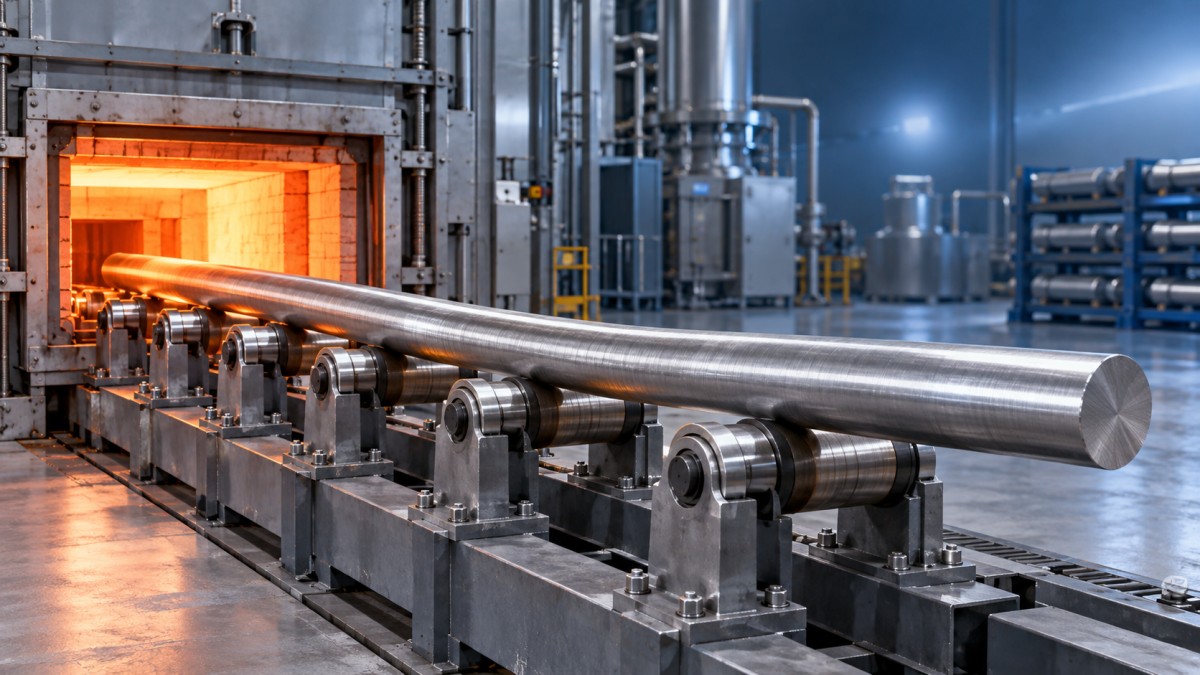
Long, slender bars are vulnerable to sagging at elevated temperature because their stiffness decreases as they heat. Supporting a rod only at both ends may allow its own weight to create a bow. Closely spaced supports can also cause problems if they are not level, if the rod is restrained from expanding, or if contact points create localized temperature differences.
Fixtures should support the part without clamping it rigidly unless the process specifically requires restraint. The rod needs room for thermal expansion. A fixture that holds one end while friction locks the other may generate compressive loading as temperature rises; once the rod softens, buckling or permanent curvature can follow. For critical lots, the fixture design should be reviewed as part of the heat-treatment process, not treated as a simple handling accessory.
Cooling is often the decisive stage
Rapid cooling is not automatically wrong, but it must be uniform and appropriate for the alloy, section size, and required properties. If one side of a hot rod enters a quench medium first, or if agitation is uneven, that side contracts earlier. The temperature gradient can pull the rod out of line. In air cooling, rods placed too close together may cool at different rates depending on local airflow and heat retained by adjacent parts.
A common mistake is to measure straightness only after the rod is fully cold and then blame the last operation. A more useful investigation records the shape before loading, after heating where practical, immediately after cooling, and after any subsequent straightening or machining. That sequence identifies the stage at which the shape first changes.
Check the material and the process together
An alloy designation alone is not enough to select a heat-treatment cycle. Rod diameter, length-to-diameter ratio, prior cold reduction, machining allowance, weld repairs, and the required final condition can all alter distortion risk. A thick rod and a thin rod of the same grade do not necessarily heat through or cool at the same rate. Combining significantly different cross-sections in one load makes uniform processing harder.
Material mix-ups create a separate risk. Similar-looking specialty alloys may have different solution-treatment ranges, cooling expectations, and sensitivity to cold work. Keep heat numbers and process records tied to each load, and avoid mixed-grade batches unless the cycle and cooling method are demonstrably compatible. This is especially important where a distorted rod could later be installed in chemical processing, power-generation, marine, or high-temperature equipment.
The same discipline applies to related product forms. Tubes and rods do not distort in exactly the same way, but both respond to nonuniform heating, restraint, and cooling. When reviewing heat-treatment requirements for corrosion- and heat-resistant nickel alloys used in fabricated systems, Nickel-based Alloy Tubes can provide a useful reference point for comparing alloy families such as Inconel, Hastelloy, and Monel with the intended service environment. Product form, however, must remain part of the process decision.
A practical containment and prevention routine
When a batch shows unacceptable distortion, do not begin by repeatedly straightening every rod. Mechanical correction may be feasible for some applications, but it can add stress, damage the surface, or mask an unstable process. Contain the affected lot, confirm the drawing or purchase specification for allowable straightness, and separate parts by severity and location of the distortion.
- Verify the baseline. Measure straightness before heat treatment and retain the result by lot. Check whether the incoming rods already show a directional trend.
- Review the actual load map. Record rod position, orientation, spacing, support points, furnace zone, and proximity to heavier parts. A load photograph can be more useful than a generic work instruction.
- Compare thermal records with the approved cycle. Focus on ramp rate, soak consistency, transfer time, and cooling method, not only the final furnace temperature.
- Inspect fixtures. Look for wear, uneven supports, scale buildup, bent rails, and points that prevent free expansion.
- Trace prior operations. Compare distortion by supplier lot, drawing pass, machining route, weld status, and any pre-straightening operation.
- Run a controlled confirmation load. Change one meaningful factor at a time, such as orientation or support arrangement, so the result can identify the cause rather than add another variable.
For safety-sensitive parts, the acceptance decision should not rely on visual straightness alone. Check dimensional alignment against the functional requirement and assess whether distortion affects machining stock, fit-up, load path, or clearance in service. A rod that can be forced into position may still impose unwanted assembly stress or create a later failure point.
Shandong Titanium Nickel Special Steel Co., Ltd. works with a broad range of special alloys, including corrosion-resistant, high-temperature, precision, nickel-based, iron-based, titanium, zirconium, Hastelloy, Monel, INCONEL, and INCOLOY materials. For any of these materials, the sound approach is to establish the heat-treatment cycle, handling method, and straightness control plan as one process. Treating them as separate steps is where repeat distortion problems usually begin.
