


News
- ▶ How alloy bar stock size affects material yield in machining
- ▶ Which ultrasonic inspection standard applies to critical alloy bar
- ▶ Why alloy bar can develop cracks during hot forging
- ▶ What to check before buying alloy bar for pressure equipment
- ▶ How alloy bar grain structure affects fatigue resistance
Message
When alloy wire is the right choice for high-temperature heating elements
When Alloy Wire Is the Right Choice for High-Temperature Heating Elements
For a high-temperature heater, wire is not simply a conductive material formed into a coil. It is the part that must repeatedly convert electrical energy into heat while surviving oxidation, expansion, vibration, load changes, and sometimes a very unfriendly process atmosphere. That is why Alloy Wire is often the right choice when a heating element must operate reliably beyond the comfort zone of ordinary resistance materials.
The business decision is rarely about buying the lowest-cost wire per kilogram. It is about avoiding premature coil breakage, resistance drift, furnace downtime, uneven heating, and replacement work that may be far more expensive than the original element. For evaluators, the useful question is not “Which alloy is best?” but “What failure mode is most likely in this heater, and which wire chemistry and form can control it?”
Start with the real operating temperature, not the controller setpoint
A common purchasing mistake is to select wire based only on the furnace or oven setpoint. The element itself usually runs hotter than the chamber. The difference depends on watt density, airflow, coil spacing, installation geometry, heat transfer to the load, and how quickly the system cycles. A wire that appears suitable at a stated chamber temperature may be operating much closer to its oxidation or creep limit.
Alloy wire becomes particularly compelling when the element temperature is high enough that ordinary metallic conductors soften, scale aggressively, or lose resistance stability. Nickel-chromium families are commonly considered where oxidation resistance and stable electrical behavior are needed at elevated temperatures. Iron-chromium-aluminum materials can be attractive for certain high-temperature applications because of their protective oxide behavior, but they require attention to fabrication and handling because material characteristics vary by grade and condition.
The distinction matters in practical equipment. A laboratory muffle furnace with modest cycling has different demands from a continuous heat-treatment line, a ceramic kiln, a thermal processing oven, or an industrial duct heater exposed to constant airflow. Do not assume that an alloy proven in one of these environments will transfer directly to another.
Atmosphere usually decides the grade before price does
High temperature alone is only half the story. Air, moisture, carburizing gases, sulfur-bearing compounds, process fumes, vacuum conditions, and deposits from the heated product can all change the selection. In clean, oxidizing air, a suitable resistance alloy can form a protective surface scale and remain serviceable for a long period. In contaminated or reducing conditions, that protection may be disrupted, and the element can fail in ways that are difficult to predict from temperature alone.
For example, a heater installed near wash-off chemicals, acidic vapors, salt-containing residues, or combustion by-products should not be assessed as a standard “dry air” element. Corrosion resistance in the surrounding hardware may become as important as the resistance wire itself. This is where a broader alloy-system review is useful: the coil, terminals, sheathing, supports, tube, and fastening method must be compatible with the same atmosphere.
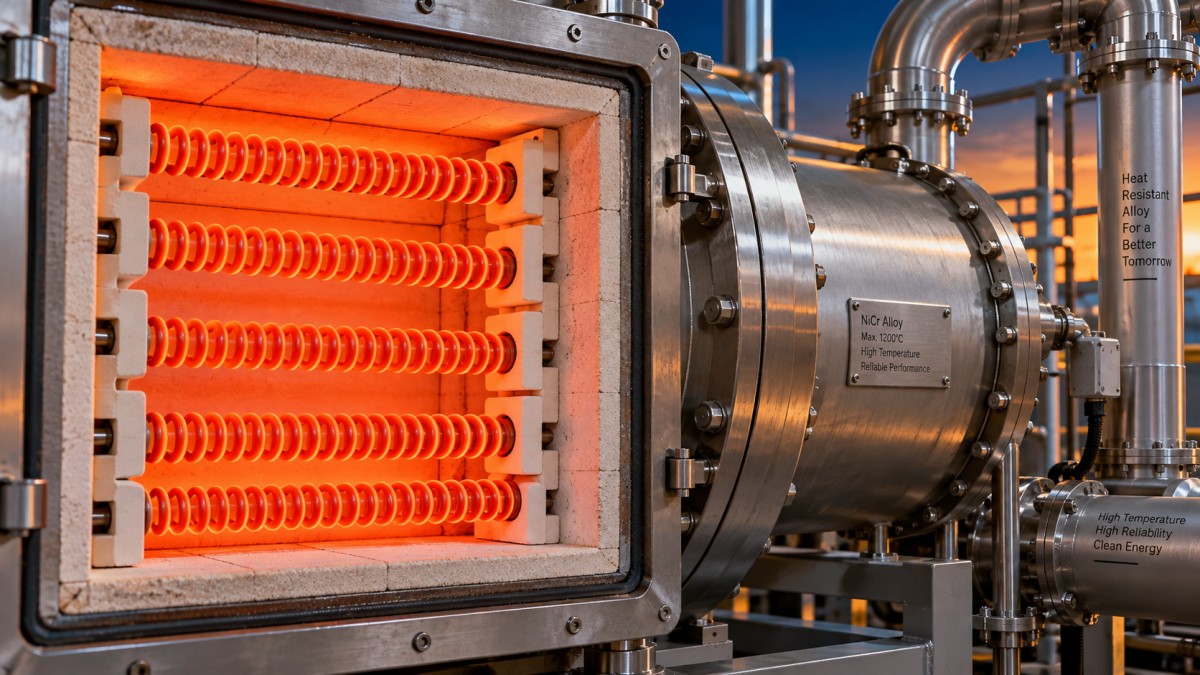
In aggressive chemical or high-temperature gas environments, buyers may also need corrosion-resistant structural components around the heater. Materials such as Hastelloy Alloy Tubes are relevant to equipment sections that require resistance to corrosive media as well as elevated-temperature strength. They are not a substitute for resistance wire, but they can be part of a durable assembly in reactors, heat exchangers, gas-handling equipment, or specialized thermal systems.
Electrical design is where good materials can still fail
Even an appropriate alloy will not compensate for an element designed with excessive surface loading. When watt density is too high, local hot spots develop. Those areas oxidize faster, resistance changes unevenly, and the coil may sag or fracture well before the rest of the element has aged. Tight coil pitch, poor terminal connections, restricted airflow, and contact between turns can produce the same result.
A sound evaluation should therefore connect the wire’s resistivity with the required voltage, target power, finished diameter, coil geometry, and usable heated length. The supplier should be able to identify the wire condition and tolerances, while the heater designer should confirm the electrical calculation. It is worth checking whether the requested resistance is based on room-temperature values or expected operating behavior; confusing the two can lead to an element that draws the wrong current after installation.
Thermal cycling deserves similar attention. A heater that runs continuously at a steady load may tolerate one design, while a system that starts and stops many times a day places more stress on the wire, supports, and terminations. Repeated expansion and contraction can gradually change coil pitch or create stress concentrations at bends. For heavily cycled equipment, mechanical ductility, fatigue behavior, and careful forming practice are not minor details.
When standard materials are still a sensible choice
Alloy wire is not automatically the premium answer to every heating task. If the operating temperature is relatively low, the atmosphere is clean, element replacement is easy, and the duty cycle is light, a simpler material may provide acceptable service at lower initial cost. Overspecifying a high-performance alloy can add expense without correcting a real operating problem.
The case for a more capable alloy is strongest when one or more of the following conditions apply:
- The element runs at a high temperature or experiences frequent thermal cycling.
- Oxidation, corrosive vapors, moisture, or process contamination have caused previous failures.
- Resistance stability and uniform heat output affect product quality or process control.
- Replacement requires shutdown, difficult access, or removal of insulated equipment.
- The design needs fine wire, controlled resistance, or complex formed elements.
In these situations, the lower life-cycle risk can justify a more carefully specified wire even when its purchase price is higher. The important point is to compare complete operating cost, not only material cost.
What to ask before approving an alloy wire source
A quotation that lists only alloy name, diameter, and weight leaves too many open questions. Buyers should ask for the proposed chemistry or recognized grade, wire diameter tolerance, resistance tolerance, delivery condition, coil or spool format, and available inspection documentation. If the wire will be wound into small-diameter coils, confirm its formability in the supplied condition rather than assuming that all wire of the same nominal alloy behaves alike.
Traceability also matters when the heater is part of controlled industrial equipment. Material certificates, heat identification, and inspection scope should be agreed before the order is released, especially where the design references a customer specification or a particular standard. A standard designation alone does not define every practical requirement; dimensions, tolerances, surface condition, and testing expectations still need to be stated.
Suppliers with experience across nickel-based, iron-based, precision, corrosion-resistant, and heat-resistant alloy families can be useful during this stage because the problem may extend beyond the wire itself. Shandong Titanium Nickel Special Steel Co., Ltd. works with a broad range of special alloy materials, including nickel-based and iron-based grades, INCONEL, INCOLOY, Monel, titanium, zirconium, and related high-temperature materials. For a complex thermal assembly, that wider material perspective can help identify mismatches between the element and its surrounding components.
A practical selection path
Before finalizing Alloy Wire, document the maximum expected element temperature, not just the process temperature; identify the atmosphere and likely contaminants; calculate the required resistance and surface load; then review how the coil will be formed, supported, connected, and replaced. If there has been a previous failure, inspect the failed element before ordering the same grade again. A localized break, uniform thinning, heavy scale, sagging, or terminal damage each points to a different root cause.
The right wire is the one that fits the actual thermal, electrical, chemical, and mechanical conditions with reasonable margin. That is a more disciplined choice than selecting the highest-temperature alloy on a datasheet—and usually a better route to a heating element that stays stable in service.
