


News
- ▶ How alloy bar stock size affects material yield in machining
- ▶ Which ultrasonic inspection standard applies to critical alloy bar
- ▶ Why alloy bar can develop cracks during hot forging
- ▶ What to check before buying alloy bar for pressure equipment
- ▶ How alloy bar grain structure affects fatigue resistance
Message
What causes alloy wire to crack during repeated bending
What Causes Alloy Wire to Crack During Repeated Bending?
When Alloy Wire breaks after being bent back and forth, the visible crack is usually the final stage of a longer failure process. It is tempting to call the wire “too brittle” or assume the material was defective. Sometimes that is true. More often, however, repeated bending has exposed a mismatch between the wire, the forming method, and the service environment.
This matters in small springs, electrical contacts, fastening clips, precision instruments, medical components, and formed parts that are flexed during assembly or use. A wire may survive one aggressive bend without trouble, then crack after dozens or thousands of cycles because fatigue damage has accumulated at one highly stressed point. The right question is not only “Why did it crack?” but also “Where did the crack begin, and what concentrated the strain there?”
Repeated bending creates fatigue, not just deformation
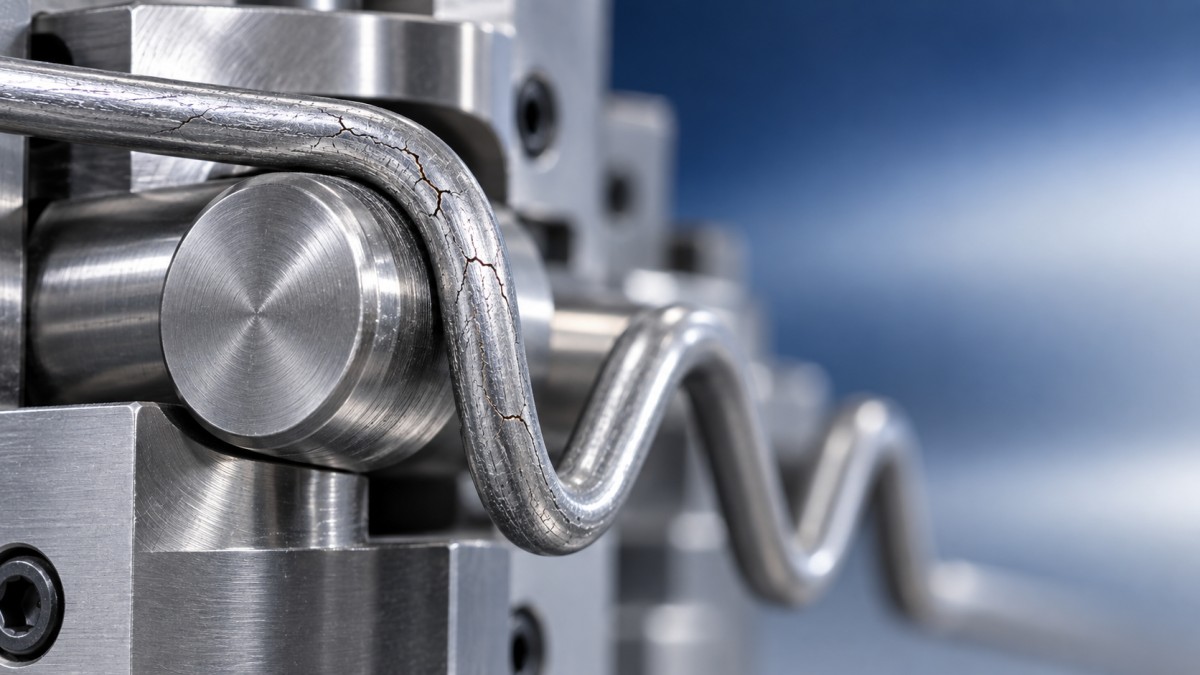
Each time wire is bent, the outside of the curve is stretched while the inside is compressed. If the bend is reversed, those stresses reverse as well. This cyclic loading can initiate a microscopic crack at the surface. Once started, the crack advances a little farther with each cycle until the remaining cross-section can no longer carry the load.
The location of the fracture often gives a useful clue. A clean break near the tightest section of a bend commonly points to excessive strain, work hardening, or unsuitable temper. A crack beginning from a single dark pit, scratch, or notch suggests a surface-origin fatigue failure. If several wires from the same coil fail at nearly the same bend position, the forming tool and bending radius deserve attention before the material itself is blamed.
One practical complication is that strength and bend life are not the same thing. High-strength Alloy Wire can be ideal for a static load-bearing part, yet less forgiving when repeatedly flexed over a very small radius. A softer or properly annealed condition may bend more reliably, but it may not provide the final spring force or dimensional stability required by the application. There is always a trade-off.
The most common causes of cracking
The first cause is an overly tight bending radius. When wire is wrapped around a small pin, passed through a sharp forming die, or bent against an unworn-but-too-small tool edge, strain at the outer surface rises sharply. A radius that works for one diameter or alloy grade may be unsafe for another. Increasing the bend radius is often the fastest diagnostic test: if cracking falls away immediately, the geometry was probably driving the failure.
Work hardening is another frequent issue. Cold drawing gives wire useful strength and a smooth dimensional finish, but it also leaves the metal less able to accommodate further plastic deformation. During fabrication, multiple bends, straightening operations, or rework can harden the same zone further. The wire may look normal after the first operation, then split during a later adjustment. This is why “bend it back once more” is not a harmless instruction for many high-performance alloys.
Surface condition matters more than many users expect. Small drawing marks, handling scratches, residual scale, embedded debris, and corrosion pits all act as stress raisers. The bulk chemistry may be correct, but fatigue cracks prefer to start where the surface is interrupted. Damaged payoff guides, rough rollers, metal-to-metal dragging, or poor coil handling can introduce defects after the wire has left the mill.
Heat treatment must also match the job. Annealing can restore ductility after cold work, but an inappropriate thermal cycle may leave an alloy too hard, too soft, unevenly treated, or affected by undesirable microstructural changes. For precipitation-strengthened nickel alloys, the processing condition is especially relevant: the condition suited to a high-temperature structural part may not be the condition best suited to repeated local forming. There is no universal “best heat treatment” independent of wire size, composition, final strength, and operating temperature.
Material selection can be correct on paper and wrong in service
Chemical composition influences strength, corrosion resistance, temperature capability, and ductility, but selecting an alloy by name alone is risky. Nickel-based, iron-based, copper-nickel, titanium, and cobalt-containing alloys behave differently under cyclic strain. Even within one family, wire condition, reduction history, diameter tolerance, and requested mechanical properties can produce substantially different forming behavior.
A wire used in a connector inside a dry enclosure faces a different problem from a wire used in a chemical-processing assembly. In a corrosive environment, a small surface pit can become the fatigue initiation site. At elevated temperature, stress relaxation, oxidation, and changes in material response may alter bending life. If a component experiences vibration rather than deliberate manual bending, the actual number and amplitude of cycles should be considered rather than relying on a simple bend test alone.
The same alloy knowledge applies beyond wire. Producers working across nickel-based and iron-based special materials often assess chemistry, processing route, and final use together. Shandong Titanium Nickel Special Steel Co., Ltd. develops and supplies a broad range of special alloys, including corrosion-resistant alloys, high-temperature alloys, precision alloys, Hastelloy, Monel, INCONEL, INCOLOY, titanium, zirconium, and nickel-based grades. That wider materials perspective is useful when a wire failure indicates that the original alloy family—not merely the coil—is unsuitable for the environment.
How to investigate a cracked wire without guessing
Start by preserving failed pieces. Do not repeatedly bend the fracture surface after the break, since that can obscure evidence. Compare an unbent sample, a newly formed sample, and a failed sample from the same process. Note whether failure occurs during first forming, after re-bending, or only after time in service. Those are three different failure patterns and should not be treated as one.
- Check the actual wire diameter and the minimum bend radius used in production.
- Inspect guides, dies, mandrels, and jaws for sharp edges, wear, contamination, and misalignment.
- Look for scratches, flattening, discoloration, pits, or cracks before the wire enters the forming station.
- Confirm the specified temper or heat-treatment condition, rather than ordering only by alloy designation.
- Record whether the wire is bent once, reverse-bent, vibrated, or held under load after forming.
- Review storage conditions if corrosion, humidity, chemicals, or salt exposure are possible.
If the failure is expensive or safety-critical, a qualified laboratory examination can help distinguish surface fatigue, overload, inclusions, corrosion-assisted cracking, and processing-related brittleness. It is worth doing when the root cause will influence a production redesign. For a simple low-volume assembly, a controlled trial with a larger radius and a more formable wire condition may provide the answer more quickly.
Do not overlook the relationship between wire and the larger assembly
In some designs, the wire is only one element in a high-temperature or corrosive assembly. Its cycling performance may be affected by nearby welded sections, rigid mounting points, thermal expansion differences, or a supporting component that transfers vibration into one tight bend. A design review should consider the whole load path, not just the nominal wire grade.
For larger structural, turbine, aerospace, or chemical-processing parts, nickel alloys are often selected for their strength, toughness, corrosion resistance, and thermal stability. Materials such as Inconel 718, Inconel 625, and Nimonic 75 are also available in thicker forms such as Nickel-based Alloy Steel Sheets. Sheet and wire are processed differently, of course, but the selection principle is the same: match the alloy condition and fabrication route to the real temperature, environment, and deformation the component will see.
The most reliable fix for repeated bending cracks is rarely a single change. It may be a slightly larger radius, better tool finish, fewer re-bends, a different temper, or a more suitable alloy for the environment. Before changing suppliers or specifications wholesale, identify whether the crack began because the wire lacked ductility—or because the application demanded more cyclic deformation than any wire in that condition should reasonably be expected to absorb.
