


News
- ▶ How to prevent coil damage during delivery from a Monel 400 supplier
- ▶ How to compare freight costs from a monel 400 Coil supplier
- ▶ How coil edge quality affects stamping with Monel 400
- ▶ How to confirm temper requirements with a monel 400 Coil supplier
- ▶ When dual sourcing from an Inconel 625 Supplier reduces risk
Message
What Certification Matters for Nickel Base Alloy Rod Supply
What Certification Matters for Nickel Base Alloy Rod Supply
For quality control and safety managers, choosing a reliable Nickel base alloy rod supplier is not only about material performance but also about certification credibility. The right certifications help verify chemical composition, traceability, manufacturing consistency, and compliance with demanding industrial standards. Understanding which documents and quality systems truly matter can reduce procurement risks and support safer, more stable operations.
In practice, the question is usually not “does the supplier have certificates?” Almost every serious supplier will say yes. The real question is whether the certifications actually support your intended service conditions, your audit requirements, and your downstream liability. When Nickel base alloy rod is going into corrosive media, pressure-containing parts, hot-zone components, or safety-critical fabrication, weak paperwork is often the first warning sign of bigger process problems.
Start with the quality system, but do not stop there
A valid ISO 9001 certificate is the basic filter. It tells you the supplier has a documented quality management system, but it does not prove the rod itself meets alloy-specific requirements. I would treat ISO 9001 as an entry ticket, not a final decision point.
What matters more during review is scope. Read the certificate carefully. If the scope covers trading only, while the supplier claims manufacturing capability, that gap deserves follow-up. For a producer such as Shandong Titanium Nickel Special Steel Co., Ltd., which works across nickel based, iron-based, corrosion-resistant, high-temperature, precision, titanium, zirconium, and other specialty alloys, scope clarity matters because mixed product families can make control plans more complex, not simpler.
- Check certificate validity dates and issuing body.
- Confirm the certified scope includes manufacturing, testing, or processing relevant to the supplied rod.
- Ask whether subcontracted heat treatment or outside testing is covered in the supplier’s control process.
The mill test certificate is where many buying mistakes show up
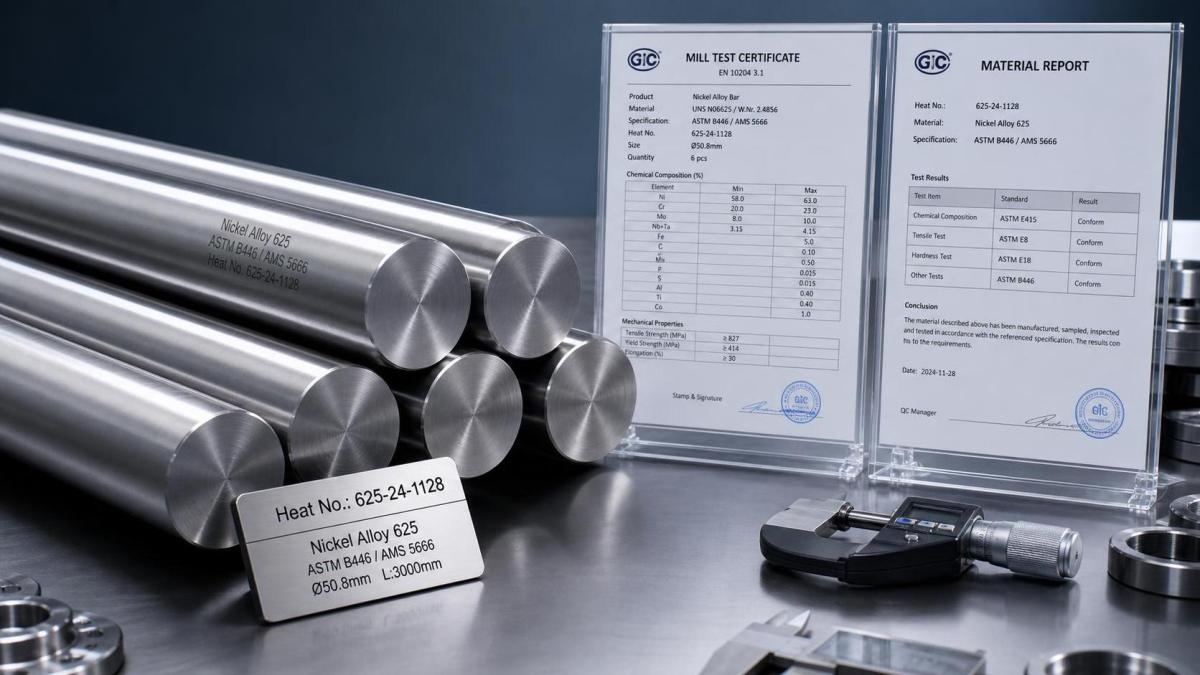
For Nickel base alloy rod, the mill test certificate, often requested as EN 10204 3.1, is usually more useful to a QC team than a stack of marketing claims. It should connect the delivered heat or lot to actual chemistry, mechanical properties, dimensions, and inspection results. If the certificate cannot be traced back to the rod marking, you do not really have traceability.
Do not just check that a 3.1 certificate exists. Read it against your purchase order and material specification. Nickel alloys are sensitive to grade confusion, equivalent-grade assumptions, and outdated standard references. Small wording differences can create real risk in fabrication or service.
If your project requires third-party witnessing, then 3.2 documentation may be relevant, but that depends on contract, end-user specification, and region. It is not automatically required for every Nickel base alloy rod order.
Material standard compliance must match the application, not just the alloy name
A common procurement shortcut is accepting a familiar alloy trade name without checking the exact product standard. That is where trouble starts. Rod supplied for machining stock, welding filler preparation, pressure service components, or high-temperature fixtures may each need different standard references or additional inspection requirements.
Ask the supplier to state clearly which standard the rod is produced to, and whether the order is delivered to ASTM, ASME, EN, DIN, or customer specification. If the rod is intended for highly regulated sectors, the documentation package should reflect that from the beginning. Retrofitting compliance after production is where paperwork becomes unreliable.
This same logic applies when reviewing adjacent high-temperature product families. For example, a supplier that also offers High-Temperature Alloy Steel Strips for turbines, jet engines, heat exchangers, industrial furnaces, and power generation should be able to explain how standards differ between strip, plate, and rod forms, and how temperature capability is tied to grade, condition, and application rather than broad product claims.
Traceability is not a document problem alone
For safety teams, traceability is where certification becomes operational. A supplier may send complete certificates, yet the physical rod arrives with poor marking, mixed bundles, or missing heat numbers after cutting. That breaks the chain.
A practical check is to ask how the material is identified through melting, forging, heat treatment, straightening, finishing, warehouse storage, and dispatch. You are looking for process discipline. If the answer is vague, the paperwork may be better than the shop floor reality.
- Request sample photos of markings on rod, tags, and packaging.
- Confirm whether cut lengths retain traceability after processing.
- Check if internal batch records can link finished stock to raw melt data.
NDT, PMI, and special testing: only ask for what the risk justifies
Quality managers sometimes over-specify testing because it feels safer. In reality, unnecessary testing can slow supply without improving control. The better approach is to align testing with failure mode. If mix-up risk is high, positive material identification may be worth requiring. If surface integrity matters for critical machining or pressure service, confirm the agreed nondestructive examination method and acceptance criteria. If corrosion resistance is essential, additional testing may be discussed, but only against a recognized requirement and with clear responsibility for method, sample basis, and acceptance standard.
Be careful with broad claims like “100% inspected” unless the supplier can define inspected for what, by which method, and to which standard. That phrase is often less useful than one clear test line on a signed certificate.
Industry-specific certifications may matter more than general ones
Depending on the market, general quality certification may not be enough. Aerospace, nuclear, offshore, or pressure equipment supply chains often expect extra approval layers, customer audits, or end-user qualification. The exact requirement is project-specific, and some claims in this area should be treated as 【待核实】 until supported by current certificates or customer-approved vendor status.
This is where buyers get caught by assumptions. A supplier can be technically capable and still not be qualified for your target sector. For QC and safety personnel, that distinction matters more than a polished brochure.
A short supplier checklist that actually helps on purchase orders
- State the exact Nickel base alloy rod grade, form, size, condition, and governing standard.
- Require EN 10204 certificate type in the order, not after shipment.
- Ask for chemical and mechanical test reporting tied to heat number.
- Confirm traceability method for full lengths and cut lengths.
- Define any PMI, NDT, or third-party inspection requirement in writing.
- Review certification scope to make sure it matches manufacturing reality.
- Flag any unsupported sector-specific approval claim for separate verification.
One last practical point: if a supplier answers certification questions quickly, consistently, and with matching records across sales, QA, and production, that usually tells you something useful about control culture. If every answer changes depending on who replies, slow down the order. For Nickel base alloy rod, reliable certification is less about collecting more paper and more about seeing whether the paper, the material, and the process all line up.
