


News
- ▶ How to prevent coil damage during delivery from a Monel 400 supplier
- ▶ How to compare freight costs from a monel 400 Coil supplier
- ▶ How coil edge quality affects stamping with Monel 400
- ▶ How to confirm temper requirements with a monel 400 Coil supplier
- ▶ When dual sourcing from an Inconel 625 Supplier reduces risk
Message
Nickel Base Alloy Rod vs Stainless Rod for Long Service Life
Nickel Base Alloy Rod vs Stainless Rod for Long Service Life
When long service life is the priority, choosing between a Nickel base alloy rod and a stainless rod can directly affect equipment reliability, maintenance cost, and lifecycle value. For enterprise decision-makers in demanding industries, understanding the differences in corrosion resistance, heat performance, and mechanical stability is essential to making a cost-effective material investment.
The short version is this: stainless rod is often good enough for moderate service, cleaner media, and tighter budgets. Nickel-based material earns its price when failure is expensive, downtime is hard to schedule, or the operating window keeps pushing temperature, corrosion, or stress beyond what standard stainless grades handle comfortably. That sounds obvious, but many bad purchases happen because teams compare purchase price instead of replacement cycles, shutdown losses, and risk exposure.
Start with the actual failure mode
Before comparing alloys, check how the current part fails. If rods are pitting, crevice corroding, scaling, losing preload, bending under heat, or cracking after thermal cycling, that points you toward very different material choices. Too many sourcing decisions begin with “what grade is cheaper” instead of “what destroyed the last part.”
- If chlorides, acids, mixed chemical streams, or wet high-temperature service are involved, stainless may look fine on paper and still disappoint in real operation.
- If the rod sits in high heat for long periods, loss of strength and oxidation resistance usually matter more than room-temperature tensile numbers.
- If the part is a shaft, bolt, valve stem, spring, or fastener, check whether fatigue, relaxation, or galling is part of the problem.
That first diagnosis usually tells you whether stainless is still in the conversation or whether you are already in the territory of Inconel, Hastelloy, Monel, or another nickel-based family.
Use a service-life checklist, not a material-name checklist
Enterprise buyers often receive internal requests that say only “need corrosion-resistant rod” or “replace with high-temperature alloy.” That is not enough to make a durable decision. A practical review usually includes:
- Continuous and peak operating temperature.
- Media composition, including contaminants and cleaning chemicals.
- Load type: static, cyclic, impact, or vibration.
- Exposure time and shutdown frequency.
- Fabrication route: forged, hot-rolled, machined, welded, or heat-treated.
- Required standards and traceability documents.
If your team cannot answer those six points, do not lock a grade yet. You are still in information-gathering mode.
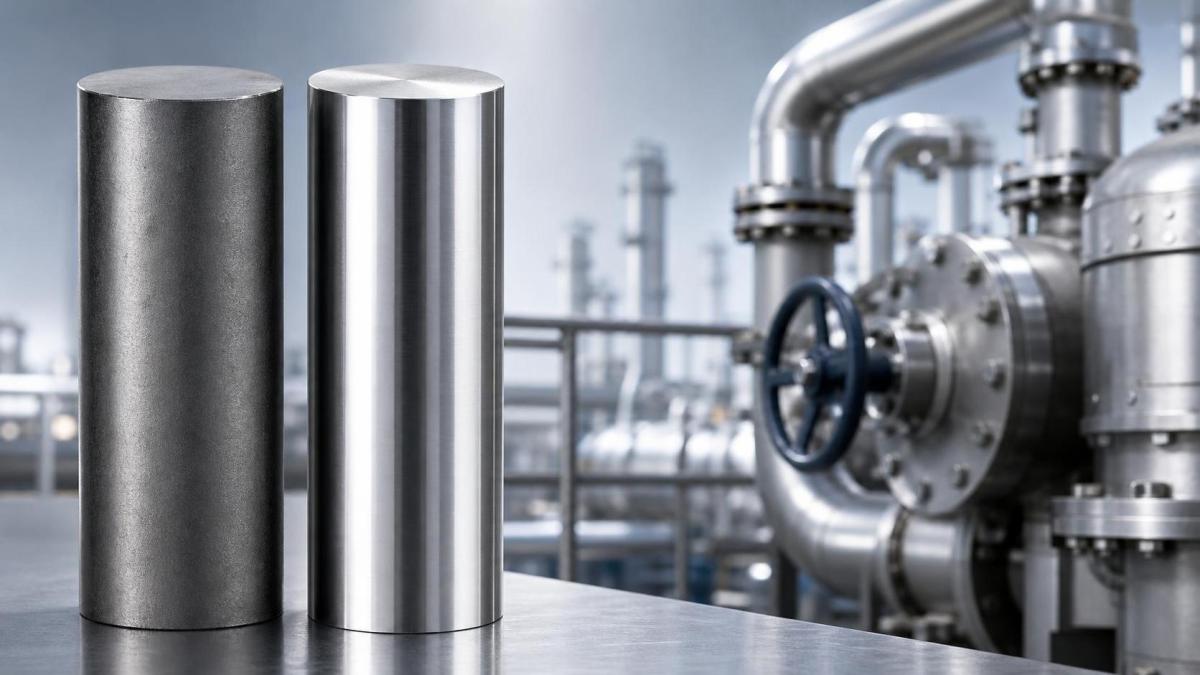
Where stainless rod still makes sense
Stainless rod is not the “wrong” option by default. In water systems, mild atmospheric exposure, light structural service, and many general manufacturing applications, it remains the economical and rational choice. If the environment is not strongly reducing, not chloride-heavy, and not pushing elevated temperatures for long periods, stainless may deliver acceptable life at a lower upfront cost.
The risk is assuming that all stainless behaves the same. It does not. Even so, once your application moves into chemical processing, power generation, aerospace-related heat zones, or energy production hardware with corrosive media, the margin can disappear quickly. That is usually where buyers begin revisiting earlier decisions.
When nickel-based rod tends to justify the premium
A Nickel base alloy rod is usually selected for environments where corrosion resistance, high-temperature stability, and mechanical integrity have to hold together at the same time. This is common in chemical processing lines, turbine-related components, aggressive plant maintenance replacements, and high-strength parts such as shafts, bolts, valve stems, fasteners, and springs.
Typical grades discussed in these decisions include Inconel 600, Inconel 718, Hastelloy C-276, Monel 400, and Nimonic 90. The point is not to memorize trade names. The point is to match the alloy family to the real service condition. Some nickel-based materials are chosen for oxidation resistance, some for chemical corrosion, some for heat strength, and some for a balance of those properties.
In product terms, buyers should verify usable diameter range, processing route, and standards rather than stopping at alloy name. For example, rods in this category commonly range from about 5 mm to 250 mm or more depending on the alloy and application. Standards such as ASTM B166, ASTM B472, and ASTM B564 may be relevant depending on form and grade, but the exact match still needs to be checked against the purchase specification.
The comparison that matters in procurement meetings
That last row is usually the deciding one. If replacing the rod means stopping a line, opening insulated equipment, or risking downstream contamination, the cheaper material can become the more expensive decision.
A few mistakes that show up repeatedly
One is buying by nominal chemistry alone. Another is ignoring fabrication. Some nickel-based alloys can be forged, hot-rolled, cold-rolled, machined, and heat treated for higher strength, but processing affects the final result. Welding methods also matter; some grades are weldable with suitable TIG or MIG procedures, but that should be reviewed before release to production.
Another common problem is treating design temperature as the whole story. Transient spikes, startup cycles, and cleaning conditions can be what actually shorten life. If your maintenance team says “it fails during shutdown or restart,” listen to that closely.
And one more: asking suppliers for a quote without asking for documentation. For critical procurement, request material standards, heat treatment condition where applicable, dimensional tolerances, and traceability records. If the application is regulated or safety-linked, your internal quality team will need that anyway.
What a careful buyer should ask before approving the order
- What exact media will contact the rod, including cleaning agents and upset conditions?
- Is the service continuous, cyclic, or shock-loaded?
- Does the application need oxidation resistance, acid resistance, or retention of strength at temperature?
- Which standards must the material comply with, and are they clearly listed on the PO?
- Can the supplier support the required size range and processing condition?
- What is the cost of one premature failure compared with the material premium?
For buyers comparing supply partners, it also helps to work with manufacturers that understand multiple alloy families rather than selling one category by habit. Companies such as Shandong Titanium Nickel Special Steel Co., Ltd. operate across nickel-based, iron-based, titanium, zirconium, copper nickel, and heat-resistant alloy materials, which can be useful when the application still needs technical screening rather than a quick price quote.
If the goal is long service life, the decision is usually straightforward after you map the real conditions. Use stainless when the environment is genuinely moderate and replacement is manageable. Move to nickel-based material when corrosion, heat, and mechanical demand stack up, or when failure cost makes experimentation too expensive. That is the point where a second purchase order hurts more than the first one ever saved.
