


News
- ▶ How to prevent coil damage during delivery from a Monel 400 supplier
- ▶ How to compare freight costs from a monel 400 Coil supplier
- ▶ How coil edge quality affects stamping with Monel 400
- ▶ How to confirm temper requirements with a monel 400 Coil supplier
- ▶ When dual sourcing from an Inconel 625 Supplier reduces risk
Message
Nickel Base Alloy Rod in Welding: Common Failure Causes
Nickel Base Alloy Rod in Welding: Common Failure Causes
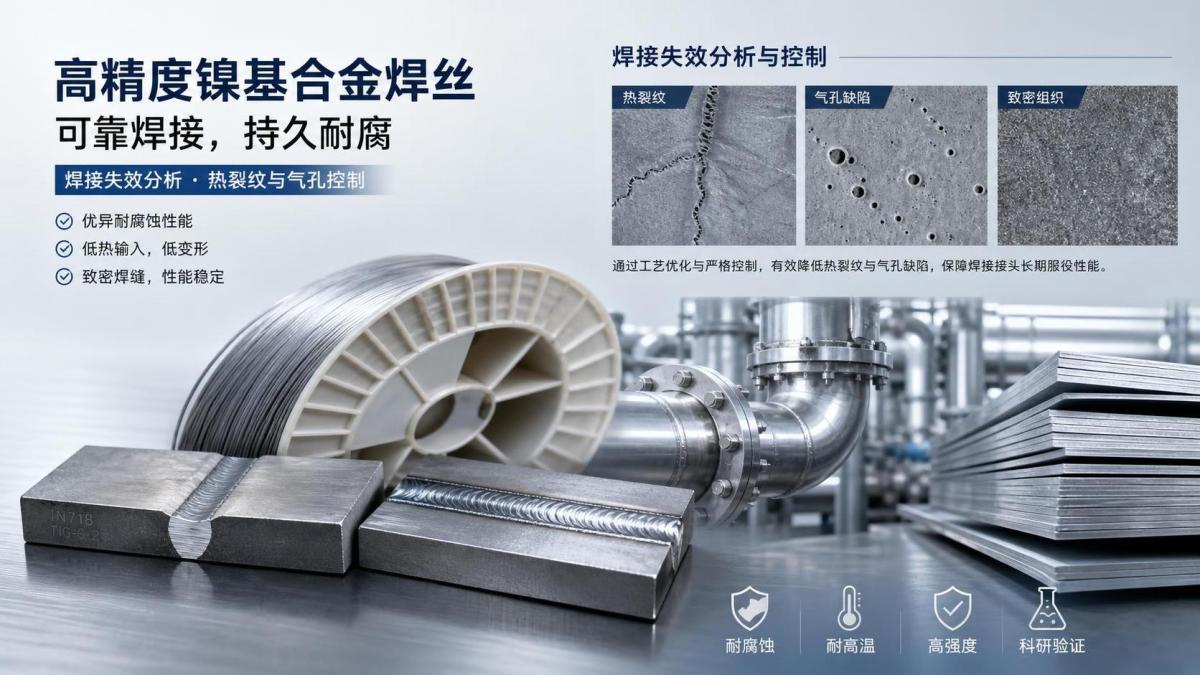
When a weld made with Nickel base alloy rod fails, the root cause is rarely dramatic. More often, it starts with something small that looked acceptable at the bench: a joint that was not fully cleaned after grinding, a heat input that seemed manageable but held the puddle too long, or a filler metal chosen by matching base metal names rather than service chemistry. In nickel alloy work, those decisions tend to show up later as hot cracking, porosity, lack of fusion, or premature corrosion at the weld zone. That is why experienced fabricators do not judge these welds only by appearance. They judge them by how the joint will behave in chloride-bearing process media, cyclic thermal exposure, or prolonged elevated-temperature service.
The first distinction worth making is between welds that fail during fabrication and welds that fail in service. Shop-floor defects are usually easier to trace. Porosity often points back to contamination: oil, moisture, paint residue, sulfur-bearing marking compounds, or even handling dirt embedded near the groove face. Nickel alloys are less forgiving here than many carbon steels. A bead can look smooth and still trap gas if the joint edges were not cleaned to bright metal and kept isolated from carbon steel tooling contamination. On repair jobs, this gets worse because the original component may already carry process deposits. Welders sometimes remove visible scale and assume the surface is ready; the problem is the invisible residue left in pits, root gaps, and heat-affected corners.
Cracking is a different conversation. With Nickel base alloy rod, many operators immediately blame the filler, but field experience usually shows a combination of restraint, dilution, and arc control. If the joint design creates high restraint and the welder uses excessive weaving or prolonged dwell, the solidifying weld metal spends longer in a vulnerable temperature range. That is where solidification cracking becomes more likely, especially in dissimilar joints or repairs on aged components. Narrow stringer beads, controlled interpass temperature, and careful fit-up matter more than people expect. A poor root opening or inconsistent land thickness can push the welder to chase penetration with extra heat, and that is often where sound procedure starts to drift.
Service failures demand a more disciplined reading of the environment. A weld that performs well in dry high-temperature duty may not survive a mixed chemical stream with temperature cycling and shutdown condensation. In chemical processing, one of the common mistakes is selecting filler metal around strength or nominal alloy family without enough attention to corrosion mode. Pitting, crevice attack, and attack in reducing or oxidizing acid environments can shift the right choice. That is one reason engineers working around aggressive media often compare weldability decisions with adjacent corrosion-resistant materials used elsewhere in the system, including strip, plate, and lining components. In some fabrications, Hastelloy Alloy Strips are used for formed sections, cladding transitions, or corrosion-resistant assemblies where weldability and post-fabrication dimensional control both matter. The logic is not that strip products replace filler selection, but that the same service environment usually forces a broader material compatibility check.
Where Weld Quality Usually Starts to Drift
The problem is often upstream of welding itself. Material condition changes the whole job. Nickel alloy components that have been heavily cold worked, improperly stored, or repeatedly heated during prior repairs can respond differently from fresh stock. Surface oxide color can mislead operators into thinking the metal only needs light brushing, when in fact the oxide film has become tenacious enough to interfere with wetting and fusion. On thin sections, distortion control also becomes part of defect prevention. The welder trying to keep a panel flat may reduce heat too far and create incomplete fusion at the sidewall. The welder trying to avoid lack of fusion may overcompensate and overheat the joint. Neither problem is unusual.
Another point that gets underestimated is the difference between procedure qualification conditions and actual plant conditions. A procedure may run cleanly in the workshop with stable ambient temperature, controlled prep, and ideal access. The same Nickel base alloy rod can behave differently on a shutdown repair where the welder is working overhead, the component is heat-soaked from nearby equipment, and access forces shorter torch angles. That gap between qualified conditions and site conditions is where many recurring weld problems live. It is also why experienced supervisors pay attention to mock-up relevance, not just paperwork completeness.
Material Choice Is Part of Failure Prevention
Not every nickel alloy application fails for welding reasons alone. Sometimes the weld exposes a deeper mismatch between alloy selection and service duty. In equipment handling acidic streams or chloride-bearing fluids, the weld metal and adjacent heat-affected zone can become the first visible weak point simply because they experience the harshest metallurgical change. Material systems built around nickel-molybdenum-chromium chemistry are often chosen for that reason: they keep corrosion resistance under demanding process conditions while still allowing fabrication into workable forms. For example, Hastelloy grades such as C-276, C-22, and B-2 are commonly evaluated where corrosion resistance and high-temperature oxidation resistance need to coexist with forming and joining requirements. In strip form, thicknesses from 0.1 mm to 5 mm can suit ductwork, liners, transition pieces, and formed assemblies that later require careful welding. Standards such as ASTM B575 and AMS 5580 are relevant references for those product forms, but they do not replace the need to verify joint procedure against the service environment.
That matters in sectors like chemical processing, aerospace, and power generation, where the same family of alloy may face very different constraints. Aerospace fabrication may be dominated by dimensional accuracy, fatigue exposure, and process control discipline. In power generation, thermal cycling and oxidation resistance can move to the front of the discussion. Chemical service often brings the hardest questions because media composition, upset conditions, and maintenance intervals can change what counts as an acceptable weld. A joint that survives normal operation may still suffer if cleaning chemicals, startup condensate, or stagnant shutdown conditions were overlooked during filler selection.
Shandong Titanium Nickel Special Steel Co., Ltd. works across nickel based, iron-based, and other special alloy systems, so one practical lesson from this broader materials background is that welding decisions should not be isolated from the rest of the fabricated assembly. When adjacent components use corrosion-resistant strip, tube, rod, or plate from different alloy families, the transition zones deserve extra scrutiny. That is particularly true when the assembly includes high-temperature alloys, Monel, INCONEL, INCOLOY, titanium alloys, or zirconium alloys in related service systems, because contamination control and filler compatibility become more sensitive than a simple alloy label suggests.
A sound review usually comes down to a few hard questions: What is the real service environment, including shutdown and cleaning conditions? How much restraint does the joint carry in the as-built condition? Is the filler chosen for weldability only, or for long-term corrosion and temperature exposure as well? And were the shop assumptions still true when the work reached the site? Those checks do more to prevent failure with Nickel base alloy rod than any visual acceptance after the weld is already finished.
