


News
- ▶ How to prevent coil damage during delivery from a Monel 400 supplier
- ▶ How to compare freight costs from a monel 400 Coil supplier
- ▶ How coil edge quality affects stamping with Monel 400
- ▶ How to confirm temper requirements with a monel 400 Coil supplier
- ▶ When dual sourcing from an Inconel 625 Supplier reduces risk
Message
Best Precision Alloy Bars for High Temperature Tooling
Best Precision Alloy Bars for High Temperature Tooling
For project managers and engineering leaders sourcing materials for extreme heat applications, choosing the right Precision Alloy Bars is critical to tooling performance, dimensional stability, and service life. With broad expertise in high-temperature and specialty alloys, Shandong Titanium Nickel Special Steel Co., Ltd. delivers reliable alloy solutions designed to meet demanding industrial specifications while supporting efficiency, consistency, and long-term project success.
Where most tooling projects go wrong is not at peak temperature, but in the gap between nominal temperature and actual service conditions. A bar that looks acceptable on a data sheet can still distort in service if the tool sees repeated thermal cycling, edge loading, intermittent oxidation, or local hot spots near burners, dies, or induction zones. That is why Precision Alloy Bars are not usually judged only by strength. In high temperature tooling, engineers are really balancing three things at once: shape retention, surface stability, and how the alloy behaves after many heat-up and cool-down cycles rather than one clean laboratory exposure.
This becomes obvious in hot forming tools, furnace fixtures, mandrels, support pins, guide elements, and heat-exposed machine parts. Some of these components carry load continuously. Others fail because they do not carry load evenly. In both cases, the alloy bar selection affects whether the tool keeps tolerance or starts drifting just enough to create downstream scrap, sticking, galling, or frequent re-machining. In practice, dimensional stability often matters more than headline tensile values, especially where tooling has to return to the same position cycle after cycle.
Why Heat Exposure Alone Is Not the Whole Story
A common mistake is to treat all high-temperature tooling as one category. It is not. A fixture in a controlled furnace atmosphere behaves differently from a die insert exposed to scale, abrasive debris, and rapid temperature swings. Likewise, tooling used in chemical process units may see lower mechanical load but harsher corrosion, which changes the material decision completely. Precision Alloy Bars used in these settings must be matched to the dominant failure mode. If the real risk is creep, oxidation resistance alone is not enough. If the problem is thermal fatigue, a strong alloy that cannot handle repeated expansion and contraction may still fail early.
In workshops and plant retrofits, another factor appears: machining and replacement constraints. Some users want maximum heat resistance, but the component geometry, lead time, or machining capacity may point toward a more workable alloy that still meets the thermal requirement. That trade-off is normal. The stronger technical choice is the one that survives the actual duty cycle and can be manufactured consistently, not the one with the most impressive alloy family name.
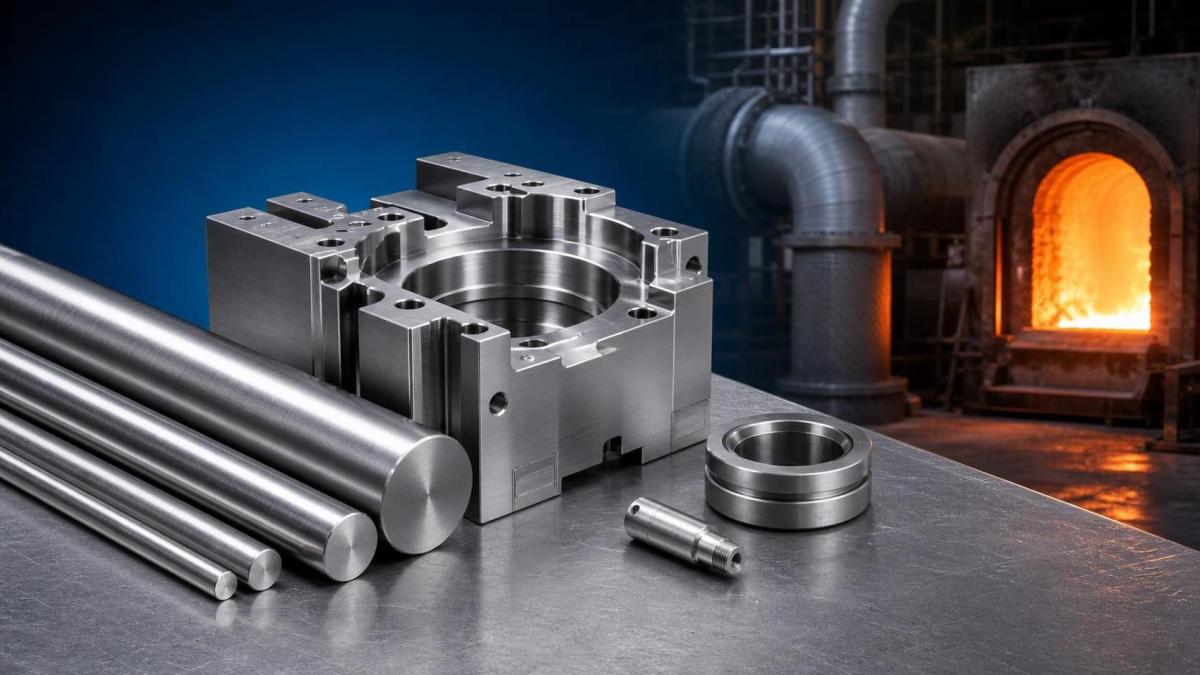
This is also where adjacent components matter. In several high-temperature assemblies, bars are not working alone; they interface with tubes, liners, or flow-carrying sections that expand at different rates. In those systems, material pairing can be as important as the individual bar grade. For example, where tooling is integrated near heated transfer lines, combustion sections, or thermal process equipment, engineers may review compatible high-temperature flow components such as High-Temperature Alloy Tubes to avoid mismatch in thermal behavior and corrosion performance across the assembly.
The Difference Between Hot Forming and Furnace Tooling
Hot forming tooling usually punishes the surface first. Contact pressure, scale, intermittent lubrication, and local temperature gradients combine to damage the exposed working face while the core is still carrying load. In that setting, Precision Alloy Bars are often evaluated for how well they resist oxidation, whether they hold a machined edge, and how quickly distortion shows up after repeated production runs. A bar that performs well in a stable soak environment may not perform the same way when only one side of the tool is heated and cooled repeatedly.
Furnace tooling is a different conversation. Here, geometry creep, sagging, and long-term scaling are usually more important than impact or localized wear. Support rails, trays, grids, and positioning elements can fail slowly and still become expensive because they alter product positioning before anyone notices. In those cases, engineers often care less about room-temperature machinability and more about whether the alloy keeps stiffness and section integrity over long campaigns. This is where nickel-rich and iron-nickel based precision materials are often considered seriously, especially if the tooling must remain dimensionally repeatable across long thermal exposure.
The decision becomes even narrower when atmosphere changes. An oxidizing furnace, a reducing atmosphere, and a chemical process heater do not attack the same way. The same bar can be reliable in one line and disappointing in another. That is why experienced buyers ask about atmosphere, cycle length, support span, restraint points, and shutdown frequency before asking about price.
What Engineers Usually Check Before Finalizing a Bar Grade
That checklist sounds basic, but it filters out many poor decisions. In real projects, users often begin with temperature range only. Yet a part operating at a moderate but continuous high temperature may need more creep resistance than a part that sees a higher short-duration temperature spike. Shandong Titanium Nickel Special Steel Co., Ltd. works across nickel-based, iron-based, corrosion-resistant, and heat-resistant alloy systems, so the practical question is usually not whether one alloy family is broadly “better,” but which family fits the way the tooling is actually used.
Where Related Components Influence the Choice
Tooling rarely sits in isolation. In aerospace thermal systems, power generation units, chemical plants, and steam service equipment, bars may be installed close to tubes, heat exchangers, reactor internals, or fuel line supports that operate within 650°C to 1000°C. When those adjacent parts are made from materials such as Inconel, Hastelloy, Incoloy, or Waspaloy, engineers often look for thermal compatibility rather than chasing a single premium grade everywhere. Components like High-Temperature Alloy Tubes, available in diameter ranges from 10 mm to 500 mm and wall thickness from 0.5 mm to 25 mm or more, are typically chosen for oxidation resistance and thermal stability in flow or containment duties; that same system logic can influence the bar material used in supports, guides, and tooling interfaces nearby.
This matters most in assemblies where one part grows thermally faster than the other. A bar that is excellent on its own can still create binding or positional drift if it is paired poorly with neighboring hot-section hardware. Engineers who have dealt with repeated shutdown repairs usually pay attention to this early, because alignment problems in high-temperature service rarely stay small.
Questions Worth Settling Before Ordering
Before specifying Precision Alloy Bars, it helps to settle a few points that are often left vague in RFQs: Is the operating temperature continuous or cyclical? Is the tooling load static, bending, or impact-driven? Will the surface see scale, sulfur-bearing gases, or aggressive process residue? Is the replacement philosophy based on long campaign life or easy scheduled swaps? Those answers change the recommendation more than many buyers expect.
The best selection process is usually a narrow one: define the failure mode you are trying to prevent, confirm the actual service window, then match the alloy bar to that duty instead of to a generic “high temperature” label. That approach avoids overbuying in mild conditions and avoids under-specifying in the applications that quietly destroy tooling through creep, oxidation, or thermal fatigue.
