


News
- ▶ How to prevent coil damage during delivery from a Monel 400 supplier
- ▶ How to compare freight costs from a monel 400 Coil supplier
- ▶ How coil edge quality affects stamping with Monel 400
- ▶ How to confirm temper requirements with a monel 400 Coil supplier
- ▶ When dual sourcing from an Inconel 625 Supplier reduces risk
Message
Nickel Alloy Price: What Affects The Cost?
Nickel alloy pricing starts with the grade, not the nickel headline
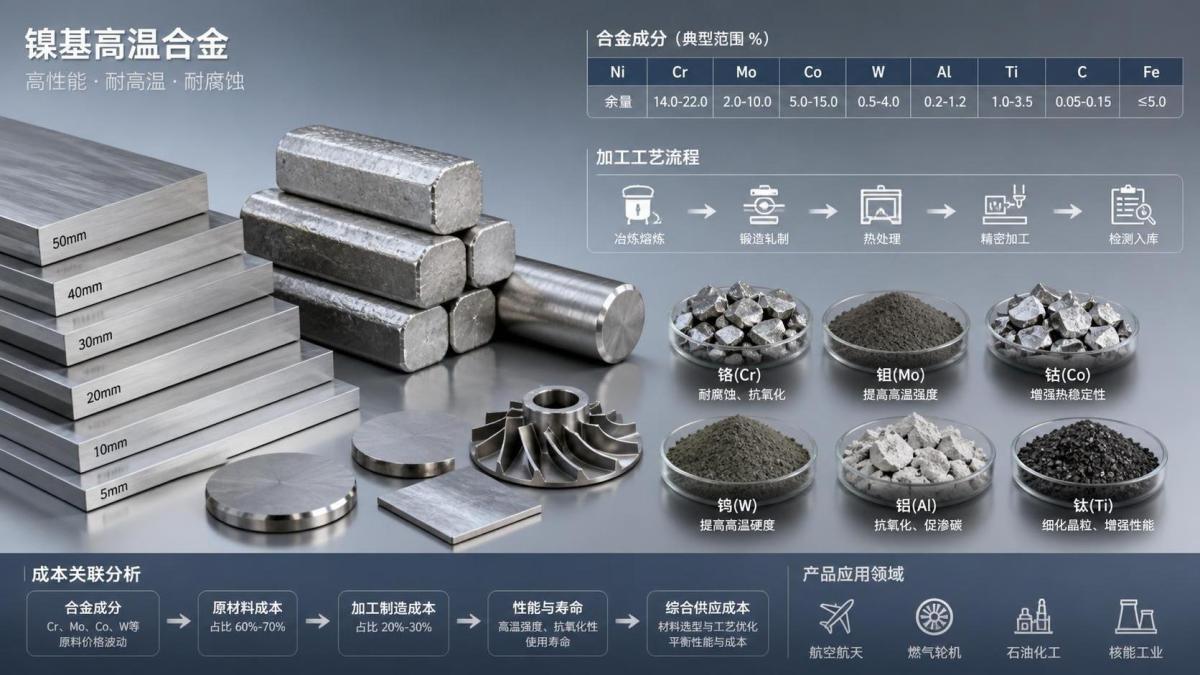
Nickel alloy price is influenced by far more than a daily movement in the nickel market. Buyers often begin with the exchange price of primary nickel, which is understandable, but that number is only one input into a finished alloy product. The final quotation can also reflect chromium, molybdenum, cobalt, copper, iron, and smaller additions that are critical to a grade's corrosion resistance, high-temperature strength, weldability, or stability.
That distinction matters most when comparing materials that appear similar in a purchasing description. A nickel-based alloy for chloride-bearing chemical service, for example, may contain a meaningful molybdenum content and require more tightly controlled chemistry than a general high-nickel stainless material. A high-temperature alloy used near a turbine, furnace, or heat-exchanger hot zone may require specific heat treatment and mechanical-property verification. Neither should be evaluated by nickel content alone.
For procurement teams, the practical question is not simply, “What is the nickel alloy price per kilogram?” It is: “What material condition, specification, documentation, processing route, and delivery risk are included in this price?”
Raw materials set the direction, but alloying elements set the spread
Nickel remains a major cost driver for many grades, especially when its market price changes sharply. However, nickel alloy prices can move differently from pure nickel because the alloy surcharge depends on the full composition. Molybdenum, cobalt, chromium, copper, and sometimes specialty additions may have their own supply constraints and price cycles. In certain corrosion-resistant or heat-resistant grades, these elements can materially affect the total cost even when nickel prices are relatively stable.
Grade selection therefore has a larger impact than many early-stage budgets assume. Hastelloy-type materials are commonly selected for severe corrosion service because of their resistance to reducing acids, chlorides, or mixed chemical environments, depending on the specific grade. Inconel and Incoloy families are often considered where oxidation resistance, creep strength, and thermal cycling matter. Monel alloys may be evaluated for marine, hydrofluoric-acid-related, or seawater-adjacent applications. These families should not be treated as interchangeable price points.
A lower-cost grade may be technically sufficient where temperature, corrosion media, pressure, and exposure duration are moderate. But selecting it without defining the actual process environment can create a much larger downstream cost through premature corrosion, cracking, unplanned shutdowns, or difficult replacement work.
Form, dimensions, and yield can change a quotation substantially
Nickel alloys are sold in forms such as plate, sheet, strip, bar, wire, pipe, tube, fittings, forgings, and custom-machined components. The same grade can have very different prices across these forms because production yield, rolling capacity, finishing requirements, testing, and inventory availability are not the same.
Plate buyers should pay particular attention to thickness, width, length, flatness, surface condition, and permissible thickness tolerance. A standard-size plate from existing stock is usually simpler to source than an unusual width, a narrow tolerance, or a small quantity requiring a dedicated rolling schedule. Thin strip may involve cold-rolling and precision thickness control; heavy plate may require longer production cycles, more extensive heat treatment, and additional ultrasonic examination where the specification requires it.
For high-temperature projects, material is often chosen as much for its delivered condition as for its nominal chemistry. High-Temperature Alloy Steel Plates used in industrial furnaces, power-generation equipment, heat exchangers, or aerospace-related applications may be supplied in thicknesses ranging from a few millimeters to heavy plate, depending on the grade and design. The relevant temperature range can extend roughly from 650°C to 1000°C for some alloy systems, but the acceptable operating limit must be verified against the exact grade, stress level, atmosphere, fabrication method, and applicable design code.
Buyers should also ask how much material will be lost during cutting and fabrication. Ordering a nonstandard blank that minimizes scrap may look expensive on a per-kilogram basis but reduce the total project cost. Conversely, choosing an oversize plate simply because it has a lower unit price can increase waste, machining time, and handling burden.
Processing requirements are often hidden inside the price
Two quotations for the same alloy designation can differ because they are not actually offering the same deliverable. One may cover hot-rolled plate in an as-rolled condition; another may include solution annealing, pickling, edge trimming, leveling, cutting to size, PMI, tensile testing, or third-party inspection. These are not minor commercial details. They affect whether the material can enter fabrication directly and whether it will satisfy the project specification.
Heat treatment is particularly important in nickel alloys. Improper thermal processing can compromise corrosion resistance, precipitation behavior, ductility, or high-temperature performance. Welding-intensive equipment may also need controlled chemistry and documented material traceability so that fabricators can qualify procedures with confidence.
- Confirm the product form and supply condition: hot rolled, cold rolled, annealed, solution treated, pickled, ground, or machined.
- State the governing specification: include grade, dimensions, tolerances, mechanical-property requirements, and testing scope.
- Clarify documentation: identify whether a mill test certificate, heat number traceability, PMI report, or inspection record is required.
- Separate value-added work: cutting, beveling, drilling, machining, packing, and expedited inspection should be visible in the quotation.
Order volume affects price, but “larger is always cheaper” is not a rule
Order size influences mill scheduling, setup cost, freight efficiency, and the supplier's ability to allocate inventory. A repeat order for standard dimensions can often be quoted more efficiently than a one-off requirement. Yet volume discounts are not automatic. A large order in a nonstandard dimension, a difficult grade, or a short lead-time window may still command a premium.
Small-lot buying has its own risks. If a distributor supplies material from mixed inventory, the buyer needs to verify that every piece is traceable to the required heat and specification. This is especially important when materials will be welded into pressure-retaining, high-temperature, or corrosive-service equipment. A lower initial cost has limited value if the documentation is insufficient for final inspection or end-user approval.
For recurring demand, a framework agreement can sometimes reduce uncertainty more effectively than repeatedly chasing the spot market. The useful negotiation points are usually not limited to price: agreed grade substitutions, stock reservation, delivery windows, documentation, inspection hold points, and a transparent mechanism for raw-material adjustments can all matter.
Supply-chain conditions can outweigh market price movements
Nickel alloy supply is exposed to a chain of constraints: raw-material availability, melting capacity, rolling schedules, specialty heat-treatment capability, export logistics, and regional inventory levels. A buyer may see a stable nickel market while lead times lengthen because a particular plate size, tube mill, or approved melting route is constrained.
Geopolitical events, energy costs, shipping interruptions, and trade measures can also change delivered cost. Where imported material is involved, purchasers should account for duties, customs classifications, currency exposure, and transport lead time rather than comparing only ex-works prices. These variables should be treated as commercial risks to assess, not assumptions. Their current effect in a particular market is subject to verification at the time of purchase.
Supplier qualification also changes the economics. A lower quotation from an unqualified source may require additional verification, destructive testing, re-testing, or inspection. In critical applications, those added activities can erase the apparent saving quickly. For projects governed by customer specifications or industry codes, check the required material standard and approval route before placing an order; requirements vary by application and contract.
Compare quotations on an equivalent basis
The lowest alloy price is rarely the most useful decision point
Nickel alloys are typically selected because ordinary steels or stainless grades cannot reliably meet the service requirement. That means the correct cost comparison is often lifecycle-based. Consider the cost of downtime, inspection frequency, replacement access, welding repair, contamination risk, and the consequences of an in-service failure. In chemical processing, a corrosion-related outage can outweigh a material saving. In high-temperature equipment, oxidation, distortion, or loss of strength can affect safety and production availability.
At the same time, over-specification should be avoided. A premium nickel alloy is not automatically the correct answer merely because the environment is demanding. Process temperature, media concentration, oxygen content, chlorides, pressure, thermal cycles, flow conditions, and expected service life should guide the selection. The best procurement outcome is usually a material that meets the design case with adequate margin, can be fabricated and documented properly, and is available within the project schedule.
Before requesting final offers, define the operating conditions in writing, lock down the acceptable grade and material condition, and ask suppliers to identify exclusions rather than bury them in a broad unit price. That approach makes nickel alloy price discussions more comparable and turns a commodity-style quote into a decision that can withstand fabrication and service reality.
