


News
- ▶ How to prevent coil damage during delivery from a Monel 400 supplier
- ▶ How to compare freight costs from a monel 400 Coil supplier
- ▶ How coil edge quality affects stamping with Monel 400
- ▶ How to confirm temper requirements with a monel 400 Coil supplier
- ▶ When dual sourcing from an Inconel 625 Supplier reduces risk
Message
Nickel Alloy Manufacturer Vs Supplier: How To Choose A Reliable Source
A maintenance team may be preparing to replace heat-exchanger components in a corrosive process line, while an engineering group is sourcing sheet stock for a high-temperature assembly. The quotation comparison looks simple at first: one source describes itself as a nickel alloy manufacturer, another as a supplier, and both can offer a familiar grade name. The difficulty often appears after the purchase order is placed—when heat numbers cannot be matched to documents, plate thickness tolerance is unclear, or the material needs to be cut and shipped faster than the original production schedule allows.
For nickel alloys, the wrong sourcing decision can affect fabrication plans, welding procedures, inspection work, and the service life expected from the finished equipment. A low initial price does not resolve a mismatch in chemistry, an inconsistent condition, or a delay caused by a source that must locate material from several upstream mills. Choosing between a manufacturer and a supplier is therefore less about labels and more about understanding who controls the material, who verifies it, and who can answer technical questions before production begins.
The source type changes the risks you need to manage
A nickel alloy manufacturer generally controls some or all of the production route, such as melting, rolling, heat treatment, finishing, or conversion into sheet, plate, bar, pipe, or custom forms. This can provide clearer access to production information and more direct discussion when a buyer has requirements involving thickness, condition, dimensions, or special processing.
A supplier may stock material from one or several producers and make it available in smaller quantities, mixed sizes, or shorter delivery windows. That can be useful when a project needs standard material quickly or when the required volume does not justify a dedicated production run. The limitation is that the supplier’s technical answer may depend on information received from the original mill. That is not automatically a problem, but it needs to be understood before material is approved for a demanding application.
The practical question is not “Which option is always better?” A better question is: what level of control and evidence does this particular project require? A repair shutdown may prioritize available inventory and document review. A new aerospace component, chemical vessel, or turbine-related part may require closer coordination on alloy condition, processing history, and traceability.
Start with the operating environment, not the alloy name
Many sourcing problems begin when the request only says “nickel alloy sheet” or uses a trade name without describing the service condition. Nickel-based materials can be selected for very different reasons: chloride-related corrosion resistance, acid handling, elevated-temperature strength, oxidation resistance, thermal stability, or controlled expansion and magnetic behavior. Materials that appear similar on a quotation may not behave the same way in service.
Before contacting a nickel alloy manufacturer or supplier, write down the details that affect selection:
- The medium in contact with the component, including expected contaminants or cleaning chemicals.
- Normal and maximum operating temperatures, plus any thermal cycling.
- Whether the material will be welded, formed, machined, or exposed to high stress.
- The required product form, thickness range, width, length, edge condition, and surface expectation.
- Whether the part drawing, internal material specification, or end-user requirement calls for specific documentation.
This preparation prevents an unhelpful comparison between quotations that are not actually for the same material condition. For example, a sheet intended for a formed chemical-processing component may need different handling than thick stock used for structural sections. Material availability alone should not decide the grade or condition.
Ask where the material comes from and how its identity is preserved
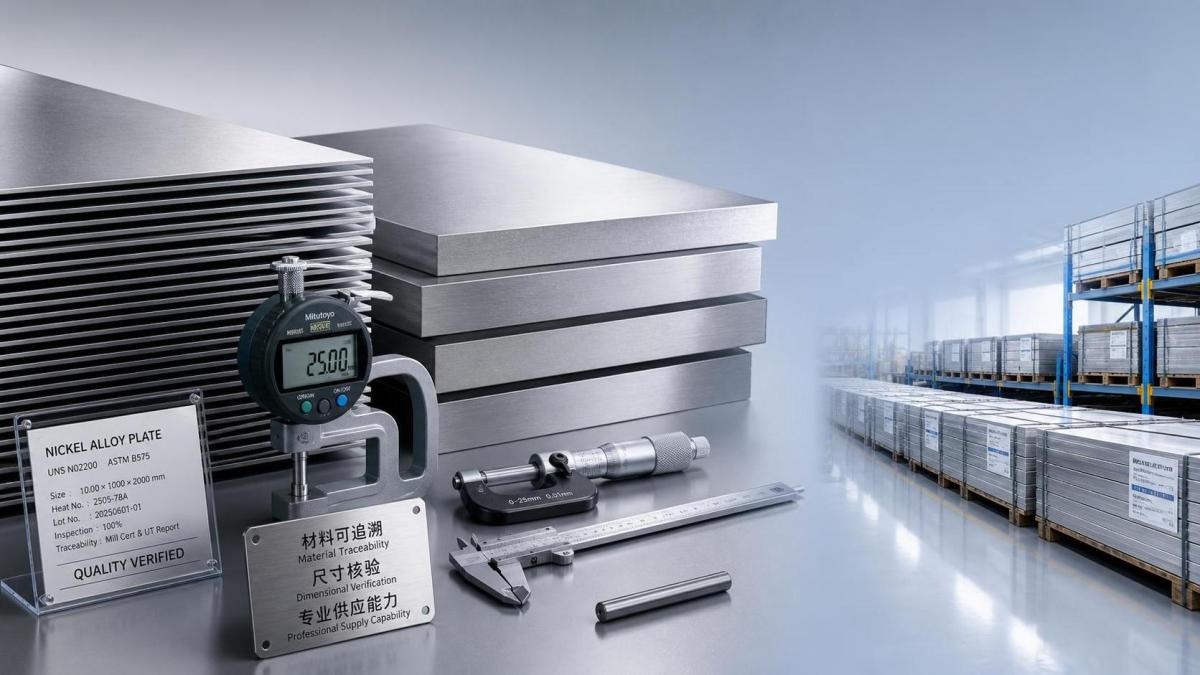
Traceability is one of the clearest ways to separate a reliable source from a vague one. A capable source should be able to explain how the delivered piece remains connected to its heat, batch, or lot records. For cut pieces, ask how original markings are transferred and how mixed lots are prevented during storage, cutting, and packing.
Useful questions are specific rather than general. Instead of asking, “Do you provide quality documents?” ask whether the documentation can identify the alloy grade, chemical composition, mechanical test information where applicable, dimensions, material condition, and corresponding heat or lot reference. If the source cannot explain the chain between the paperwork and the physical material, the buyer has a reason to pause.
This matters especially when parts will be welded or when material must be released through an incoming inspection process. A document package cannot correct a wrong piece of stock after it has already been cut into production blanks.
Compare technical communication before comparing lead time
A reliable source does not need to promise that every alloy is immediately available. More important is whether it communicates the limits of availability honestly. If the requested thickness is uncommon, if a particular temper must be confirmed, or if a requested dimension requires further processing, that should be stated early.
Technical communication is also a useful test when evaluating a manufacturer versus a supplier. Provide a real requirement and observe the response. Does the source ask about operating temperature, corrosion medium, fabrication method, and required form? Or does it simply repeat a grade name and price? A short response is not necessarily poor, but a source handling specialty alloys should recognize when the information provided is insufficient for a safe recommendation.
For applications requiring high strength and resistance at elevated temperatures, it can be helpful to discuss product form directly. Nickel-based Alloy Steel Sheets are available in grades such as Inconel 718, Inconel 625, and Nimonic 75, with thicknesses ranging from 1 mm to several centimeters. These materials are used in settings including structural components, turbine blades, aerospace parts, and chemical processing equipment. Their nickel-based composition may include iron, chromium, molybdenum, and, depending on the alloy, elements such as cobalt or titanium. The intended service conditions and fabrication route should still determine whether a particular grade is appropriate.
When a manufacturer is usually the stronger fit
Direct manufacturer involvement is often valuable when the request includes nonstandard dimensions, a difficult forming requirement, a large or recurring quantity, or a need to clarify production and heat-treatment conditions. It can also be preferable when engineering needs to discuss whether hot-rolled or cold-rolled material is more suitable for the next fabrication step.
Thicker nickel alloy sheets and plates may require advanced forming methods because of their strength and material behavior. A manufacturer with relevant processing knowledge can help identify practical limitations before the material reaches the fabricator. That does not replace the buyer’s engineering review, but it can reduce misunderstandings about achievable size, condition, and delivery sequence.
Manufacturer sourcing also makes sense when consistency across multiple deliveries is important. The buyer should still confirm that the quoted source will remain involved through production rather than transferring the request to an unspecified third party.
When a supplier may be the practical choice
A supplier can be the more efficient route when the requirement is a standard grade and dimension, the purchase volume is modest, or a maintenance department needs stock without waiting for a new production schedule. Established suppliers may hold a useful range of nickel, nickel-based, copper-nickel, corrosion-resistant, and high-temperature alloys in forms that are ready for distribution.
The key is to verify the supplier’s inventory discipline. Ask whether the material is physically in stock, whether it is reserved after quotation, and whether the documents shown belong to the actual lot proposed for delivery. If the supplier plans to source material after receiving the order, ask who the upstream producer will be and what information will be available before shipment.
Suppliers can also be valuable for consolidating several material types into one delivery. That convenience should not lead to lower verification standards for the critical alloy item in the order.
A practical approval path before placing the order
First, align the internal request: grade, form, dimensions, service condition, and documentation needs should be clear enough that different sources quote against the same basis. Then compare responses for completeness, not just price. A quotation that identifies the exact product form, condition, available size, delivery basis, and documentation route is easier to evaluate than one containing only a generic alloy description.
Next, request clarification on any open point before issuing the order. This may include permissible thickness variation, cut-size capability, surface condition, packaging for damage prevention, or whether material identification remains visible after processing. For a high-consequence component, the purchasing team should involve engineering and quality personnel before accepting substitutions.
Finally, inspect the received material against the purchase requirement. Confirm labels, dimensions, visible condition, and document references before cutting or releasing stock to production. If there is a discrepancy, isolate the material while it is still identifiable. This is far easier than investigating an issue after blanks have been mixed with other inventory.
Signs that deserve a closer look
Be cautious when a source offers an unusually broad selection but cannot state whether it manufactures, stocks, or brokers the requested material. The same concern applies when the alloy designation changes between the quotation and the documents, when the source avoids questions about heat identification, or when it presents broad performance claims without linking them to the requested grade and condition.
Another common warning sign is a supplier who agrees immediately to every requested size without checking whether the material is available as rolled stock, cut stock, or a special production item. Reliable sourcing does not mean there will never be limits; it means those limits are identified early enough for the buyer to make a sound decision.
In the end, the dependable choice may be a manufacturer, a specialist supplier, or a combination of both. The right source is the one that can provide material appropriate to the actual environment, preserve traceability, communicate processing constraints clearly, and support the level of verification the application demands.
