


News
- ▶ How to prevent coil damage during delivery from a Monel 400 supplier
- ▶ How to compare freight costs from a monel 400 Coil supplier
- ▶ How coil edge quality affects stamping with Monel 400
- ▶ How to confirm temper requirements with a monel 400 Coil supplier
- ▶ When dual sourcing from an Inconel 625 Supplier reduces risk
Message
Nickel Alloy Grades: Composition, Properties & Applications
Nickel Alloy Grades: Composition, Properties & Applications
Nickel alloy grades are engineered for conditions in which carbon steel, stainless steel, and many conventional non-ferrous metals begin to lose reliability. The reason is not simply that they contain nickel. Their performance comes from carefully balanced additions of chromium, molybdenum, iron, copper, cobalt, and other elements that control corrosion behavior, high-temperature strength, oxidation resistance, and metallurgical stability.
For engineers and buyers, the difficult part is that “nickel alloy” is not a single material category with a single answer. A grade that performs well in hot oxidizing gas may not be the right choice for reducing acids. A material selected for seawater service may be unnecessary, or even poorly matched, in a chloride-rich chemical process. The practical task is to match the alloy’s composition and product form to the actual exposure, fabrication route, and required service life.
Why Composition Determines Service Performance
Nickel provides a stable austenitic matrix and helps alloys retain toughness across demanding temperature ranges. From there, the role of each major alloying element becomes more specific. Chromium is central to oxidation resistance and protection in many oxidizing environments. Molybdenum is widely valued for improving resistance to localized corrosion and for supporting performance in reducing acid conditions. Iron can balance cost and contribute useful structural properties, while copper is especially relevant in several nickel-copper grades intended for marine and certain chemical environments.
This is why grade names should never be treated as interchangeable labels. INCONEL, INCOLOY, Hastelloy, Monel, and nickel-based heat-resistant alloys represent broad commercial families rather than one uniform performance level. Exact chemistry, product standard, heat treatment, dimensions, and welding practice can all influence the result in service.
The Main Property Trade-Offs
Corrosion resistance is often the first reason to consider a nickel alloy, but the word “corrosion” hides several distinct failure mechanisms. Uniform wall loss in an acid is different from pitting in chloride-bearing water, stress corrosion cracking in a heated system, or crevice attack beneath deposits and gaskets. The process stream may also change during cleaning, upset conditions, shutdown, or start-up. Those excursions can be more severe than normal operating conditions.
Temperature adds another layer of complexity. At elevated temperatures, buyers should consider oxidation and scaling, creep resistance, thermal expansion, fatigue under cycling, and the possibility of metallurgical changes after prolonged exposure. A grade with strong room-temperature tensile properties is not automatically suitable for a furnace component, turbine-adjacent part, or high-temperature pressure system. Design temperature, exposure duration, atmosphere, and loading must be reviewed together.
Fabrication is equally important. Sheet, plate, strip, pipe, bar, wire, and forgings do not face the same forming or joining requirements. Thin material may need repeatable flatness and tight thickness control; formed components need ductility; welded fabrications need compatible filler selection and proper heat input. A good grade choice can still underperform if weld zones, surface condition, or post-fabrication cleaning are overlooked.
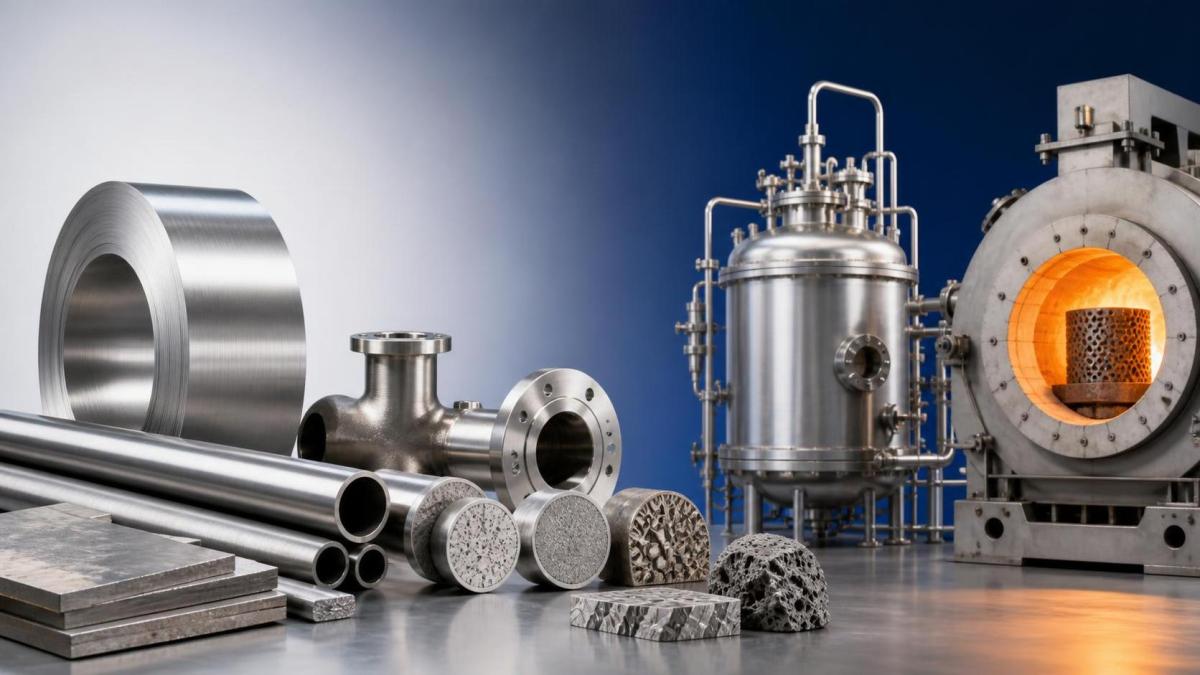
Where Different Nickel Alloy Grades Are Used
Chemical processing is one of the clearest applications because equipment may encounter sulfuric acid, hydrochloric acid, wet chlorine-bearing streams, solvents, or mixed chemical environments. In this setting, molybdenum-containing nickel alloys are frequently evaluated when reducing conditions or localized corrosion are concerns. The final selection should still be based on concentration, temperature, contaminants, pressure, flow, and whether the equipment will be welded or stressed.
In aerospace and power generation, nickel-based heat-resistant alloys are often chosen for their ability to retain strength and resist oxidation at high temperature. Components such as combustion hardware, heat-treatment fixtures, thermal processing equipment, and selected exhaust or hot-gas parts can require materials that tolerate repeated thermal cycles rather than merely short-term heat exposure.
Marine systems create a different selection problem. Saltwater exposure, stagnant zones, galvanic interaction with dissimilar metals, and crevice conditions can all affect material behavior. Nickel-copper alloys are well known in this area, while more highly alloyed nickel materials may be considered where the chemical environment becomes more complex than ordinary seawater service.
A Closer Look at Hastelloy Strip for Fabricated Components
For corrosion-resistant fabricated parts, strip is often more than a raw material detail. It affects forming consistency, weld preparation, dimensional repeatability, and how efficiently a component can be produced. Hastelloy Alloy Strips are available in grades including Hastelloy C-276, C-22, and B-2, with thicknesses ranging from 0.1 mm to 5 mm. These grades are typically considered for chemical processing, aerospace, and power-generation applications where corrosion resistance and heat resistance must be evaluated together.
The differences between these grades matter. C-276 and C-22 are commonly associated with broad corrosion-resistance duties, while B-2 is more closely associated with reducing acid conditions and should be assessed carefully where oxidizing contaminants may be present. Strip can be cold-rolled, annealed, or drawn to required dimensions, then cut, welded, or joined for a specific fabrication. Applicable material and product requirements may include ASTM B575, ASTM B619, ASTM B626, or AMS 5580, but the appropriate standard depends on the grade, form, and project specification.
Some nickel-chromium-molybdenum materials are selected partly for resistance to high-temperature oxidation and scaling, with performance in suitable conditions often extending beyond 1000°C (1832°F). That figure should not be used as a blanket design temperature. Actual limits depend on alloy grade, atmosphere, mechanical load, component geometry, and duration of exposure.
How to Avoid a Costly Grade Selection Error
The most common mistake is selecting by family name or nominal nickel content alone. The better approach is to define the service condition before narrowing the material list. Start with the medium and its concentration, including impurities and cleaning chemicals. Add the operating and upset temperatures, pressure, flow pattern, expected deposits, and mechanical stresses. Then confirm the needed product form, thickness tolerance, surface condition, and fabrication process.
It is also worth checking documentation early. A purchase description should identify the exact grade, governing standard, dimensions, heat treatment where relevant, test requirements, and traceability expectations. “Equivalent” material should be reviewed with caution, particularly for corrosion-critical or high-temperature components. Small chemistry differences can change the material’s response in a narrowly defined environment.
Shandong Titanium Nickel Special Steel Co., Ltd. develops, produces, and supplies special alloys across nickel-based and iron-based material families, including corrosion-resistant alloys, high-temperature alloys, precision alloys, Hastelloy, Monel, INCONEL, INCOLOY, copper-nickel, titanium, zirconium, hafnium, and other specialty materials. For projects involving more than one exposure condition, access to a broad alloy range can help keep the discussion focused on technical fit rather than forcing one grade into every duty.
The right nickel alloy grade is usually the one that addresses the actual failure risk with a realistic fabrication and supply plan. Before finalizing a specification, verify the chemistry, applicable standard, product form, joining method, and full operating envelope—not only the normal process condition shown on the first datasheet.
