


News
- ▶ How to prevent coil damage during delivery from a Monel 400 supplier
- ▶ How to compare freight costs from a monel 400 Coil supplier
- ▶ How coil edge quality affects stamping with Monel 400
- ▶ How to confirm temper requirements with a monel 400 Coil supplier
- ▶ When dual sourcing from an Inconel 625 Supplier reduces risk
Message
Nickel Alloy Chemical Composition And Mechanical Properties
Nickel alloy chemical composition and mechanical properties determine whether a component can tolerate a corrosive fluid, sustained heat, cyclic loading, or a combination of these conditions. Nickel forms a stable austenitic matrix across a broad temperature range and contributes toughness, ductility, and resistance to several reducing environments. Its performance changes substantially when chromium, molybdenum, iron, cobalt, copper, aluminum, titanium, niobium, or carbon are added in controlled amounts.
Grade selection therefore starts with the actual service condition rather than a general statement such as “corrosion resistant” or “high temperature.” Fluid chemistry, chloride level, oxygen content, pressure, metal temperature, crevice geometry, thermal cycling, and fabrication route can all change the required balance between composition and mechanical strength.
How Major Elements Influence Nickel Alloys
Nickel is the principal matrix element in many corrosion-resistant and heat-resistant alloys. A high nickel content can improve resistance to chloride stress-corrosion cracking compared with many conventional stainless steels, while preserving useful toughness at low temperatures. Nickel also supports a face-centered cubic structure, which generally provides good formability and weldability when the alloy chemistry and heat treatment are appropriate.
Chromium is commonly added to promote oxidation resistance and to form a protective surface film in oxidizing acids and high-temperature gases. Chromium-rich nickel alloys may be selected for furnace components, hot-gas equipment, and chemical process systems where oxidizing media are present. However, chromium alone does not define corrosion performance; reducing acids, localized chloride attack, and stagnant crevices often require additional alloying.
Molybdenum improves resistance to reducing acids and can strengthen resistance to pitting and crevice corrosion in chloride-bearing solutions. It is particularly relevant where deposits, low flow velocity, gasket interfaces, or seawater exposure can create localized chemical concentration. A higher molybdenum level may improve performance in these environments, but it may also affect hot-workability and requires careful control during melting and processing.
Iron is used in several nickel alloy families to adjust cost, thermal expansion, strength, and metallurgical stability. Depending on the grade, iron can be a substantial constituent rather than a minor residual element. Its effect must be evaluated with the full chemistry because the nickel-to-iron ratio influences corrosion behavior, magnetic response, and phase stability.
Cobalt can retain strength at elevated temperatures and is used in certain heat-resistant nickel-based compositions. Aluminum, titanium, and niobium are important in precipitation-strengthened alloys because they can form strengthening phases during controlled aging. These grades may deliver higher yield strength than solid-solution-strengthened alloys, although their fabrication and heat-treatment requirements are usually more demanding.
Copper is central to nickel-copper alloys used in selected marine, alkaline, and reducing-acid services. The nickel-copper system has different corrosion behavior from nickel-chromium-molybdenum alloys, so it should not be substituted simply because both materials are described as nickel alloys.
Mechanical Properties Depend on Condition, Not Grade Name Alone
A material specification should state the product form and metallurgical condition together with the nominal grade. Sheet, strip, plate, bar, pipe, forgings, and weld consumables can have different property requirements. Annealed material emphasizes ductility and forming capability; cold-worked material may have higher strength but reduced elongation; age-hardened material obtains strength from a defined thermal treatment.
Tensile strength indicates the maximum engineering stress reached during a tensile test, while yield strength indicates the stress at which permanent deformation is conventionally defined. Elongation gives a useful indication of tensile ductility, but it should be read with gauge length, product thickness, and test method in mind. Hardness can assist with incoming inspection or condition control, yet it does not replace tensile testing when a structural property requirement applies.
For elevated-temperature service, room-temperature tensile data are only an initial reference. Creep resistance, stress-rupture strength, oxidation behavior, thermal fatigue, and microstructural stability may govern the usable design temperature. A material that remains strong in a short-duration tensile test can still deform over time under sustained load. Conversely, a highly corrosion-resistant alloy may not be suitable for a heavily loaded hot section without reviewing its long-term temperature capability.
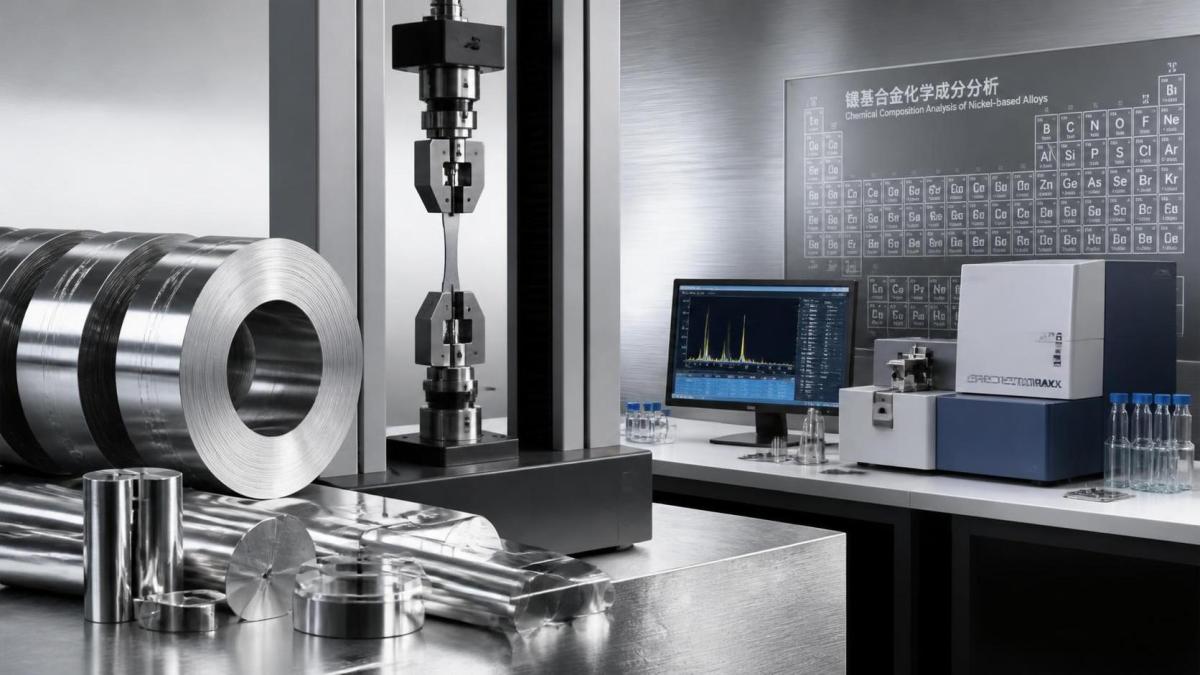
Composition and Property Relationships in Service
Solid-solution-strengthened nickel alloys obtain much of their strength from alloying elements dissolved in the nickel matrix. They often retain good ductility after annealing and can be practical where corrosion resistance, weldability, and moderate-to-high temperature strength are required together. Their mechanical properties can rise through cold work, but the resulting residual stress should be considered in chloride-containing or caustic environments.
Precipitation-strengthened grades use a solution treatment followed by aging to develop fine strengthening particles. This route can provide much higher yield strength for fasteners, springs, shafts, turbine-related hardware, and other loaded parts. The gain in strength comes with tighter control of time and temperature. Excessive heat exposure, incorrect aging, or welding without an appropriate post-weld treatment can change the intended mechanical response.
Nickel-copper materials are frequently considered for marine hardware, pump components, heat-exchanger parts, and equipment exposed to certain acids or alkalis. In strip form, the combination of corrosion resistance and ductility is useful for formed components. For example, Monel Alloy Steel Strips may be supplied in Monel 400 or Monel K-500 material, with thicknesses from 0.1 mm to 100 mm, widths from 10 mm to 2500 mm, and custom lengths. The mechanical condition should be specified separately because Monel 400 and age-hardenable Monel K-500 are not interchangeable where design strength is controlling.
Fabrication Details That Affect Final Performance
Nickel alloys can work harden rapidly during machining and cold forming. Stable tooling, rigid fixturing, positive feed, adequate cutting fluid, and avoidance of tool dwell reduce surface work hardening and localized overheating. A poor machined surface can become an initiation point for fatigue or localized corrosion, especially where a component experiences vibration or alternating pressure.
Welding requires matching or compatible filler metal, clean joint preparation, and control of heat input. Contamination from sulfur-bearing oils, low-melting metals, shop dust, or carbon-steel grinding debris can compromise the joint or adjacent surface. TIG, MIG, and gas-shielded arc processes may be suitable for selected grades and thicknesses, but procedure qualification must reflect the intended alloy, joint geometry, and service condition. When welding precipitation-strengthened material, the required heat treatment after welding should be established before fabrication begins.
Surface condition deserves attention after forming, welding, or machining. Pickling, polishing, or brushed finishes may be selected according to the component and service environment. Removing heat tint, embedded iron contamination, and fabrication residues is particularly relevant for corrosion-critical equipment. Abrasives and handling tools used on carbon steel should not be shared without controls, since transferred iron can create staining or local corrosion sites.
Common Selection Errors
- Using a general nickel-alloy label without confirming the full chemical composition, delivery condition, and product-form standard.
- Comparing room-temperature tensile strength while overlooking corrosion mode, expected metal temperature, or sustained-load exposure.
- Assuming seawater resistance eliminates crevice-corrosion risk around seals, lap joints, deposits, or poorly drained details.
- Replacing an annealed alloy with a high-strength cold-worked or aged condition without reviewing bend radius, welding sequence, and residual stress.
- Accepting chemical analysis from a heat record while omitting traceability between the record, the marked material, and the finished cut pieces.
Material release should connect the drawing, alloy designation, chemistry limits, mechanical-property requirements, dimensions, surface condition, and inspection records. For critical parts, positive material identification can be used as a receiving or pre-installation control, while laboratory chemistry remains the reference method where precise elemental verification is needed. The same discipline should continue through cutting, nesting, welding, and final marking so that similar-looking nickel alloys are not mixed.
Nickel alloy performance is achieved through the combined effect of composition, processing condition, component geometry, and service environment. A chemically suitable grade can underperform after incorrect heat treatment or contaminated fabrication, while a mechanically strong grade can be a poor choice for a specific corrosive medium. Defining these factors together produces a material specification that can be fabricated and maintained without relying on assumptions.
