


News
- ▶ Alloy Sheet Types Explained: Nickel, Titanium and Stainless Steel
- ▶ Nickel Alloy Strip Orders: Defining Tolerances and Coil Dimensions
- ▶ Troubleshooting Edge Cracks in Slit Nickel Alloy Strip
- ▶ Nickel Alloy Strip for Heat Exchangers: Corrosion and Formability
- ▶ How Cold Rolling and Annealing Affect Nickel Alloy Strip Properties
Message
Alloy Sheet Types Explained: Nickel, Titanium and Stainless Steel
Choosing the right alloy sheet starts with understanding how different metals perform under real operating conditions. Nickel, titanium, and stainless steel sheets each offer distinct combinations of corrosion resistance, strength, weight, and temperature tolerance.
This guide explains their key properties, common applications, and practical differences to help you compare materials and make a more informed selection for your project.
Which Alloy Sheet Is Right for Your Application?
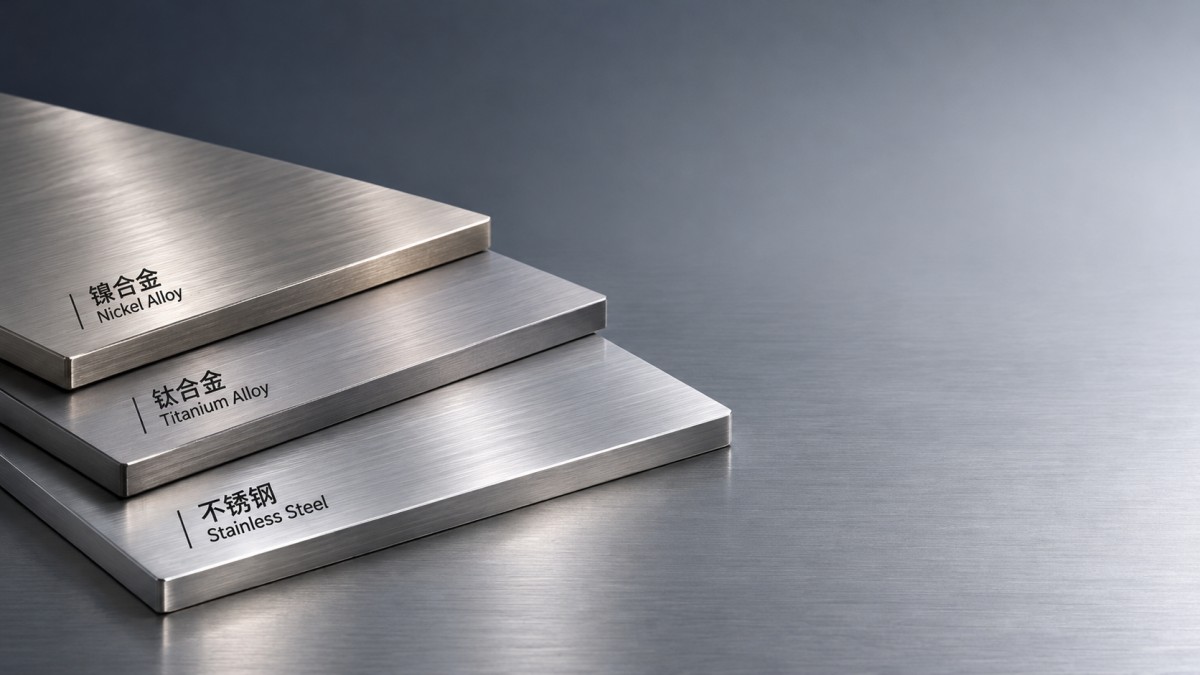
Stainless steel is often the practical starting point for general fabrication. Titanium is attractive when low weight and corrosion resistance matter, while nickel alloys address demanding chemical and thermal conditions.
The best choice depends on the specific grade and environment. A material that performs well in seawater, for example, may not be suitable for a concentrated acid.
Consider the operating medium, temperature, mechanical loads, fabrication method, and expected service life together. Initial material price is important, but it does not capture replacement and maintenance costs.
How Do Nickel, Titanium, and Stainless Steel Sheets Compare?
These material families overlap in capability, but their typical strengths differ. The following comparison provides a starting point rather than a substitute for grade-specific engineering data.
- Nickel alloys: Often selected for aggressive chemicals, elevated temperatures, or both. Performance varies substantially between grades, and material costs can be high.
- Titanium alloys: Known for low density and strong corrosion resistance in many environments. Fabrication and raw material costs require careful consideration.
- Stainless steels: Available in many grades and product forms, with a broad balance of corrosion resistance, strength, and cost.
For a straightforward indoor enclosure, stainless steel may offer sufficient protection at a manageable cost. A chemical reactor lining may justify a more specialized nickel alloy.
Where equipment weight affects transport, installation, or performance, titanium deserves consideration. Its lower density does not automatically mean a component can use thinner sheet.
When Should You Choose Nickel Alloy Sheet?
Nickel alloy sheet is commonly considered for chemical processing equipment, heat exchangers, and components exposed to demanding temperatures. Its corrosion and heat resistance depend on composition.
Nickel-molybdenum alloys can perform well in certain reducing acids, while nickel-chromium-molybdenum grades provide resistance across a broader range of oxidizing and reducing environments.
For example, Hastelloy C-276 and C-22 are often evaluated for corrosive chemical service. Hastelloy B-2 is associated with reducing environments, including certain hydrochloric acid applications.
These grades are not interchangeable. Acid concentration, contaminants, temperature, and aeration can change corrosion behavior, so published compatibility data should be checked against actual process conditions.
For narrower fabricated components, Hastelloy Alloy Strips are available in C-276, C-22, and B-2, with stated thicknesses from 0.1 to 5 mm.
These strips can be considered for chemical processing, aerospace, and power generation. Confirm the grade, dimensions, product form, and applicable specification with the supplier before ordering.
Nickel alloys can cost more than common stainless steels. Their value is strongest when improved service life, reduced downtime, or resistance to a specific medium offsets that premium.
When Does Titanium Sheet Make Sense?
Titanium sheet is substantially less dense than steel and many nickel alloys. It can help reduce component weight while providing useful strength and corrosion resistance.
Commercially pure titanium, including Grade 2, is frequently considered for corrosion-resistant equipment. Titanium alloy grades such as Grade 5 are chosen when higher strength is needed.
Titanium is used in marine equipment, chemical processing, heat exchangers, and aerospace components. In many seawater applications, its protective oxide film provides strong corrosion resistance.
However, titanium is not universally resistant to every chemical. Reducing acids, certain concentrated solutions, and other specific conditions may require a different material or grade.
Fabrication also affects feasibility. Titanium requires careful handling and shielding during welding because contamination at high temperatures can impair weld quality and mechanical properties.
Compare total component cost, including forming, welding, inspection, and service life. A lighter design can be valuable, but it should be verified against stiffness and load requirements.
When Is Stainless Steel Sheet the Practical Choice?
Stainless steel sheet covers a wide range of alloys containing chromium. Its corrosion resistance comes largely from a protective surface film that can reform under suitable conditions.
Grades 304 and 316 are common starting points for general fabrication. Grade 316 contains molybdenum and generally offers better resistance to chloride pitting than 304.
Typical uses include tanks, architectural components, food-processing equipment, and industrial enclosures. The appropriate grade depends on cleaning chemicals, exposure, temperature, and hygiene requirements.
Chlorides can cause localized pitting or crevice corrosion, even when the surrounding surface looks sound. Weld areas, deposits, and poorly drained joints deserve particular attention.
Higher-alloyed stainless steels may be appropriate for more demanding conditions, but selection should account for corrosion data and fabrication requirements rather than a grade name alone.
Stainless steel is often widely available and economical for moderate service. That advantage can disappear if an unsuitable grade leads to frequent repairs or premature replacement.
What Should You Check Before Selecting a Grade?
Start with the environment. Identify every significant chemical, its concentration, operating temperature, exposure duration, and any contaminants or cleaning agents that contact the sheet.
Next, assess mechanical demands. Required strength, stiffness, pressure, vibration, and fatigue life influence both grade and thickness; higher strength alone does not resolve every design constraint.
Check normal and upset temperatures separately. A short temperature excursion can affect oxidation, strength, or corrosion behavior, even when the normal operating temperature appears acceptable.
Review fabrication early. Forming radius, cutting, welding, heat treatment, and surface finish can affect cost and performance, especially for thinner sheet or tightly specified components.
Finally, consider service life and failure consequences. For critical equipment, corrosion testing, engineering review, and relevant code requirements may be necessary before final material selection.
What Specifications Should You Provide to a Supplier?
Provide the exact alloy designation, product form, thickness, width, and length. Sheet and strip may overlap in thickness, but width and delivery form should be explicit.
State the required material standard, condition, surface finish, dimensional tolerances, and inspection requirements. Ask for material test documentation and traceability when the application requires them.
Standards apply to particular products and conditions. For example, ASTM B575 covers specified nickel alloy plate, sheet, and strip products; confirm the applicable edition and grade.
Do not assume a tube or pipe standard applies to sheet. The purchase specification should match the actual product form and any project-specific code requirements.
Share the intended environment when seeking technical input, but retain responsibility for final design approval. Supplier data can support selection without replacing application-specific verification.
How Do You Compare Total Cost?
Compare candidate materials over the expected equipment life, not just by price per kilogram. Include fabrication, inspection, installation, maintenance, downtime, and anticipated replacement.
A less expensive stainless steel may be the best value in mild conditions. In harsher service, a higher-cost alloy can be economical if it reliably extends service life.
Where weight is consequential, include the effect of transport and installation. Request comparable quotations using the same dimensions, tolerances, documentation, and delivery requirements.
Conclusion: Match the Material to the Conditions
Stainless steel is a useful baseline for many applications, titanium is compelling when weight and suitable corrosion resistance matter, and nickel alloys address selected severe environments.
Begin with operating conditions, then compare specific grades, fabrication needs, and lifetime costs. Validate the final alloy sheet selection against reliable data and applicable engineering requirements.
