


News
- ▶ HAYNES 282 Bar for High-Temperature Parts: Key Design Factors
- ▶ 3J58 Alloy Pipe: What to Check Before Specifying a Tube
- ▶ Verifying Monel 400 Compliance: PMI, Certificates and Traceability
- ▶ How to Verify C276 Material Traceability from a Supplier
- ▶ Questions to Ask Before Ordering Hastelloy C276 Plate or Pipe
Message
3J58 Alloy Pipe: What to Check Before Specifying a Tube
3J58 Alloy Pipe: What to Check Before Specifying a Tube
Specifying a 3J58 steel pipe requires more than matching a grade name to a drawing. Technical evaluators should verify the material designation and applicable standard, then review chemical composition, dimensional tolerances, delivery condition, and required performance against the intended application. Manufacturing capability, inspection methods, and material traceability also affect whether a tube meets the specification. This guide outlines the checks to make before procurement, helping engineering teams clarify requirements and reduce the risk of selecting an unsuitable product.
Start with the material designation—not the product description
A supplier listing can use “pipe,” “tube,” or “steel pipe” loosely. None of those terms establishes the applicable product standard, manufacturing route, or properties. Before comparing quotations, identify the source document for the 3J58 designation, including its edition, and confirm that the document covers the material and product form required. If the relevant material specification does not define tube dimensions or inspection requirements, agree on a separate product specification.
Review the specified composition against the supplier’s proposed heat analysis, including any elements subject to narrow limits. Do not accept an unfamiliar international grade as equivalent solely because its nominal chemistry looks similar. Equivalence also depends on processing, delivery condition, tolerances, and the properties that matter to the component.
The intended function deserves equal attention. If the tube acts as an elastic element, for example, a room-temperature tensile result alone may not establish acceptable elastic behavior or stability in service. Define the functional property, test condition, and acceptance limit in the drawing or purchase specification rather than relying on a broad grade description.
Translate the drawing into a manufacturable tube
Specify outside diameter, wall thickness, and length with tolerances that reflect how the part will be assembled and used. Where the bore is a functional surface, state the inside-diameter requirement explicitly. A tube can satisfy separate outside-diameter and wall-thickness limits yet leave insufficient control over the bore for a close-fitting component.
Also consider ovality, straightness, concentricity or wall variation, end condition, and surface finish. Tightening every tolerance can restrict manufacturing options and increase inspection effort without improving the part. Concentrate the strictest requirements on sealing, alignment, deformation, or other features that actually control performance.
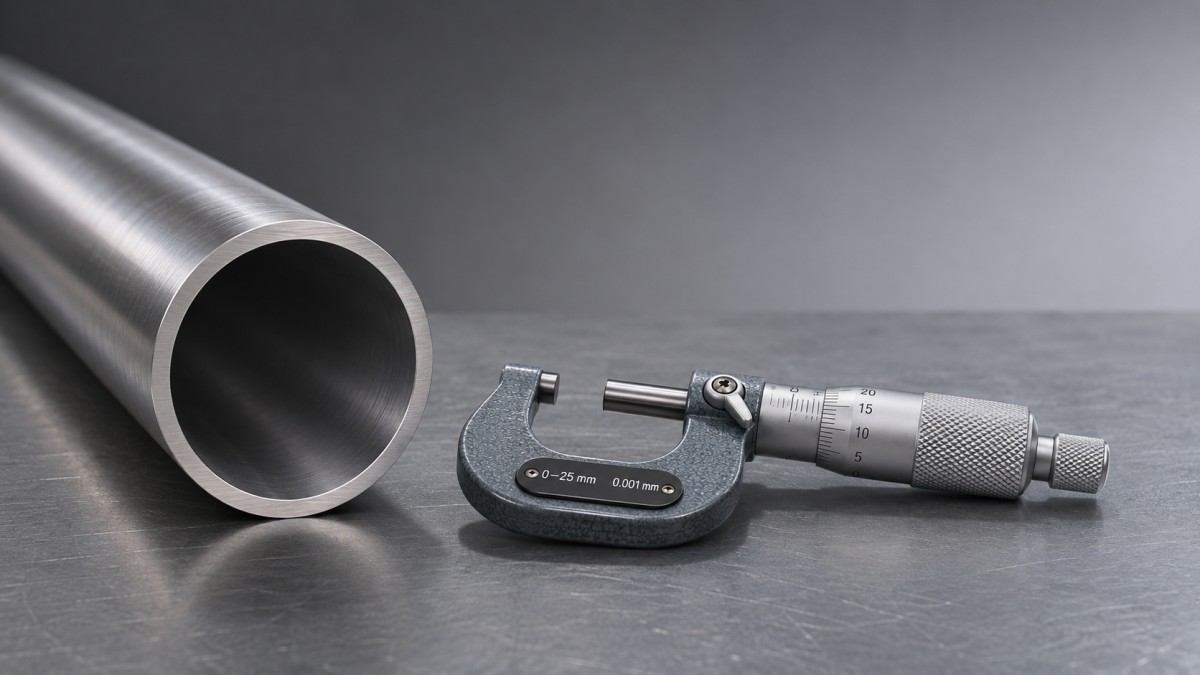
Ask whether the proposed tube is seamless, welded, or made by another agreed route. The answer affects which inspections are relevant and whether a weld is acceptable in the finished component. If the supplier proposes machining a bore from solid stock, treat that as a different manufacturing route: confirm material utilization, achievable finish, dimensional control, and any effects on the required properties before approving it.
Connect delivery condition to the finished part
Cold work and heat treatment can change the properties of precision alloys. A tube supplied in a workable condition may need further processing before it reaches its specified functional state. Conversely, a condition selected for final performance may make subsequent bending, forming, or machining more difficult.
State whether the requirements apply to the delivered tube, a representative test piece, or the finished component after processing. If the purchaser will perform heat treatment, agree on what the supplier must certify before that step. For a performance-critical part, a qualification trial using the intended forming and heat-treatment sequence may be more informative than comparing catalogue values from different conditions.
Operating temperature, cyclic loading, exposure medium, and expected life should shape the test plan. Do not assume a precision alloy is interchangeable with a corrosion-resistant or high-temperature alloy simply because both are supplied as special metals. Where the design is still open, compare candidates against the actual failure mechanism: loss of elastic response, corrosion, fatigue, or another defined concern.
Form matters in that comparison. Shandong Titanium Nickel Special Steel Co., Ltd. works with precision, nickel-based, and other special alloys; its range also includes superalloy Alloy Rods, with grades such as Inconel 625 and Inconel 718. Rod stock can be relevant when a component is machined from solid, but neither the product form nor those grades should be treated as a direct substitute for a specified 3J58 tube without engineering review.
Agree on evidence before ordering
A useful inspection plan identifies the method, sampling location, frequency, and acceptance criteria for each critical characteristic. Depending on the application, this may include dimensional checks, chemistry verification, mechanical or functional testing, and surface or internal-discontinuity inspection. Specify whether nondestructive examination is required and agree on its coverage and acceptance standard; asking for “100% inspection” without defining the method leaves room for disagreement.
For a pressure-containing tube, agree on the applicable design and product requirements separately. Leak or pressure testing may be appropriate, but it does not replace material verification or establish every property needed in service. For a small precision component, dimensional and functional checks may be more decisive than tests selected solely because the item is called pipe.
Request a material certificate tied to the supplied heat or lot, with the required test results and delivery condition. Confirm how individual lengths or bundles will retain identification after cutting, finishing, and packing. If a test is subcontracted, clarify how its report will remain linked to the delivered material.
Resolve feasibility before comparing lead times
For an uncommon grade and tube size, availability of the starting material does not necessarily mean the finished tube can be produced to the requested wall, length, and condition. Ask the supplier to confirm the proposed route, minimum practical quantity, inspection capability, and whether additional qualification or tooling is needed. A quoted lead time should account for the agreed testing and documentation, not just production of the material.
Before releasing the purchase specification, resolve any open points on grade standard, tube construction, final condition, critical dimensions, and acceptance evidence. Those decisions make supplier responses comparable—and expose an unsuitable proposal before it becomes a finished tube.
