


News
- ▶ Monel 400 vs K-500: Comparing Strength and Corrosion Resistance
- ▶ Is Monel 400 Suitable for Seawater Piping? Key Design Limits
- ▶ Monel 400 Mechanical Properties: Strength, Ductility and Temper
- ▶ UNS N04400 and Monel 400: Understanding the Designations
- ▶ Monel 400 Standards for Pipe, Plate and Bar: What to Specify
Message
Monel 400 vs K-500: Comparing Strength and Corrosion Resistance
Choose Monel 400 when its specified strength is sufficient and fabrication flexibility is the priority. Consider Monel K-500 when a component needs substantially higher strength, particularly for a shaft, fastener, or other highly loaded part. Both alloys can resist seawater and many chemical environments, but K-500 is not automatically the better corrosion choice: its higher strength and heat treatment can introduce additional risks in certain services.
For a meaningful comparison, read the Monel 400 specification alongside the proposed K-500 product requirements. Alloy grade alone does not define the strength of a finished component. Product form, dimensions, processing condition, and the properties required after fabrication all affect the decision.
Where the strength difference comes from
Monel 400 is a nickel-copper alloy that gains strength primarily through cold working; it is not hardened by age-hardening heat treatment. K-500 has a similar nickel-copper foundation but contains additions, notably aluminum and titanium, that allow it to be strengthened by controlled heat treatment. In the age-hardened condition, K-500 can provide considerably higher yield and tensile strength than typical annealed Monel 400.
Yield strength matters when a part must carry load without permanent deformation. Tensile strength describes resistance to failure under a tensile load. Neither value alone establishes whether a component is suitable: fatigue loading, stress concentrations, temperature, and the environment can govern the design before a simple static-strength limit is reached.
A direct comparison also depends on condition. Cold-worked 400 should not be compared with annealed K-500 and treated as representative of every available product. For a shaft or rod, specify the required properties for the actual diameter and delivery condition, then use those values in the design assessment.
Corrosion resistance: similar families, different failure risks
Both alloys are used in marine environments because their nickel-copper chemistry offers useful resistance to seawater. That does not mean every seawater component has the same corrosion risk. Flow velocity, stagnant zones, deposits, oxygen availability, temperature, and contact with dissimilar metals can change the behavior of a particular assembly.
For example, a shaft exposed to moving seawater and a bolted joint with a narrow, oxygen-depleted gap do not present the same conditions. When evaluating either alloy, consider crevices beneath gaskets and deposits, as well as galvanic interactions with adjacent materials. A material selection based only on a general statement such as “resistant to seawater” leaves those details unresolved.
In some environments, age-hardened K-500 can be more susceptible to stress-corrosion cracking than Monel 400. Cracking requires a combination of a susceptible material condition, tensile stress, and a suitable environment. Applied loads are only part of the picture: stresses introduced by cold work, machining, assembly, or welding can also matter.
This is especially relevant for highly stressed fasteners and shafts. K-500’s extra strength may be valuable, but using that strength to reduce section size can increase operating stress and reduce design margin. Assess the environment and stress level together rather than assuming that a stronger alloy necessarily provides a more reliable component.
For chemical equipment, identify the actual medium, concentration, temperature, and potential contaminants. Nickel-copper alloys can perform well in a range of services, but neither grade is a universal solution for every acid or oxidizing chemical. Corrosion compatibility under the intended operating and cleaning conditions should be established before mechanical strength becomes the deciding factor.
What to compare in the material specification
A specification should describe the material being purchased, not just name the alloy. The relevant product standard and purchase requirements establish the applicable chemistry, permitted conditions, inspection, and acceptance criteria for a given form. Requirements for bar, plate, and other forms should not be assumed to be interchangeable.
For a practical comparison, request the following information for each candidate:
- Grade and product form: Identify 400 or K-500 and specify whether the component starts as rod, bar, plate, or another form.
- Delivery condition: State whether the material is annealed, cold-worked, or, for K-500, supplied in an age-hardened condition.
- Mechanical requirements: Set the minimum properties required for the supplied dimensions and identify the test direction or location where relevant to the product specification.
- Inspection and documentation: Define the material test report, traceability, dimensional tolerances, and any additional examination needed for the application.
- Final processing: Identify machining, welding, heat treatment, and any property requirements that apply after those operations.
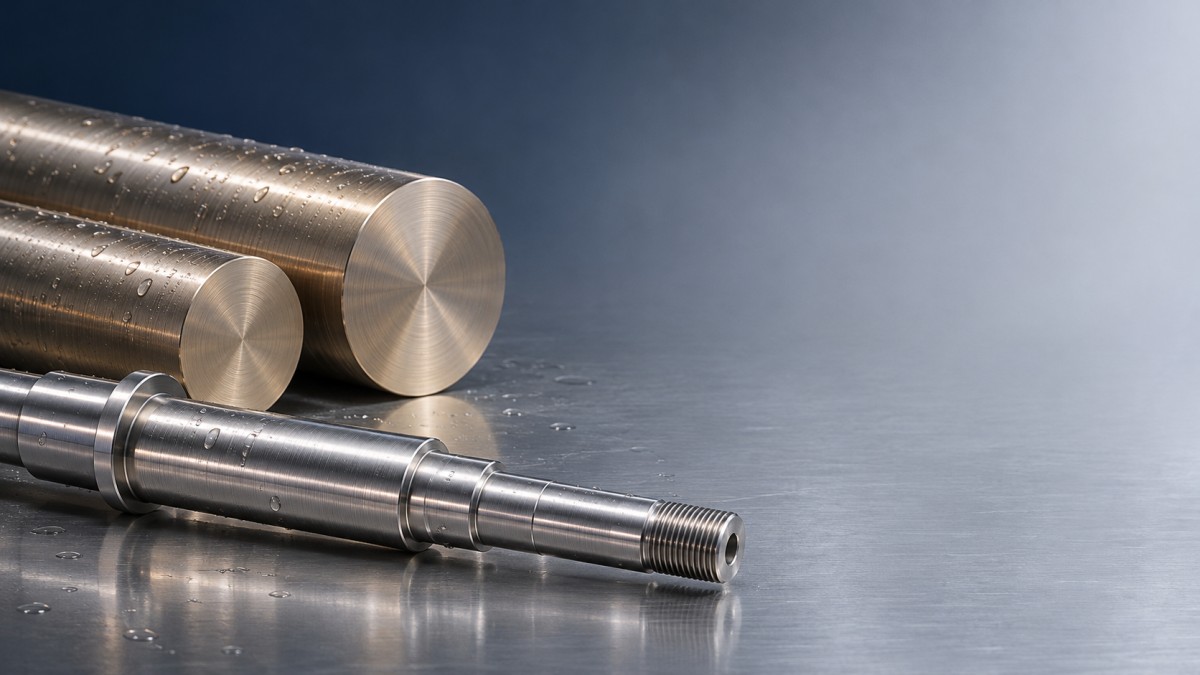
For components machined from Monel Alloy Rod, the grade, diameter, and condition should be selected together. A property range presented for both grades is not a substitute for acceptance values tied to the rod being ordered. A design that depends on K-500’s age-hardened strength should make that condition explicit in the purchase requirements.
Fabrication can change the comparison
Monel 400 is often attractive when the design requires forming or welding and its available strength is adequate. Cold working can raise its strength, but the amount of strengthening depends on the processing route. Fabrication requirements should therefore be considered before relying on a particular strength level.
K-500 requires more coordination between manufacturing and final properties. The heat-treatment condition affects machinability and strength, so the sequence of rough machining, heat treatment, and finishing should be planned around dimensional tolerance and the properties needed in service. The appropriate route depends on component geometry and the supplier’s process capabilities.
Welding deserves particular attention. A K-500 weldment should not be assumed to retain the same uniform age-hardened properties as the original material. Heat from welding can alter properties in the weld and adjacent material; joint design, welding procedure, and any subsequent heat treatment must be evaluated against the component’s requirements. Where a design relies on high strength at a welded joint, that assessment can be more decisive than the base-metal comparison.
Match the alloy to the component, not just the environment
For a marine pump shaft, K-500 may be the stronger candidate when torque, bending, or fatigue requirements make 400 insufficient. The assessment should still include seawater exposure at seals and crevices, surface finish, and the stresses introduced by assembly. If the required strength is modest, 400 may provide an adequate and simpler starting point.
For chemical equipment, the operating medium can eliminate an alloy before a strength comparison is useful. Where both grades are compatible, a highly loaded stem or fastener may benefit from K-500, while a less heavily stressed fabricated component may favor 400. In food-processing or other hygienic equipment, surface finish, cleaning chemistry, and product-contact requirements also belong in the specification; alloy name alone does not establish suitability.
Temperature can change the decision as well. Room-temperature strength should not be used as the sole basis for an elevated-temperature design, and a general temperature capability should not be treated as an allowable operating limit for every condition. Consider exposure duration, the required properties at temperature, and whether thermal service affects the selected heat-treatment condition.
Begin with the environment and required service life, then determine the loads and minimum properties at the component’s operating temperature. Compare those requirements with the properties of each grade in the intended product form and condition. Finally, account for fabrication and inspection. That sequence makes the choice between 400 and K-500 a component-level decision rather than a comparison of headline strength values.
